Which factors should guide your choice?
Start by checking how the piano connects to the sound system and how you play. Then compare the space you have, how easy it is to move, and which sounds you want to use for hymns.
| What to consider |
What to look for when buying |
Who is this important for? |
| Connection to the rehearsal room sound system |
Check that the audio output on the exact model is compatible with the mixer or active speakers; don’t assume a headphone socket will do the job. |
If I play with singers through the sound system, I want to know in advance how the piano connects to it. Around 33% of consumers put amplification in the rehearsal room first. |
| Keyboard and pedal |
Try the key action and check the number of keys, which pedal option is included and whether any upgrades are compatible. |
For anyone practising chords and dynamics on a piano keyboard, the feel of the keys and pedal control can be decisive. Around 27% of consumers prioritise piano playing. |
| Moving and setting up |
Measure the space, allowing room for the stand and pedal; bear in mind the instrument’s weight and any accessories you’ll need to carry. |
If I move the piano regularly or put it away after rehearsals, I want to know how much space and lifting the whole set-up will involve. Around 20% of consumers prioritise portability or the space needed for set-up. |
| Sounds for hymns |
Try any organ sounds with a representative hymn and check how easy it is to switch between sounds while playing. |
If you want an organ-like sound as well as piano accompaniment, check that the sound and controls suit your repertoire. Around 20% of consumers put sound selection first. |
Joybuy product picks
These picks are 61-key instruments for a compact practice set-up. Check that the range suits the hymns you want to accompany.
 Image unavailable
MLS-931 digital piano, 61 keys, black
The listed audio inputs and outputs may be useful in a set-up with external equipment; check that they’re compatible with the sound system in your rehearsal room.
The product name specifies a weighted keyboard. The instrument has 61 keys, fewer than the 88 keys mentioned in the piano-focused research criteria; check that the range suits your repertoire.
The description lists 300 sounds, 300 rhythms, USB-MIDI, an LCD screen, speakers, a headphone socket and a music rest.
View at Joybuy
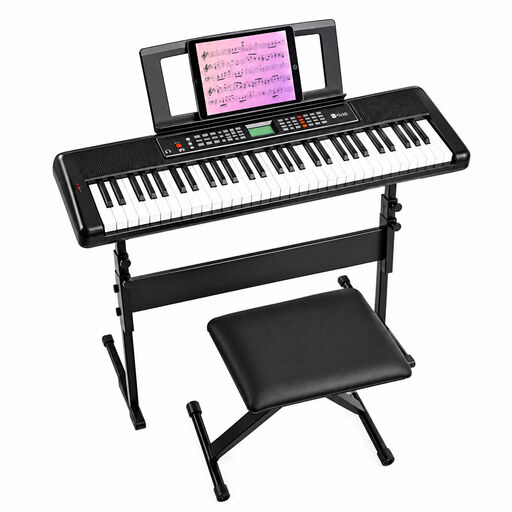 Image unavailable
Keyboard piano set, 61 keys, black
This set may suit a dedicated practice space; check that its audio connections are compatible with the equipment in your rehearsal room.
The set includes a stand, bench and music rest. The instrument has 61 keys, fewer than the 88 keys mentioned in the piano-focused research criteria; check whether this range suits your hymns.
The description lists USB-MIDI, audio connections, 300 tones, 300 rhythms and a three-level learning mode.
View at Joybuy
 Image unavailable
Electronic keyboard piano, 61 keys, black
The description lists audio inputs and outputs; check they’re compatible with the mixer or speakers you use for rehearsals.
The instrument has 61 keys, fewer than the 88 keys mentioned in the piano-focused research criteria. Check that the range suits your repertoire.
The description lists 500 sounds, 300 rhythms, a recording function, USB-MIDI, speakers, a music rest, metronome and headphone socket.
View at Joybuy
Frequently asked questions
Do I need a headphone socket to play through the sound system?
First check which input the sound system has, then look for a suitable audio output on the exact piano model. Kawai lists LINE OUT for the ES120, while Roland lists dedicated outputs for external active speakers on the FP-30X. Don’t rely solely on the presence of a headphone socket.
How can I reduce the risk of hearing damage during a rehearsal?
Keep the volume as low as practical for playing together and assess the entire sound set-up. Arboportaal warns that sound can be harmful if the level in the ear canal is too high, even if it sounds pleasant. The workplace rules described by Arboportaal apply to situations where employees are working; don’t assume they automatically apply to every amateur rehearsal.
Which accessories might I need in addition to the piano?
It depends on the version and rehearsal set-up. Kawai lists the HML-2 stand and F-351 pedal unit as optional accessories for the ES120; also check that the cables you need are compatible with the piano and the equipment in the rehearsal room.
What warranty applies when I buy as a consumer in the Netherlands?
According to the Dutch government, you’re entitled to a product that works properly, and the Netherlands has no fixed statutory warranty period. If a product is faulty, the seller must offer a solution; a manufacturer’s warranty is in addition to your statutory rights. This guidance relates to consumer purchases and doesn’t automatically determine the terms of a business purchase made by an organisation.
Can I return a piano bought online?
According to the Dutch government, consumers generally have a 14-day cooling-off period for distance purchases, although there are exceptions. Check the terms for the specific purchase before ordering, particularly if an organisation is buying for business purposes.


