
Piano technique student
You practise scales, finger independence and fast repetitions, and mainly want to know how the keyboard feels and responds.


For finger exercises in a shared music room, a portable digital piano is handy if you want to put it away after use; a fixed piano is a better fit if it can stay in place permanently. Focus on the keyboard and key range, whether you can practise with headphones, and which stand and pedals you’ll need. Manufacturer specifications are useful for comparing models, but they can’t tell you which keyboard will feel most comfortable to play.
You practise scales, finger independence and fast repetitions, and mainly want to know how the keyboard feels and responds.
You want to practise with headphones rather than using the speakers. Keeping the listening volume at a sensible level is important too.
You need to set the instrument up, move it or put it away regularly, so you’ll want to consider its dimensions and weight, as well as the stand you’ll need.
Choose this if: you want to be able to move or put the instrument away after use. Yamaha, Roland and Casio describe the portable models mentioned as having 88 keys, but they use different types of keyboard.
Bear in mind: you may need to buy a stable stand separately; also check which pedals are included with the version you’re considering.
Choose this if: the piano can stay in the music room permanently. Yamaha describes the YDP-145 as an 88-key model with a weighted keyboard.
Bear in mind: a fixed setup takes up space permanently, so check that it can be placed and used in line with the room’s rules.
| What to consider | What to look for when buying | Who is this important for? |
|---|---|---|
| Key response for finger exercises | Try scales, playing softly and repeated notes on the exact model. Yamaha lists the P-145 as having an 88-key GHC keyboard; Roland describes the FP-10 as having an 88-key PHA-4 Standard keyboard. | When I practise scales and repeated notes, I mainly want to know how the keys respond. Around 36% of consumers prioritise key response for finger exercises. |
| Quiet practice and listening volume | Check the headphone socket and the type of plug you’ll need. Start at a low volume and ask what rules apply to the room. | When I share the music room, I want to practise with headphones rather than using the speakers. Around 29% of consumers give quiet practice and listening volume top priority. |
| Moving and storage | Measure the available storage space and check the weight. Casio lists the CDP-S110BK as measuring 1.322 × 232 × 99 mm and weighing 10,5 kg. | If I need to put the instrument away after a lesson, I want to know whether its dimensions and weight suit the space. Around 21% of consumers prioritise portability. |
| Accessories you’ll need | Check what’s included in the exact offer and whether the stand and pedals suit your setup. Yamaha lists the LP-5A three-pedal unit as optional; Roland lists the DP-10 for half-pedalling as optional. | When I need a complete practice setup, I want to know in advance which parts I’ll need to arrange separately. Around 14% of consumers give the required setup and accessories top priority. |
The key range is different. If your exercises require 88 keys, a 61-key model won’t be suitable.
Check the number of keys and try the exact model to see how it responds to the exercises you want to do.
The Yamaha LP-5A three-pedal unit and the Roland DP-10 for half-pedalling are described as optional.
Check what’s included in the offer and whether the accessories you want are compatible with your chosen model.
The Health Council of the Netherlands warns that frequent or prolonged exposure to loud noise can cause hearing damage.
Start at a low volume and don’t automatically turn it up to drown out background noise.
The portable P series is worth considering if you’re looking for a piano-focused model that you can move after use.
The portable FP series is worth considering for keyboard-focused practice and headphone use.
The CDP-S110BK is a portable model to consider if a slim depth and easy storage are important to you.
The Joybuy options below have 61 keys. They’re only suitable if that key range works for your exercises; don’t choose any of these models if you need 88 keys.
 Image unavailable
This could suit you if you’re looking for a 61-key model and its keyboard type works for your exercises. The product name mentions a weighted keyboard and a headphone socket; check that the key range is sufficient.
 Image unavailable
The product title mentions a metronome and recording function, which could be useful if you want to practise to a steady tempo. The title says the model has 61 keys; check that this range suits your lessons.
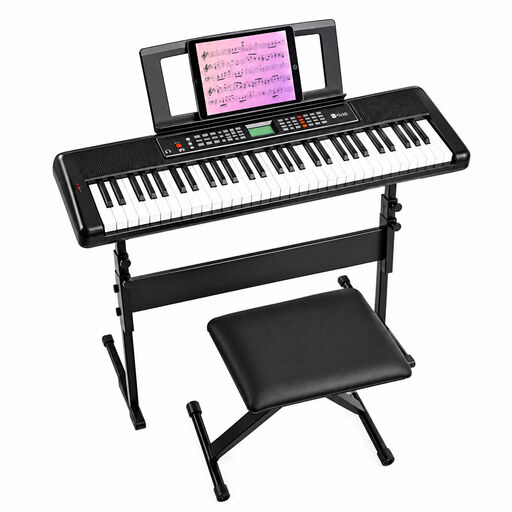 Image unavailable
The product name mentions a kit with a stand and bench, which could suit you if you need these for your practice setup. Check that the included setup works for the room, and bear in mind the 61-key range.
A headphone socket lets you avoid using the speakers, but make sure you set the listening volume sensibly. The Health Council of the Netherlands warns that frequent or prolonged exposure to loud noise can cause hearing damage; its advice for amplified music events is not a volume limit for this piano or music room. Also ask about the rules for the room.
Choose a model with enough keys for the exercises you need to do. The Joybuy models on this page have 61 keys; Yamaha describes the P-145 and Roland the FP-10 as having 88 keys. Compare the exact keyboard and try it out if how the keys respond is a factor in your decision.
Make sure the piano is set up securely, and check the power supply, the headphone plug you’ll need and which pedals are included. If you want to practise half-pedalling on an FP-10, Roland lists the optional DP-10 for this.
The models discussed here produce their piano sound electronically, so they don’t need tuning in the same way as an acoustic piano. Follow the manual for your chosen model when cleaning the keys and sockets.
When you buy online from a business, you’ll often have a 14-day cooling-off period; the Dutch government lists exceptions and distinguishes these purchases from buying from a private individual. When you buy as a consumer, you’re entitled to a product that works as it should, but there is no fixed statutory warranty period. If something is faulty, contact the seller. Check who the seller is and which terms and conditions apply to your order.