
Piano student practising technique
Wants a key range and touch suited to piano-focused finger exercises, rather than just simple melodies.


For finger exercises that require the range and touch of a piano keyboard, a digital piano with weighted keys is a more logical starting point than a shorter keyboard. Measure not only the instrument, but also the stand and your seating area; a shallow cabinet can help, but it won’t make an 88-key piano any narrower. Also compare the action of the exact model and check which accessories are included.
Wants a key range and touch suited to piano-focused finger exercises, rather than just simple melodies.
Needs room for the instrument, stand and seating, and may want to put the instrument away after practising.
Wants to practise with headphones and needs to check that the exact model has an accessible headphone socket.
Start with the range and touch your finger exercises require, then measure the entire playing area, including the stand and seating position. Next, check the headphone sockets and which accessories are included with the version you’re considering.
| What to consider | What should you check? | Who is this important for? |
|---|---|---|
| Key action and range | Check the number of keys and the type of keyboard on the exact version. If possible, try repeated keystrokes too. | If I do piano-focused exercises, I want a key range and touch that suit my learning materials. Around 33% of consumers make range and touch their top priority. |
| Space for the complete set-up | Measure both the width and depth, allowing for the stand, music rest and seating position. Casio lists the CDP-S110BK as 1.322 × 232 mm; Yamaha lists the P-145 as 1.326 × 268 mm. | If my practice space is narrow, I want to know whether the instrument and playing set-up will fit, and whether I can put the instrument away afterwards. Around 33% of consumers put placement first. |
| Practising with headphones | Check the type of socket and whether it will remain accessible in your set-up. Casio lists PHONES/OUTPUT for the CDP-S110BK; Korg lists PHONES/LINE OUT for the B2. | In a shared room, I want to practise without sound coming through the speakers. Around 20% of consumers make quiet practice their main priority when choosing. |
| Essentials for your playing area | Check which power supply, music rest and pedals are included. Check that optional stands and pedal units are compatible with the exact model. | If I want to set up a practical place to practise, I want to know in advance which accessories I’ll need and which are already in the box. Around 14% of consumers prioritise a complete set-up. |
The stated depth may not include the music rest. You’ll also need space for the stand and your playing position, so the instrument’s measurements don’t tell you how much room the complete set-up will take up.
Measure the available width and depth and, if necessary, sketch out your planned set-up before choosing a model.
A title that mentions both touch-sensitive keys and a weighted keyboard doesn’t, by itself, make it clear how the keyboard is constructed.
Check the specifications for the exact model with the manufacturer and, if possible, try the action for yourself.
The P-145 and ES120 have optional stand or pedal set-ups. Korg, by contrast, lists a damper pedal as included with the B2, so the contents vary by model and version.
Check the package contents and accessory compatibility before ordering, rather than relying on the product photo alone.
The P-145 is a portable model with 88 GHC keys, for anyone looking for a piano keyboard in a compact case.
According to Roland, the FP-30X has 88 PHA-4 Standard keys and sockets for practising with headphones.
According to Casio, the CDP-S110BK has 88 Scaled Hammer Action Keyboard II keys.
The ES120 is a portable piano with weighted keys, for anyone who may want to create a permanent set-up later.
According to Korg Netherlands, the B2 is a portable keyboard with 88 NH keys, built-in speakers and a headphone socket.
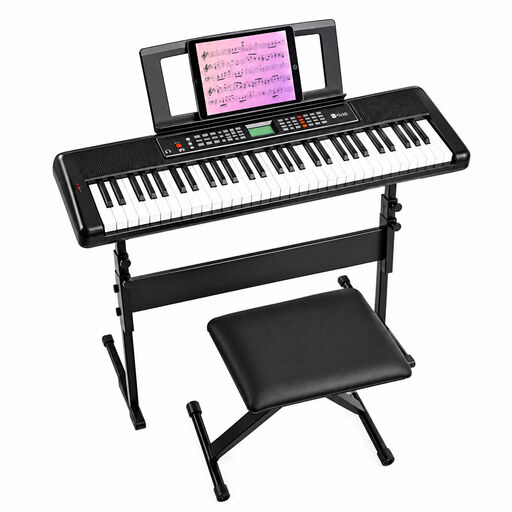
This product is a shorter keyboard offered as an alternative to a digital piano. It may suit you if your exercises don’t require a full piano range; it isn’t an equivalent substitute if your finger exercises need the full reach of a piano keyboard.
 No image available
May suit you if you’re specifically looking for a shorter keyboard and your exercises stay within the range of 61 keys.
The product name lists 61 keys, 300 sounds, 300 rhythms, a 3-level learning mode, an LCD display and USB-MIDI. The stated set includes a stand, stool and music rest.
With 61 keys, this model doesn’t have the full range of an 88-key piano. Check whether your exercises and learning materials require that range.
That depends on your exercises and learning materials. If you need the range or weighted touch of a piano keyboard, a shorter keyboard isn’t an equivalent substitute. Check in advance which keys your exercises use.
Measure the width and depth of the space, allowing for the stand, music rest and seating position. Also check which power supply and pedal are included with the exact version; Korg lists an adapter, music rest and damper pedal with the B2.
According to the Dutch government (Rijksoverheid), online purchases from a business come with a 14-day cooling-off period in many cases. Products must also be fit for purpose; if there’s a fault, contact the seller to arrange a solution. The Dutch government states that the Netherlands does not have a fixed statutory warranty period of two years.
Electrical appliances must meet the applicable European product requirements. The Dutch government states that electronic devices in the EU must carry a CE mark. Check the product information and the seller; a CE mark in an advert alone doesn’t confirm that the item being sold meets all the requirements.
According to Milieu Centraal, you can return an old electrical appliance to a shop free of charge when you buy a new, similar appliance there; this also applies to online purchases. If the instrument still works, you could also give it a second life.