
Learners practising film themes
You want to learn to play the melody and accompaniment, and need a keyboard on which to practise your touch and use of the pedal.


A compact entry-level piano is a good choice for learning film themes in a spare room if you mainly want to practise on your own and the complete set-up will fit. Choose a more advanced instrument if you’ll make real use of its extra practice or connection options. In either case, compare the feel of the keys and check which stand and pedals are included.
You want to learn to play the melody and accompaniment, and need a keyboard on which to practise your touch and use of the pedal.
You share your home with others and want to practise in the spare room using headphones.
The room has another purpose too, so you need to fit the instrument, music rest, stand and seat into the available space.
A good fit for: anyone who mainly practises film themes independently and has limited depth available. According to their manufacturers, both the Yamaha P-145 and Casio CDP-S110BK have 88 keys. Their stated instrument depths are 268 mm and 232 mm respectively, excluding accessories.
Keep in mind: try the action for yourself and measure the space needed for the music rest, stand and seat too. The optional Yamaha LP-5A three-pedal unit is not the same as an included pedal.
A good fit for: anyone who wants to practise with learning materials or backing audio as well as playing the piano. Roland describes the FP-30X as having Bluetooth for apps and audio; Kawai lists Bluetooth MIDI and audio for the ES120.
Keep in mind: check that the app and connection you want work with your device, and find out which pedals are included with the version you choose.
A good fit for: anyone who wants to leave their piano in one place rather than move it around. The Kawai CN-201 is a model worth comparing with portable options as a fixed digital piano.
Keep in mind: measure the complete set-up and check the pedals included with the exact version.
| What to consider | What to look for | Who should prioritise this? |
|---|---|---|
| Feel of the keys and range | Compare the keyboard and touch settings; try the exact model if possible. | If you want to learn expressive piano parts, you’ll want to know how the keys respond to your touch. Around 25% of consumers prioritise feel and key range. |
| Quiet practice | Check the type of headphone socket and the number of outputs on that version. | If you share your home with others, you’ll want to listen through headphones rather than use the speakers. For around 25% of consumers, headphone practice is the top priority. |
| Space for the complete set-up | Measure the space and allow for the music rest, stand and seat. | If the spare room is used for other things too, the whole playing area needs to fit. Space is the top priority for around 20% of consumers. |
| Practice support and connections | Compare the features you want and check compatibility with your device and learning app. | If you use digital learning materials, you’ll want the features to suit the way you practise. Around 15% of consumers give practice support and connections top priority. |
| Pedal and what’s included | Check what comes with that version and whether the pedals and stand you want are compatible. | You’ll want to know what you can use straight away and what else you need for your set-up. A complete set is the top priority for around 15% of consumers. |
The stated instrument dimensions don’t tell you how much room you’ll need for the music rest, stand and seat together.
Measure the whole playing area before choosing a portable or fixed model.
The pedals supplied as standard and those available as optional extras vary by version.
Check what’s in the box and whether the pedals are compatible with the model you’re considering.
Bluetooth audio, Bluetooth MIDI and support for specific apps are different features.
Decide whether you need backing audio or a connection to a learning app, then check that both the piano and your device support it.
The P-145 is a portable entry-level option for anyone looking for the essential piano features.
The CDP-S110BK is a portable option if a slim body and an included basic pedal are important to you.
The FP-30X is a portable option to compare if lessons, backing audio and headphone practice matter to you.
The portable ES120 and fixed digital piano CN-201 offer different set-ups to compare.
These product picks include 61-key instruments and sets. Check whether 61 keys are enough for the film themes you want to practise, and what’s included with each version of the set.
 No image available
An option to compare if you’re looking for a 61-key instrument for a compact practice set-up.
The product name lists a weighted keyboard, 300 tones, 300 rhythms, an LCD screen, USB-MIDI, speakers and a headphone socket.
 No image available
An option to compare if you want a 61-key instrument with a recording function and metronome.
The product name lists a MIDI controller, recording function, speakers, metronome and music rest.
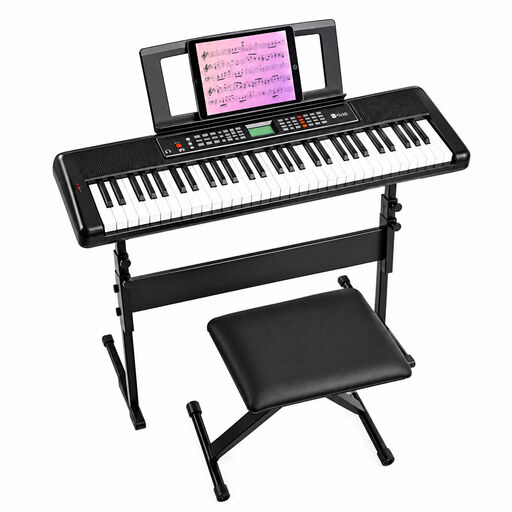 No image available
A set to compare if you want to put together a practice area with a stand and bench.
The product name lists 61 keys, a stand, bench, music rest, three-level learning mode and USB-MIDI.
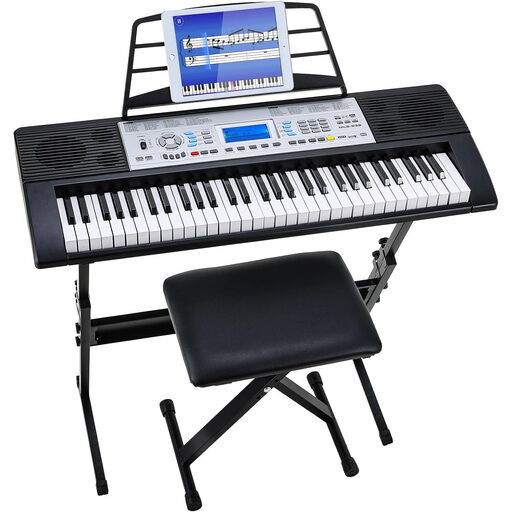 No image available
An option if you’re looking for a practice area with a stand and stool, and want to compare learning modes.
The product name lists 61 keys, 500 tones, a three-level learning mode and dual speakers.
Three pedals aren’t essential for beginners. Check which pedal comes with the version you choose and whether your learning materials call for a specific pedal function. Casio lists an SP-3 pedal as included with the CDP-S110BK, while Yamaha lists the LP-5A three-pedal unit for the P-145 as optional.
Measure the space for the instrument, music rest, stand and seat. Then follow the safety and set-up instructions in the manual for the exact model. The dimensions of the instrument alone don’t give you the measurements for every complete set-up.
According to the Dutch government, you’re entitled to a product that works properly in the Netherlands, and you should contact the seller if there’s a fault. There’s no fixed statutory two-year guarantee period; a manufacturer’s guarantee is in addition to your statutory rights.
For an online purchase, ACM ConsuWijzer says you’ll usually have up to 14 days from delivery to change your mind. Before buying, check which exceptions apply and the returns policy for trying out and returning the version you choose.
According to information from the European Union, CE marking is required for products covered by the relevant harmonised rules. The mark is a declaration by the manufacturer, not an independent EU quality certificate. Check the product information for the exact version and power adapter.