If you want to practise film music with both hands across different registers, a digital piano with weighted keys and a wide enough range may suit your learning goals. In a shared space, the headphone socket, available room and included stand and pedals are also important. Using headphones prevents sound coming from the speakers, but the sound of the keys themselves may still be audible.
Who is this for?
Film music pianist
Wants to practise melody and accompaniment with control over touch and dynamics, and compares the range of their pieces with that of the keyboard. Yamaha Netherlands and Roland Netherlands describe models with 88 keys and piano-focused keyboards.
Practising in a shared room
Needs a headphone socket and a suitable place to play, or an instrument that can be moved after use. Check whether the room can accommodate a permanent set-up, too.
Player practising along with film clips
Wants to practise with an external device and needs to decide whether they need audio playback, a MIDI connection or the ability to record their own playing. These are different functions, so check what the exact version supports.
What should you look for when buying?
| Consideration |
What should you look for? |
Who is this important for? |
| Touch and keyboard range |
Compare the lowest and highest notes in your arrangement with the keyboard. Check whether the keys are weighted and touch-sensitive. |
I want to play the melody and accompaniment with both hands, and need the keyboard to cover the range of my pieces. Around 31% of consumers prioritise touch and range. |
| Practising with headphones |
Check the piano’s socket and whether it’s compatible with your headphones. Bear in mind that the sound of the keys may still be audible. |
When I practise in a shared room, I don’t want to use the speakers and I want to disturb others as little as possible. Around 25% of consumers put quiet practice first. |
| Positioning and moving the piano |
Measure the space needed for the complete set-up, including the music rest and stand. Check whether you’ll need to put the instrument away after use. |
I need to consider the space available and want to know whether the piano can be moved after a practice session. Around 19% of consumers base their choice on space and portability. |
| Playing along and connections |
Decide whether you want to play audio, use MIDI or record independently. Check which cables and apps you’ll need, and whether your devices are compatible. |
I want to use a film clip or practice software, so I need the right connection. Around 13% of consumers prioritise playing along and digital connections. |
| Pedal and stand |
Check what’s included with the exact version and whether the supplied pedal or stand meets your practice needs. |
If I need a complete set-up straight away, I want to know exactly which parts are included with the version I’m buying. Around 12% of consumers put a complete set-up first. |
Common things to consider
-
Treating Bluetooth audio, MIDI and recording as the same function
Playing audio, sending notes to software and recording your own playing are different things. A mention of audio or MIDI doesn’t prove that a piano can record audio on its own.
First decide which function you need, then check the connections and features of the exact version.
You may also need a compatible cable, app or recording device for some types of connection.
-
Confusing a piano sold on its own with a version that includes a stand and pedals
The Korg B2+ is a standalone piano; Korg describes the B2+SP as a version with a stand and three pedals. Yamaha lists the LP-5A three-pedal unit as optional.
Compare the full model code and check which parts are included with the offer.
You may need a suitable stand or an extra pedal if it isn’t included with the version you choose.
-
Measuring only the keyboard
The space you need may also depend on the music rest, stand and room to sit at the piano. Yamaha gives different dimensions for the P-145BT depending on the set-up.
Measure the complete playing area and check which set-up is allowed in your practice space.
Brands to compare
Yamaha
According to Yamaha Netherlands, the P-145BT is a portable piano with 88 GHC keys.
- Yamaha lists Bluetooth audio.
- The LP-5A three-pedal unit is optional; check whether audio or MIDI suits the way you plan to use it.
Roland
According to Roland, the FP-10 has a portable 88-key PHA-4 Standard keyboard.
- Roland mentions headphone use and a built-in metronome.
- Roland warns that Bluetooth availability may vary by country; check the version you’re considering.
Casio
According to Casio, the CDP-S110BK is a slim digital piano with compact hammer-action keys.
- Casio lists a PHONES/OUTPUT socket, AUDIO IN and an SP-3 sustain pedal included.
- Check whether the connections and included pedal suit your practice needs.
Korg
According to Korg, the standalone B2+ has 88 NH keys, USB-C, AUDIO IN and PHONES.
- The connections offer different ways to connect external equipment.
- The B2+SP is a separate version with a stand and three-pedal unit; don’t assume these parts are included with the standalone B2+.
Kawai
In 2022, Kawai described the ES120 as a portable digital piano with wireless audio and MIDI connections.
- Kawai listed Bluetooth audio and Bluetooth MIDI, as well as headphone sockets.
- Check the current version and whether the specific connection is compatible with your device and set-up.
Joybuy products
The products below have 61 keys. Compare their range with the notes in your film music arrangement and check which connections you need.
 No image available
MLS-931 digital piano, 61 keys, black
May suit you if the notes in your arrangement fall within the range of 61 keys; compare this with the range of a full-size keyboard.
The product name lists a weighted keyboard, USB-MIDI, headphone socket, music rest, LCD, 300 tones and 300 rhythms.
View at Joybuy
 No image available
Electronic keyboard, 61 keys, black
Compare the range of 61 keys with your arrangement before deciding whether it’s enough for your film music pieces.
The product name lists a MIDI controller, recording function, speakers, metronome and music rest.
View at Joybuy
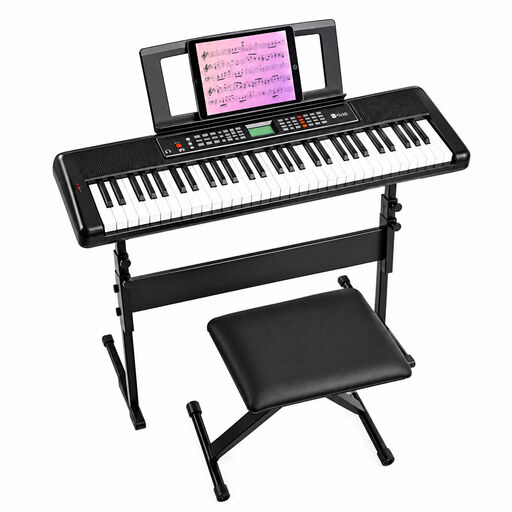 No image available
Digital keyboard piano set, 61 keys, black
This set may suit you if you’re looking for a playing area with the listed accessories; check whether 61 keys provide enough range for your arrangement.
The product name lists a stand, stool and music rest, plus 300 tones, 300 rhythms, an LCD screen and USB-MIDI.
View at Joybuy
Frequently asked questions
Do I need 88 keys for every piece of film music?
Not necessarily. Compare the lowest and highest notes you play at the same time in your arrangement with the keyboard’s range. A full-size keyboard may be a better fit if that range and piano-style touch are part of your learning goals.
How do I set up a shared practice space?
Measure the space needed for the complete set-up, check the headphone socket and use a suitable, stable stand. Also check whether the piano needs to be put away after use.
Is Bluetooth audio the same as MIDI or recording?
No. Bluetooth audio is for sound, while MIDI can send the notes you play to equipment or software. Neither feature on its own proves that the instrument can record audio independently; check that it has the function you need.
How can I tell whether a pedal or stand is included?
Check the full model code and the parts included with the version you’ve chosen. Korg distinguishes between the standalone B2+ and the B2+SP, which comes with a stand and three pedals; Yamaha lists the LP-5A three-pedal unit as optional.
Can I practise as loudly as I like with headphones?
No. The World Health Organization recommends keeping listening levels down and taking listening time into account. Start at a low volume and take breaks; a headphone socket doesn’t automatically set a safe listening level.


