
Four-hand duet players
You play together on one full keyboard and want to assess the key action, range and use of the pedal. Yamaha, Roland and Korg describe models with features for different practice situations.


For a four-hand piece, first assess how well you play together on the standard, full keyboard and how the pedals are arranged; Duo mode, which splits the keyboard into two playing areas, doesn’t offer the same physical key range. If you’re practising the same passage separately, a split mode can be useful. Then compare the key action, listening options, portability and connections to suit your rehearsals.
You play together on one full keyboard and want to assess the key action, range and use of the pedal. Yamaha, Roland and Korg describe models with features for different practice situations.
You want to practise the same passage side by side, each on a separate half of the keyboard. Compare the split-point limitations and pedal operation with the music you’re practising; Roland, Yamaha and Korg document their own features for this.
You take your piano to different rehearsal spaces or use headphones and external equipment. Kawai describes the ES120 as suitable for the practice room; the full set-up and connections are still important.
Choose this if: your parts use both the usual bass and treble ranges and need to fit on the same keyboard.
Bear in mind: a shared practice keyboard doesn’t give you two full keyboards; the pedal you need also depends on the piece.
Choose this if: you want to practise the same passage side by side and each need your own playing area.
Bear in mind: there’s less physical playing space for each person; on the Korg B2, the split point and range are fixed in Partner Mode.
Choose this if: you regularly take the piano with you or connect it to external speakers or recording equipment.
Bear in mind: a portable instrument doesn’t automatically make up a complete set-up; check the stand, pedals and connections included with the version you choose.
| What to consider | What should you check? | Which consumers? |
|---|---|---|
| Playing range and pedals | Try your parts in the standard playing mode and check which pedal function you need. | For a four-hand piece, I want to try both parts on the standard keyboard and know in advance who’ll operate the pedal. Around 36% of consumers give playing range and pedal use the highest priority. |
| Two practice areas | Check the split point, the range on each side and who can use the sustain pedals. | If we’re practising the same passage side by side, I want to know how much range each section has and how the pedals work. Around 29% of consumers give separate practice areas the highest priority. |
| Listening together and playing back recordings | Check how many headphone sockets there are and whether the version has a recording function that suits your needs. | For playing together quietly or listening back to a rehearsal, I want to check which listening and recording features are available. Around 21% of consumers give listening together and playing back recordings the highest priority. |
| Portability and studio connections | Compare the weight of the complete set-up and its connections with the equipment in your studio. | If I move the piano or connect it to studio equipment, I want to know what I’ll need in addition to the instrument. Around 14% of consumers give portability and studio connections the highest priority. |
A mode with two practice areas divides the physical keys. On the Korg B2, the split point and range are also fixed in Partner Mode.
Try your own piece in the standard playing mode first, then assess the practice mode separately.
Kawai lists the stand and triple pedal unit for the ES120 as optional; the Korg B2 and B2SP differ in the stand and pedal unit supplied.
Compare what’s included with the version you choose with what you already have in the studio.
Depending on your set-up, you may need to buy a stand, pedal unit or carrying case separately.
According to Korg, the single pedal supplied with the B2 operates the right-hand side in Partner Mode.
Check how the pedals work in the mode and version you want before choosing.
You may need a different pedal set-up for separate sustain control.
According to the manufacturer, the Yamaha P-225 has an 88-key GHC keyboard and a Duo function.
Roland documents Twin Piano on the FP-30X, as well as an 88-key keyboard and two headphone outputs.
Kawai describes the ES120 as suitable for the practice room and specifies a Responsive Hammer Compact keyboard.
Korg documents Partner Mode for the B2 and also describes the B2SP version with a stand and three pedals.
This selection includes keyboards with 61 keys. Compare the range with your parts, especially if you’re playing in different registers on one keyboard. For the version you choose, also check which conformity information applies; Business.gov.nl explains the European requirements, including CE marking and an EU declaration of conformity where required.
 No image available
The weighted keyboard and headphone socket may be useful if key action and quiet practice matter to you; check whether 61 keys are enough for your parts.
Specifications from the product title: weighted keyboard, USB-MIDI, built-in speakers and headphone socket.
 No image available
The product title lists a recording function; check whether the 61-key range suits the parts you want to practise.
Specifications from the product title: recording function, speakers, metronome and music stand.
 No image available
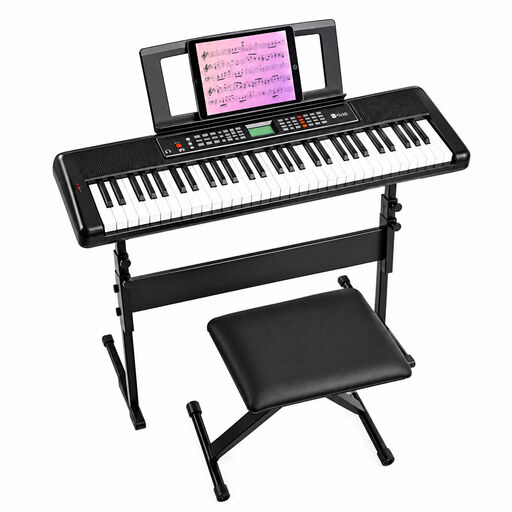
This set includes a stand, bench and music stand; check whether the keyboard range suits your duet.
Specifications from the product title: 61 keys, 300 sounds, 300 rhythms and USB-MIDI.
No. In the documented Partner Mode on the Korg B2, the physical keys are divided into two areas with a fixed split point. For a four-hand piece where both parts need the standard keyboard, assess the normal playing mode.
Check the outputs on the exact model and the inputs on your existing equipment. For the ES120, Kawai recommends switching off Speaker EQ and Spatial Headphone Sound when using Line Out to connect to external speakers or recording equipment.
No. Kawai lists an optional HML-2 stand and F-351 pedal unit for the ES120; Korg describes the B2SP as a version with a stand and three pedals. So check what’s included with the version you choose.
When you buy as a consumer, the product must meet the expectations you’re entitled to have of it, and you can contact the seller if there’s a fault. According to the Dutch Government, there’s no fixed statutory guarantee period in the Netherlands; what you can expect depends, among other things, on the product and the information provided.
Electrical and electronic equipment must comply with the European requirements that apply to it. According to Business.gov.nl, CE marking and an EU declaration of conformity are required for equipment covered by the relevant requirements; Bluetooth may also be subject to radio equipment regulations. Check the information for the exact version.