
Blues learner practising with both hands
Practises bass lines, chords and transitions, and wants a key action that stays comfortable during repeated playing. Berklee Online describes blues accompaniment as including left-hand bass lines and chords.


For practising blues chord progressions in a rehearsal room, start by choosing a keyboard that lets you play bass lines and chords comfortably at the same time. Then check that it connects to the sound system available. If you’ll be transporting the piano often, take its weight and any accessories you’ll need into account too. A model without built-in speakers requires suitable headphones or external audio equipment.
Practises bass lines, chords and transitions, and wants a key action that stays comfortable during repeated playing. Berklee Online describes blues accompaniment as including left-hand bass lines and chords.
Wants to be heard while playing with others and needs outputs that work with the available sound system. Roland, Kawai and Korg list separate audio outputs for specific models.
Regularly sets up and packs away their equipment, so needs to consider the instrument’s weight and dimensions, as well as what else they need to play. Yamaha and Korg list weights for specific models; the stand and soft case for the Korg D1 are separate accessories.
Berklee Online describes blues accompaniment as including left-hand bass lines and chords. So first decide how you play, then check that the piano suits your sound system and the way you practise.
| What to consider | What to look for when buying | Who it matters most to |
|---|---|---|
| Key action and range | Try playing bass lines and chord changes on the keyboard; check the number and type of keys, as well as the pedal connection. | If I play bass lines and chords at the same time, I want enough range and a key action that feels right for me. Around 40% of consumers say that practising blues with both hands is their main purchasing concern. |
| Connecting to equipment for playing with others | Check which inputs the mixer or active speakers have and compare them with the piano’s outputs. Remember to consider suitable cables too. | At a band rehearsal, I want to know how to connect the piano to the available sound system. Around 30% of consumers prioritise connecting their piano for playing with others. |
| Transport and set-up | Compare the dimensions and instrument weight; include the stand, pedal, power supply and cables in your practical assessment. | If I take my piano with me often, I want to know whether I can transport the complete set-up. Around 20% of consumers say transport is their main purchasing concern. |
| Quiet practice | Check for a headphone socket and consider whether you’ll also want to hear the piano through speakers without headphones. | When I practise without speaker sound, I want to be able to connect suitable headphones. Around 10% of consumers prioritise quiet practice. |
The MLS-931 has 61 keys, which gives it a different playing range from the 88-key models mentioned, such as the Yamaha P-225 and Korg D1.
Check the model number and number of keys before buying. Consider whether the range suits the bass lines and chords you want to practise with both hands.
The Korg D1 has no built-in speakers. You’ll therefore need headphones or suitable external audio equipment to hear it while playing.
Check what equipment is available in the rehearsal room and what you’ll need to practise independently elsewhere.
Allow for suitable external audio equipment and cables if you don’t already have them.
The stated weight is for the instrument and doesn’t tell you how much the complete set-up weighs when ready for transport. Korg lists the D1 as weighing 16 kg.
Compare the full set-up you actually plan to transport and use.
Korg lists the stand and soft case for the D1 as separate accessories, so check which items are included with the version you’re buying.
The FP-30X is a portable digital piano worth comparing if you want to practise independently and connect the instrument to an external sound system.
The ES120 is a portable option to compare if you want to combine piano playing with electric piano sounds and connections for playing with others.
The P-225 is a compact P-series piano worth comparing if a full-size keyboard and portability are important to you.
The D1 is an option for a rehearsal room that already has external audio equipment and where a variety of piano sounds are wanted.
The Privia PX-S1100BK is an option to compare if space is limited.
The Joybuy products below have 61 keys and list built-in speakers; they’re options for independent practice. Check that the playing range and connections suit your blues practice and the equipment in your rehearsal room.
 Image unavailable
Could suit you if you’re looking for a 61-key keyboard with weighted keys for independent practice; check that the range is enough for your bass lines and chords.
The product information lists USB-MIDI, audio input and output, built-in speakers and a headphone socket. The title also mentions a music stand.
 Image unavailable
Could suit you if you’re looking for a 61-key instrument for independent practice; compare its range with the parts you want to play with both hands.
The product name lists MIDI, a recording function, built-in speakers, a metronome and a music stand.
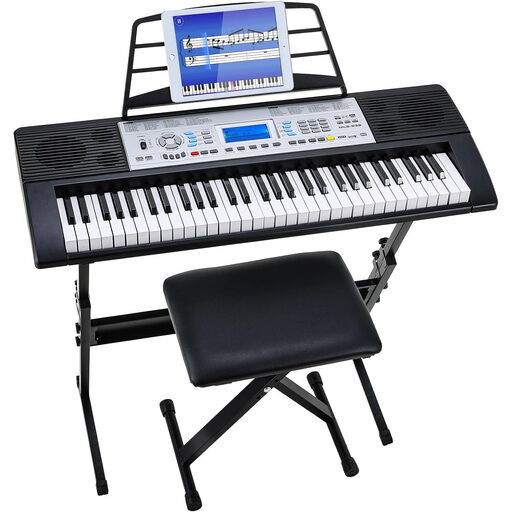 Image unavailable
Could suit you if you’re looking for a permanent practice set-up with a keyboard, stand and stool; check that 61 keys are suitable for your practice.
The product name lists 500 sounds, dual speakers, an LCD screen and a three-step learning mode.
Compare the inputs on the mixer or active speakers with the outputs on the exact version of the piano. Korg lists LINE OUT (L/MONO, R) for the D1; Roland lists separate outputs for the FP-30X. Check which cables you’ll need too.
According to Korg, you’ll need headphones or suitable external audio equipment to hear the D1 while playing, as it has no built-in speakers.
No. According to Korg, the stand and soft case are separate accessories. Korg lists the adapter, music rest and damper pedal among the included items, but check the contents of the specific offer.
It depends on the range you need for your bass lines and chords. Compare 61 keys with a full-size 88-key keyboard, and try playing the parts you want to practise on the instrument.
For distance purchases from a business, you’ll usually have a 14-day cooling-off period, according to the Dutch government. You’re also entitled to a product that is fit for purpose; in the Netherlands, there is no fixed statutory warranty period. ACM ConsuWijzer distinguishes purchases used mainly or exclusively for business purposes, which are not automatically covered by the same consumer protections.