
Practising with housemates
You want to practise regularly without using the built-in speakers, and agree on noise levels at home. The Dutch government advises people to try agreeing on arrangements together first if noise is causing a problem.


Start with a digital piano that has a headphone socket and will fit in your shared space. For piano technique and parts played with both hands, a weighted 88-key keyboard is worth considering. If playing along with a rhythm is your priority, built-in rhythms or a metronome may matter more. Headphones mute the sound from the speakers, but they won’t automatically make the keys inaudible to the people you live with.
You want to practise regularly without using the built-in speakers, and agree on noise levels at home. The Dutch government advises people to try agreeing on arrangements together first if noise is causing a problem.
You’re practising chords and bass notes with both hands, and want to develop your touch and timing too. Models from Roland and Kawai include features such as metronomes to help you practise your timing.
You want to repeat a blues progression with a metronome or built-in drum rhythms, rather than just playing freely. Kawai lists rhythm functions for the ES60 and ES120.
First decide what matters most to you: quiet practice, a piano-style touch or playing along with rhythms. Then check that the complete setup will fit in the space available.
| What to consider | What should you check? | Who is this important for? |
|---|---|---|
| Quiet practice | Check how many headphone sockets there are, what type of plug they use and whether the version you’re considering has these sockets. | I want to practise without sound from the speakers when my housemates are at home. Around 36% of consumers make quiet practice their top priority. |
| Piano-style touch | Compare the key action and number of keys, and measure the piano’s width and depth to make sure it will fit where you plan to put it. | I want to practise chords and bass notes with both hands across a full keyboard. Around 29% of consumers prioritise piano-style touch and range. |
| Timing and rhythms | Check whether the version has a metronome, the rhythms you want and sounds you can use. | I want to repeat a blues progression with a steady beat or drum accompaniment. Around 21% of consumers mainly choose based on the options for practising with rhythms. |
| Space for setup | Measure the space, including room for the stand and a seat. Check which stand, power supply and pedals are included in the bundle. | I can only choose once I know the piano and the setup I want will fit in my shared space. Around 14% of consumers prioritise having limited space for a setup. |
The headphone socket is for audio output. Whether your housemates can hear the keys depends on more than just that socket.
Agree on practice times and try out the setup in your own home.
Yamaha lists Bluetooth audio for the P-145BT. Don’t assume this feature is also available on the P-145 without checking.
Compare the full model number and check that the version on offer has the connection you want.
A stand or a more extensive pedal setup may be sold separately. This could mean you’ll need to put the setup together separately and allow extra space for it.
Measure the space, including room for a seat, and check which parts are included in the bundle you choose.
Yamaha lists the three-pedal unit for the P-145 as optional, so check whether the pedal setup you want is included with the version on offer.
Roland lists features such as a metronome for the FP-10, and two headphone outputs and options for adding pedals for the FP-30X.
The P-145 is a portable piano with 88 GHC keys; the P-145BT is a separate version.
Kawai lists metronome and drum rhythm functions for the ES60 and ES120.
Casio describes the CDP-S110 as a compact digital piano with Scaled Hammer Action Keyboard II.
Korg’s specifications for the B2+ list an 88-key NH keyboard.
These Joybuy products are portable 61-key models with rhythm functions and a headphone socket. They may suit practice with a steady beat and without sound from the speakers, but offer a smaller range than an 88-key keyboard.
 No image available
The headphone socket and metronome are useful for practising without sound from the speakers and working on your timing. With 61 keys, this model has a smaller range than an 88-key keyboard.
The product details list 300 rhythms, 300 sounds and USB-MIDI.
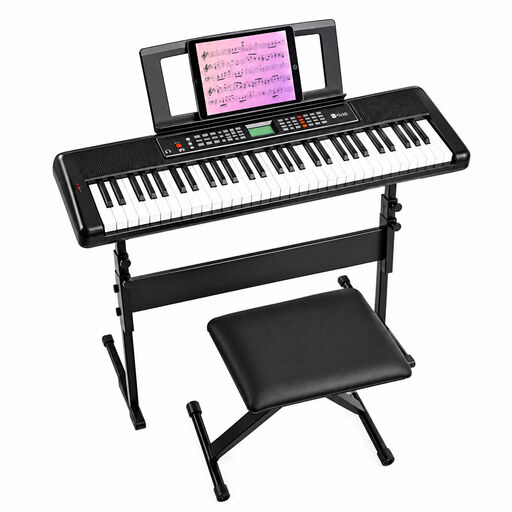 No image available
The headphone socket and metronome are useful if you want to practise without sound from the speakers and develop your timing. The 61 keys offer a smaller range than an 88-key keyboard.
The product details list touch-sensitive keys, 300 rhythms, 300 sounds, USB-MIDI and an LCD screen. The product name includes a stand and bench.
Not necessarily. Headphones prevent sound coming from the speakers, but don’t tell you how audible the keys will be in your home. The Dutch government advises people to agree on arrangements first if noise is causing a problem; this doesn’t mean there is a generally permitted time for practising.
No, you can practise the chord progression with a metronome too. If you want to play along with drums, compare the rhythms on the exact piano model: Kawai lists 30 drum rhythms for the ES60 and 100 for the ES120.
No. Yamaha lists the LP-5A for the P-145 as optional, while Roland lists separate stand and pedal options for the FP-30X. Check which parts are included in the bundle on offer.
For distance purchases, in many cases you have a 14-day cooling-off period, subject to exceptions. You’re also entitled to a product that meets the legal guarantee: it must be of satisfactory quality. The Dutch government explains these rights; check who the seller is and which terms apply to your purchase.