What should you look for when buying?
First, decide whether you want to view individual crystals on a computer or using a screen built into the microscope. Then check the working distance, the space needed for the complete setup and whether you’ll be inspecting a surface or examining thin sections.
| What to consider |
What to look for |
Which consumers this matters to |
| Space for the setup |
Measure the available surface area and clearance above it, including the stand, arm, cable and largest crystal you want to examine. Also check whether there’s room for a computer beside the specimen. |
If I’m working on a small bench, I want to know whether both the base and the crystal will fit under the camera. Around 29% of consumers prioritise space for the complete setup. |
| Working distance and crystal shape |
Compare the working distance at your intended magnification with the height of your specimen. For the DST-1028 5MP, Bresser specifies 110 mm at 10× and 10 mm at 280×; the manufacturer links these magnifications to viewing on a 27-inch monitor. |
If I want to see the shape of a three-dimensional crystal before examining the details, I need enough space between the lens and the specimen. Around 23% of consumers prioritise seeing crystal shapes and details. |
| Reflections on shiny surfaces |
Check whether the exact version has an adjustable polariser and whether the lighting can be adjusted. Celestron describes a polariser on the Labs Digital 5MP Handheld for reducing reflections; this is not a substitute for a petrographic setup. |
If glare obscures the surface, I want to be able to reduce those reflections. Around 18% of consumers say controlling reflections is their top priority when choosing. |
| Photos and connections |
Check the connection, compatible computer and software, and how images are saved. For the DST-1028 5MP, Bresser specifies Windows 10 and 11 and PC software; this information doesn’t automatically apply to other models. |
If I want to record crystals and find the images later, I want to know how they’re saved and transferred. Around 18% of consumers prioritise documentation. |
| Surface or thin section |
Decide whether you’re examining the surface of an individual crystal or identifying a mineral in a thin section. Euromex describes features for petrographic microscopy including an analyser and a rotatable stage. |
If my aim is to identify minerals in thin sections, I want a setup designed for that kind of examination, rather than one that only reduces reflections on a surface. Around 12% of consumers prioritise petrographic identification. |
Joybuy product selection
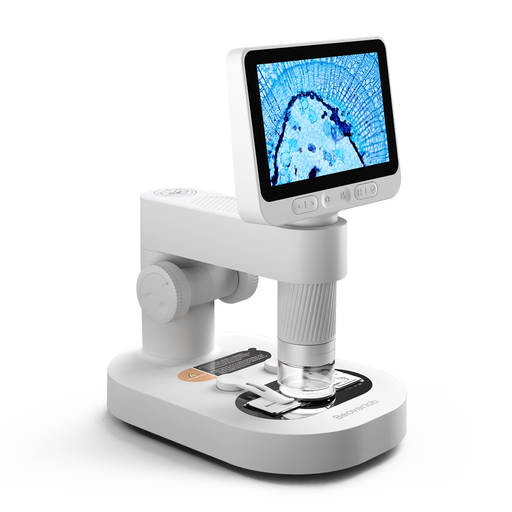
This Joybuy selection features a digital microscope with its own screen, for anyone who’d rather not use a separate computer on the workbench. Check that the working distance and complete setup suit the crystals you want to examine.
 No image available
Digital microscope for children with detachable screen, microscope slides and accessories
Could be a good fit if you don’t want to use a separate computer beside the specimen while viewing.
The description mentions a detachable screen and use as either a handheld microscope or with the stand.
According to the product description, it has eight adjustable LED lights.
Keep the camera and small accessories out of reach of children under 3; use under adult supervision.
Joybuy
Frequently asked questions
Is higher magnification always better for a rough crystal?
No. To see the shape of an individual three-dimensional crystal, a useful overall view is important. Then check that the working distance leaves enough room at the magnification you want for examining details. For the DST-1028 5MP, Bresser specifies different working distances at 10× and 280×, and links the magnifications to viewing on a 27-inch monitor.
Can I use a polarising filter to identify minerals?
A polariser on a handheld microscope can help reduce reflections on a shiny surface, but that’s not the same as petrographic identification in thin sections. For this application, Euromex describes features including an analyser and a rotatable stage.
What should I check before connecting a microscope to my computer?
Check that the exact model’s connection and supported operating system are compatible with your computer, and consider where the cable and stand will go. For the DST-1028 5MP, Bresser specifies Windows 10 and 11 and software available to download; this information doesn’t automatically apply to other models.
How can I make images of the same crystal easier to compare?
Keep the crystal in a stable position and try to keep the settings, lighting and placement as consistent as possible. If you’re using measurement software, check how the manufacturer handles calibration; a magnification figure alone doesn’t establish the scale of a saved image.
What rights apply when buying online in the Netherlands?
Many online consumer purchases come with a 14-day cooling-off period, although exceptions depend, among other things, on the type of purchase and the seller. You’re also covered by the statutory guarantee: if a product doesn’t perform as you could reasonably expect under normal use, the seller is responsible for providing an appropriate solution. The Dutch government explains the cooling-off period, while ACM ConsuWijzer provides information about guarantees.


