
Fair demonstrator
Wants visitors to examine fibres and fabric structure without a complicated set-up. Celestron describes a model with its own screen, while Bresser describes a USB model for viewing on a computer.


Choose a portable microscope with its own screen if you want visitors to view samples without a computer at the fair. A USB model with a stand is better suited to a permanent setup where you want to examine and record samples steadily. Also compare the lighting, the clearance beneath the lens and the power supply required. Remember that a magnified image is not proof of the exact fibre composition.
Wants visitors to examine fibres and fabric structure without a complicated set-up. Celestron describes a model with its own screen, while Bresser describes a USB model for viewing on a computer.
Wants to examine and compare fabric samples in a permanent set-up. According to the manufacturers, Bresser and Levenhuk models come with a stand. When choosing, also consider the space available for your sample and the lighting.
Wants to know whether a visible difference tells them anything about the type of fibre. ASTM International describes microscopic fibre analysis as specialist work involving different microscopes and lighting techniques. A demonstration at a fair is not automatically enough for this purpose.
First, decide whether visitors need to view samples without a computer. Then consider whether you mainly want to record samples steadily, move your set-up around frequently or identify fibres professionally.
| Buying priority | What to look for | Who is this most important for? |
|---|---|---|
| Viewing together | Check whether the device has its own screen or needs a computer, and whether the image will be easy to see at your fair stand. | I want to show visitors fabric structure straight away, without setting up a computer first; around 36% of consumers prioritise viewing together. |
| Recording samples | Check whether the stand and specimen holder have room for your fabric sample, and whether the lighting and software suit the way you work. | If I want to examine samples steadily and save images, I look at the set-up and whether a computer is needed; around 29% of consumers prioritise recording fabric details. |
| Portable set-up | Check whether you need a computer and what power supply and accessories are required for your chosen set-up. | When I want to move between fair stands or samples, I don't want to depend on a computer; around 21% of consumers prioritise a portable set-up. |
| Identifying fibres | Establish which microscope and lighting techniques, and what level of expertise, are needed to support the conclusion you want to draw. ASTM International describes several techniques and types of equipment for this purpose. | If I want to do more than make fibres visible, I don't want to base a claim about composition on a single image from a fair; around 14% of consumers prioritise reliable fibre identification. |
A magnification figure alone doesn't tell you how well a microscope will work with a fabric sample, how much focusing space it offers, how it is lit or how you want to display the image. The screen and USB models reviewed differ in several of these respects.
Start with your sample and your fair set-up. Then check that you can bring the detail you want into focus at the chosen lighting level and working distance.
The USB models reviewed display the image on a computer and use the accompanying software. A suitable connection and workspace are therefore part of the set-up.
Before the fair, test the connection and software with your own computer, and check that the stand fits on the table available.
A magnified image of fibres does not, by itself, establish the full composition of a fabric. ASTM International describes various techniques and instruments for microscopic fibre analysis.
Present what you can see as an observation. Don't base a formal statement about fibre types solely on a simple image taken at a fair.
The DST-1028 reviewed is a USB handheld microscope with a stand, designed for viewing material samples on a computer.
The DTX 90 reviewed is a USB model with a stand and specimen stage for individual samples at a fixed location.
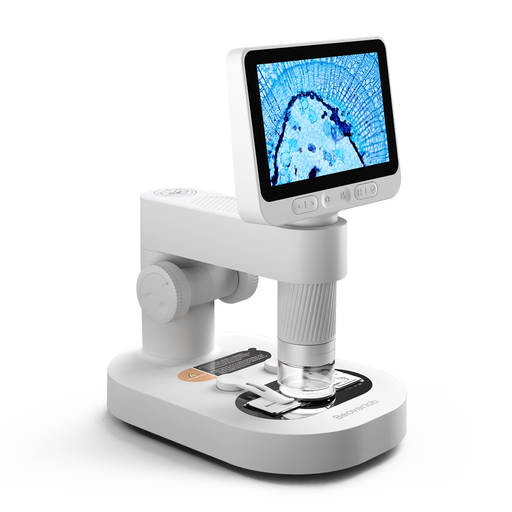
The models reviewed offer two different set-ups: the portable 44310 with its own screen and the USB-connected Handheld Digital Microscope Pro 44308.
This selection is suited to viewing fabric samples during a demonstration where you want visitors to look at the screen without needing a computer.
 No image available
Suitable for demonstrations where you want to examine fabric samples by hand and show the image straight away on the detachable screen.
The product name describes handheld use and a detachable screen. Keep small accessories out of reach of children under 3 due to the risk of choking, and use the product only under the direct supervision of an adult.
Yes, you'll need a model that displays images itself. According to Celestron, the Celestron 44310 reviewed has its own screen and runs on two AA batteries, which are not included. A USB model that displays the image on a computer requires a different set-up.
Place the sample securely under the lens and adjust the focus while changing the lighting as needed. According to Levenhuk, the Levenhuk DTX 90 reviewed has clips on its specimen stage. For a different model, check that the stand has enough room for your sample.
No, a magnified photo alone can't prove that. ASTM International's guidance on microscopic fibre analysis describes several techniques and instruments for specialist examination. Use a simple image taken at a fair as an illustration, not as conclusive proof of the fabric's full fibre composition.
For a consumer purchase in the Netherlands, statutory consumer rights apply alongside any manufacturer's warranty: the product must meet what you could reasonably expect. ACM ConsuWijzer explains that, under the applicable conditions, the seller must put a faulty product right. There is no single fixed statutory warranty period for every microscope.
Online purchases generally come with a cooling-off period of up to 14 days after delivery, subject to statutory exceptions. ACM ConsuWijzer explains the time limit; check which conditions apply to your purchase.