
Marker in a quiet workspace
You type lots of short comments alongside colleagues and want to be mindful of the sound of the keys. CHERRY and Trust describe certain models as quiet, but that isn’t the same as a comparative sound measurement.


Choose based on what matters most to you: quieter key presses in a shared space, a layout that suits the way you work or shortcuts for tasks you repeat. Then check the size, connection and space available for your mouse. Claims about quietness or comfort don’t prove that a keyboard will suit everyone better. The Arboportaal emphasises that varying your activities and setting up your workstation properly remain important when working at a screen for long periods.
You type lots of short comments alongside colleagues and want to be mindful of the sound of the keys. CHERRY and Trust describe certain models as quiet, but that isn’t the same as a comparative sound measurement.
You switch between reading, typing and using a mouse, and want to assess the keyboard size and hand position in relation to your workspace. The Arboportaal describes repetitive movements and static strain when working at a screen; a keyboard doesn’t replace a properly set-up workstation or regular changes of activity.
You repeat comments or use the same shortcuts regularly, and want to check whether configurable functions work with your marking software and work computer. Logitech describes features for configuring actions, but their usefulness depends on the software and settings at your workstation.
First decide whether quietness, working posture, repetitive tasks, or layout and connectivity matter most to you. Then compare the specific key layout and connection options with your desk and work computer.
| What to consider | What should you check? | Who is this important for? |
|---|---|---|
| Key noise | Check the key mechanism and, if possible, try the space bar and larger keys too. Treat ‘quiet’ as a product claim, not as a like-for-like measurement. | If I type lots of short comments in a shared space, I mainly want to be mindful of the noise for my colleagues. Around 36% of consumers prioritise key noise when making a purchase. |
| Working posture | Assess the keyboard’s height and shape, its distance from the mouse and how your hands rest at your adjusted desk. | During long marking sessions, I want a size and hand position that suit my workspace, without treating comfort claims as a guarantee. Around 29% of consumers give working posture the highest priority. |
| Shortcuts | Check which shortcuts your marking software supports and whether you’re allowed to use the required configuration software on your work computer. | If I often carry out the same tasks, I want to know whether I can configure them using my own software. Around 21% of consumers prioritise simplifying repetitive tasks. |
| Layout and connectivity | Check the key layout, whether you need a numeric keypad and which connections are permitted on your work computer. | When I enter numbers or need a specific connection, I want to be sure the layout and connection are right for my computer. Around 14% of consumers give that combination the highest priority. |
CHERRY and Trust describe some models as quiet, but manufacturers’ descriptions don’t show how the models compare with one another in the same office.
Consider quietness as one factor and, if possible, try the keys for yourself.
According to BakkerElkhuizen, the S-board 840 has no separate numeric keypad, but does have an integrated numeric section.
Think about how often you enter numbers and whether the layout it offers will be enough.
If the integrated section isn’t sufficient, you may need a separate numeric keypad.
Logitech links Smart Actions on the MX Keys S to Logi Options+. That doesn’t automatically mean the features will be available on your work computer or in your marking software.
Before buying, check whether the software is permitted and whether your application supports the shortcuts you want.
For a consumer purchase, your statutory rights may still matter after a manufacturer’s guarantee has expired. The ACM ConsuWijzer explains that, under the statutory conditions, the seller must offer a remedy for a faulty product.
Keep your proof of purchase and check who is legally the buyer, especially if the keyboard is being bought on behalf of an organisation.
The wired STREAM KEYBOARD is worth considering for a fixed workstation where quiet typing matters.
The Ody II is a wireless option with a USB receiver, if that connection suits your work computer.
Wave Keys has a wave-shaped design and palm rest; MX Keys S is worth considering if you want to explore configurable actions.
The wired S-board 840 is a compact option to consider if you often switch between your keyboard and mouse.
This selection of Joybuy keyboards includes compact options, models with a numeric keypad and keyboards with different connection options for desk-based work.
 No image available
The TKL layout may suit you if you often switch to your mouse while marking and want more desk space.
Wired; TKL layout; QWERTY; listed for PC and PS5.
 No image available
This compact model may suit you if you’re looking for a TKL layout and a wired connection works for your workstation.
TKL layout; US QWERTY.
The product description mentions quiet membrane keys; treat this as a product claim, not a comparative sound measurement.
 No image available
A keyboard with a numeric keypad may suit you if you regularly enter numbers while marking.
Full-size; numeric keypad; QWERTY; black; plug-and-play according to the product name.
 No image available
Consider this model if you’re looking for a 75% layout and several connection options, and the layout suits the work you do.
Mechanical; 75% layout; US QWERTY; Tri-Mode: wired, Bluetooth or 2.4G.
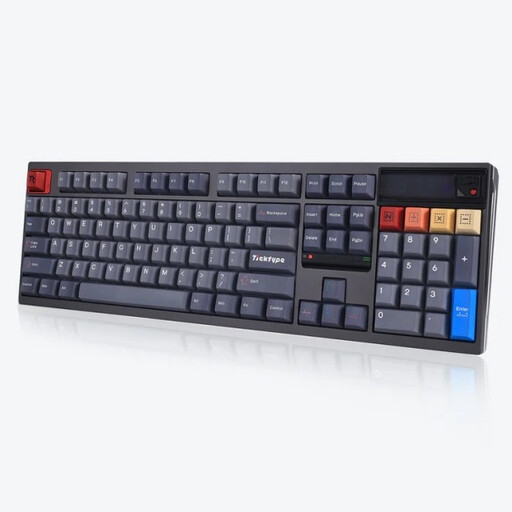 No image available
This model may suit you if you’re looking for a full-size keyboard with wireless connection options. Treat the claim about quiet keys as a product claim, not a comparative measurement.
108 keys; US layout; Tri-Mode; 8000mAh; RGB; Silent Tactile Switches according to the product name.
For employees who work at a screen for more than 2 hours a day, the Dutch Arboportaal states that the screen and keyboard must not be attached to each other. A separate screen or keyboard must therefore be usable with a laptop; this requirement doesn’t necessarily apply to every buyer.
No. The Arboportaal advises you to vary screen-based tasks, change your working posture and take micro-breaks. Adjust your workstation too; a product claim about ergonomics doesn’t replace these measures.
Check whether you’re allowed to use a USB receiver or Bluetooth, and whether the necessary connection is available. Trust lists a USB receiver for the Ody II; Logitech lists Bluetooth and Logi Bolt for Wave Keys. You’ll need to check what’s permitted at your particular workplace.
For an online consumer purchase, you usually have a statutory cooling-off period of up to 14 days after delivery, with some exceptions, according to the ACM ConsuWijzer. If a product is faulty, the seller may also have to offer a remedy under the conditions of the statutory guarantee; a manufacturer’s guarantee doesn’t replace this. Check who is legally the buyer if the keyboard was bought on behalf of an organisation.