
Mapmakers without a spare socket
If you don’t want to use a socket for your keyboard during a work session, you can choose between replaceable batteries and a rechargeable battery charged in advance.


First, choose between replaceable batteries and a rechargeable battery. This determines whether you’ll need to change the batteries or plan ahead to recharge. Next, check whether your computer supports Bluetooth or a USB receiver, and whether the keyboard layout works with your mapping software. A compact model takes up less space, while a larger layout can put more keys within easy reach. Battery life varies by model and is specified by the manufacturer.
If you don’t want to use a socket for your keyboard during a work session, you can choose between replaceable batteries and a rechargeable battery charged in advance.
If you switch between, for example, a computer and a tablet, check which connection types and keyboard layouts each device supports.
If you use keyboard shortcuts frequently, it’s worth choosing a physical layout and customisation options that suit your mapping software. The QGIS documentation notes that keyboard shortcuts can be reassigned.
Start with the power supply and available connections. Then compare the layout and key positions with what you need for your mapping work.
| What to consider | What should you check? | Who is this for? |
|---|---|---|
| Working without a socket | Check whether the keyboard uses replaceable batteries or a rechargeable battery, and how to get it ready before a long session. | If I don’t want to recharge while mapping, I weigh up taking spare batteries with me against charging the battery in advance. Around 36% of consumers prioritise working without a socket. |
| Connecting devices | Check for Bluetooth support, the type of spare USB port needed for a receiver, if applicable, and compatibility with each device. | If you switch between devices, you’ll want to know whether each one supports your chosen connection. Around 29% of consumers prioritise device connectivity. |
| Desk space and keys | Compare the exact layout with the keys and shortcuts you use; check your QGIS shortcut settings if needed. | If I have limited desk space but use certain keys often, I compare the layout with the way I work. Around 21% of consumers prioritise desk space and easy-to-reach keys. |
| Typing comfort during long sessions | Consider the size, key feel and position in relation to your screen and pointing device. Assess the keyboard as part of your overall workstation. | For consumers who spend long periods making maps, it matters how the keyboard fits their workspace and hands. Around 14% put typing comfort during longer sessions at the top of their list. |
A rechargeable model still needs charging; a model with replaceable batteries requires you to change them when they run out.
Check the power type and, if you choose a model with a rechargeable battery, plan to charge it before a long mapping session.
Some models use a USB receiver instead. This is different from Bluetooth and requires a compatible spare port.
Check the connections available for the exact model and version, and make sure your computer has the right ports.
The physical keys and their positions can affect how you work with mapping software. You can customise shortcuts in QGIS.
Make a note of the keys you use, then compare them with the exact keyboard layout and your software settings.
Manufacturers quote battery life under different conditions and sometimes in different units. For example, Logitech gives different battery life figures for the MX Keys for Business depending on the backlighting; Keychron quotes the K3 Max in hours.
Only compare these figures after checking the model, settings and stated usage conditions.
Trust offers a rechargeable option with the Lyra and a model with a USB receiver in the Ody II; these use different connection types.
The compact Pebble Keys 2 K380s is a Bluetooth model; the MX Keys for Business is a separate model with Bluetooth Low Energy and a receiver.
CHERRY describes the KW 9200 MINI as a compact, rechargeable keyboard with Bluetooth, 2.4 GHz and a wired connection.
Rapoo describes the E9700M as a slim, rechargeable keyboard with Bluetooth and a 2.4 GHz option via a receiver.
Keychron positions the K3 Max as a compact mechanical keyboard with a 75% layout, for those who want to customise their keys.
This selection includes wireless keyboards with compact or fuller layouts and Bluetooth, 2.4 GHz or wired connection options.
 No image available
The 75% layout is a compact option if you want to free up desk space.
The title lists a US QWERTY layout and wired, Bluetooth and 2.4G modes. Check that the US layout suits the way you use your keyboard.
 No image available
The 75% layout could be a good fit if you’re looking for a more compact keyboard for a limited workspace.
The title lists a US QWERTY layout and three connection modes. Check that the layout suits the way you use your keyboard.
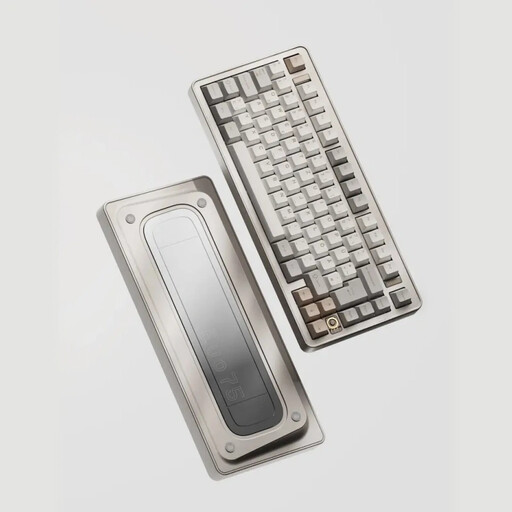 No image available
This model may appeal if you’re looking for a 75% layout and customisable keys.
The title lists a US layout, VIA compatibility, hot-swappable switches and an 8000 mAh battery. The description lists Bluetooth, 2.4 GHz and wired use.
 No image available
The 98% layout offers a different arrangement from the more compact 75% models in this selection.
The title lists a US QWERTY layout, volume knob, TFT screen and 10,000 mAh battery, with wired, Bluetooth and 2.4G modes. Check that the layout works with your mapping software.
 No image available
The 75% layout is a compact option if you want to save space on your desk.
The title lists a US QWERTY layout, 8000mAh battery, volume knob and Flying Fish switches. The description lists Bluetooth, 2.4 GHz and wired use; check that the US layout suits the way you use your keyboard.
No, not for a separate receiver, as long as your computer supports the required Bluetooth connection. If you choose a 2.4 GHz receiver, such as the one used by the Rapoo E9700M, check that you have a suitable spare USB port.
That depends on both the keyboard and your software. You can customise shortcuts in QGIS, and Keychron lists key remapping as a feature of the K3 Max. Before setting up keys or macros, check that your software and chosen version support the changes.
Take loose used batteries to a collection point, such as a shop or supermarket that sells batteries. The Government of the Netherlands lists these as examples of collection points.
The Government of the Netherlands says that if there’s a problem with a product, you can ask for a repair or replacement at no extra cost. For eligible online consumer purchases, you’ll also usually have a 14-day cancellation period; this is separate from getting a faulty product put right.
Not for every user. According to Arboportaal, the workplace requirements in question apply when an employee works at a screen for more than 2 hours a day: the screen and keyboard must not be attached to each other. When using a laptop, it must be possible to use a separate screen or keyboard; this requirement does not automatically apply to private use.