
Home baker with a long dough rest
Wants to time the planned rest in one go and check the dough when the alarm sounds. According to TFA Dostmann, the TFA 99HOURS has an hours-and-minutes setting for longer durations.


First, choose a timer that can count down the full planned dough-resting time in one go. Then consider whether you need a clear, adjustable alarm or separate timers for other dishes. A kitchen timer reminds you to check the dough, but it cannot tell you by itself when it is ready: the temperature and condition of the dough also matter. Before buying, check which type of battery it needs and whether one is included.
Wants to time the planned rest in one go and check the dough when the alarm sounds. According to TFA Dostmann, the TFA 99HOURS has an hours-and-minutes setting for longer durations.
Getting ready to welcome guests and wants to choose a signal to suit the distance from the kitchen and the desired volume. According to TFA Dostmann, the TFA 38.2056.04 has three sound settings and an LED warning.
Wants to time dough and other dishes separately, or simply use one timer when only one process is under way. OXO describes the Triple Timer as having three separate timers.
First, compare the longest planned dough-resting time with the maximum continuous countdown. Then decide whether the alarm and number of timers suit what you’re doing in the kitchen at the same time.
| What to consider | What to look for when buying | Who this matters to |
|---|---|---|
| Dough-rest timing range | Compare the longest resting time in your recipe with the maximum time the timer can count down continuously. According to the manufacturer, the GastroMax timer has a maximum of 99 minutes and 59 seconds; the TFA 99HOURS offers an hours-and-minutes setting of up to 99 hours and 59 minutes. | If my recipe calls for a long rest, I don’t want to have to reset the timer halfway through. Around 36% of consumers give a sufficiently long timing range top priority. |
| An alarm that gets noticed | Check whether the volume is adjustable, whether there’s a light signal and where you’ll put the timer while the dough is proving. TFA Dostmann describes the 38.2056.04 as having three sound settings and an LED warning. | If I’m busy with guests or other preparations, I want to notice the alarm without it being unnecessarily disruptive. Around 29% of consumers prioritise an alarm that gets noticed. |
| Timing several dishes | Look at how many countdowns can run at once. A memory for saved times isn’t the same as multiple timers running simultaneously. | If I’m timing dough and other dishes at the same time, I want to know which one needs my attention. Around 21% of consumers give separate timers top priority. |
| Controls and positioning | Compare the controls and check whether the timer has a magnet or stand. Also check which type of battery it needs and whether one is included with the version you’ve chosen. | If I only need to time one resting period, I want to set the timer quickly and put it somewhere convenient. Around 14% of consumers prioritise ease of use. |
A timer with a maximum of 99 minutes and 59 seconds can’t count down a longer dough rest in one go.
Check whether the display shows minutes and seconds or hours and minutes. For a long rest, choose a model with a suitable range.
The memory function on the TFA 99HOURS doesn’t mean you can time three dishes independently at once. OXO describes the Triple Timer as having three timers.
Check how many countdowns can run simultaneously; don’t confuse saved times with separate timers.
How quickly dough proves also depends on factors such as the temperature of the water and air, humidity, and the size and shape of the dough. King Arthur Baking lists these factors when assessing risen dough.
Use the set time as a prompt to check the dough, then assess it according to the recipe and the relevant proving stage.
According to the manufacturer, the TFA models mentioned require two AAA batteries, which aren’t included. Brabantia says a CR2032 is included with the Brabantia Tasty+ mentioned here.
Check the battery type and what’s included with the exact version you want to buy.
Compare the 38.2056.04 for an adjustable alarm when timing shorter periods with the 38.2049.02 for a longer hours-and-minutes setting.
A straightforward option for a single resting period of up to 99 minutes and 59 seconds.
The Tasty+ kitchen timer with magnet is designed for those who want to set the timer using a rotating outer ring.
The Triple Timer is designed for those who want to time three dishes separately.
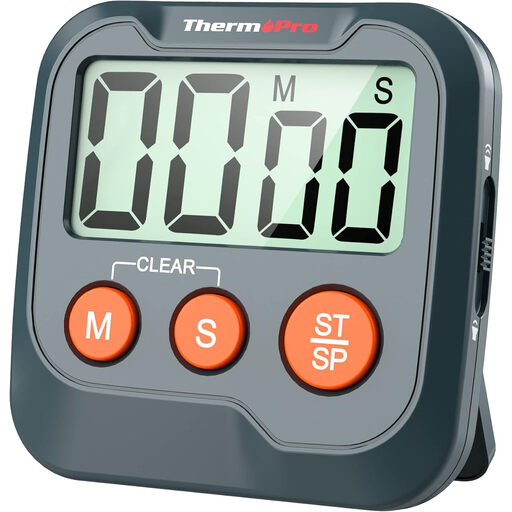
This timer is designed for a dough rest of up to 99 minutes and 59 seconds, with adjustable volume and several positioning options.
 No image available
Suitable for a dough rest of up to 99 minutes and 59 seconds if you want to be able to adjust the volume.
Counts down from up to 99 minutes and 59 seconds, with a stopwatch function and adjustable volume.
No, you shouldn’t rely on the time alone. Use the alarm as a prompt to check the dough: according to King Arthur Baking, factors including the temperature of the water and air, humidity, and the size and shape of the dough affect how quickly it proves. Follow the instructions for your recipe and the specific proving stage.
Check the battery type required by your chosen model and place or attach the timer somewhere you’ll notice it. According to TFA Dostmann, the 38.2056.04 uses two AAA batteries, which aren’t included; according to the manufacturer, a battery is included with the GastroMax timer mentioned here. Check that you’ll be able to hear or see the alarm where you’ve placed it.
Online product purchases are generally covered by a statutory cooling-off period; ACM ConsuWijzer states that it ends 14 days after delivery. Check which exceptions and returns conditions apply to your purchase. You also have a statutory guarantee: if a product breaks sooner than you could reasonably expect under normal use, the seller is your point of contact for a solution.
According to the Dutch Government, used batteries must not go in the bin; you can take them to a collection point. You can take an old electrical appliance to a designated collection point or recycling centre, among other options.