
Baker working with a long prove
You want to time a longer recipe step in one go, but you’ll check the dough when the alarm sounds. King Arthur Baking emphasises that proving time varies depending on the conditions.


Choose a simple digital timer for a single check-in, as long as the time you need is within the model’s range. For a longer countdown or two tasks at once, a timer with a range of several hours or dual channels is a better fit. Use the alarm as a reminder to check the dough, not as proof that it has finished proving: King Arthur Baking points out that factors such as temperature affect proving time.
You want to time a longer recipe step in one go, but you’ll check the dough when the alarm sounds. King Arthur Baking emphasises that proving time varies depending on the conditions.
You’re making bread and other parts of lunch at the same time and want to keep the timings separate. TFA Dostmann says model 38.2025 can track two times at once.
You mainly want a reminder to check the prove, and will set the timer to suit your recipe and the timer’s range.
First, compare the time you need with the timer’s maximum countdown. Then decide whether you need one reminder or two separate timing channels.
| What to consider | What should you check? | Who is this important for? |
|---|---|---|
| Range for a long prove | Compare the exact model’s maximum countdown with the time you plan to check the dough; assess the dough when the alarm sounds. | If I want to time a long recipe step in one go, I’ll choose a timer with a suitable range. Around 36% of consumers say a long prove is their main reason for buying one. |
| Two timings at once | Check whether the model can track two timings at once, and whether the duration and direction for each channel suit your tasks. | If I’m proving dough and making another lunch dish at the same time, I want to keep both check-in times separate. This matters particularly to consumers who want to track two tasks at once: around 29%. |
| An easy-to-hear alarm | Check the type of alert and whether its volume can be adjusted; don’t rely on the word ‘alarm’ alone. | If I don’t want to miss a check-in while doing other kitchen jobs, I’ll pay attention to the model’s alert. Around 21% of consumers say an easy-to-hear alarm is their main requirement. |
| Controls and battery | Check how to set, start and reset the timer, and find out which type of battery it needs and whether one is included. | This is worth considering if you mainly want a timer that’s easy to set and would like to know in advance which battery it needs. Around 14% of consumers say this is their main requirement. |
The time needed to prove can vary depending on the dough and the conditions. King Arthur Baking therefore recommends assessing how the dough is developing rather than relying on the clock alone.
Set a time to check, then assess the dough according to your recipe.
According to its manual, the HEMA timer reviewed counts down for a maximum of 99 minutes and 59 seconds. Brabantia gives the Tasty+ a range of up to 99 minutes.
Compare the exact model’s maximum countdown with your recipe. For one longer countdown, choose a model with a documented range of several hours.
The HEMA timer reviewed and the IKEA KLOCKIS need batteries that are sold separately; TFA Dostmann says the same for model 38.2025. According to Brabantia, the Tasty+ comes with a CR2032.
Before buying, check the battery type and what’s included with the exact variant.
For models that don’t include a battery, you’ll need to get the right one before you can use the timer.
Model 38.2025 is designed for longer countdowns and two timings at once.
The Tasty+ magnetic kitchen timer is a digital timer for a single check-in within its stated range.
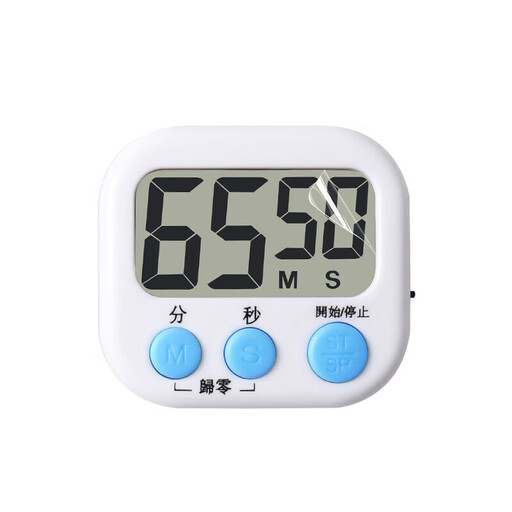
Item 80841225 is a digital magnetic timer with separate minute and second buttons.
KLOCKIS 705.904.53 combines a timer with a clock, alarm and temperature display.
This Joybuy selection focuses on a simple digital timer for a single check-in while your dough is proving.
 No image available
This timer is designed to remind you to check while baking; use the alarm to check the dough, not as proof that it has finished proving.
The product description mentions a countdown function and use for cooking and baking.
No. Use the set time as a reminder to check. King Arthur Baking points out that factors including water and air temperature, humidity and the shape of the dough affect how long it needs to prove. Check how the dough is developing too, following your recipe.
It depends on the model. According to Brabantia, the Tasty+ comes with one CR2032. HEMA item 80841225 needs one AAA/LR03, which is not included, while two AAA batteries for the IKEA KLOCKIS are sold separately. When inserting batteries, follow the polarity markings and the instructions for the exact model.
For a standard online purchase, ACM ConsuWijzer says you generally have a statutory cooling-off period of up to 14 days after delivery, subject to legal exceptions. A product must also work as you could reasonably expect when used normally. If it’s faulty, the seller is responsible for providing an appropriate solution free of charge. There is no fixed statutory guarantee period that applies to every timer.
According to the Dutch government, used batteries should be taken to a collection point. A discarded battery-powered device can be taken to an appropriate collection point or, when you buy a similar new device, returned under the one-for-one take-back scheme.