
Home baker with guests on the way
A timer helps you plan when to check the dough, but you still need to judge it yourself. King Arthur Baking stresses that proving time can vary depending on kitchen conditions and the dough.


For a single short proving stage, a simple countdown timer is enough. For a long prove or several cooking steps happening at once, a timer with an hours-long range or multiple independent timers is more practical. Treat the alarm as a reminder to check the dough, not proof that it is ready: King Arthur Baking points out that kitchen conditions and the dough itself affect proving time. So check the maximum range, number of timers and battery requirements for the exact model.
A timer helps you plan when to check the dough, but you still need to judge it yourself. King Arthur Baking stresses that proving time can vary depending on kitchen conditions and the dough.
If a single proving stage lasts longer than 99 minutes and 59 seconds, a timer with an hours-long range can save you from having to restart the countdown partway through. TFA Dostmann lists longer ranges on models including the 38.2049.
If you want to keep track of bread proving and other cooking tasks at once, look for a timer with separate countdowns. TFA Dostmann describes two simultaneous timers on the 38.2025, while OXO lists three timers on its Triple Timer.
| What to consider | What to check before buying | Who should pay particular attention? |
|---|---|---|
| Checking the dough on time | Check that the model counts down and has an alarm or signal you’ll recognise. | If I’m expecting guests, I want a reminder to check the dough without having to keep watching the clock. Around 40% of consumers prioritise having a planned time to check it. |
| Range for the proving stage | Compare the maximum countdown time of the exact model with the longest stage in your recipe. | For a long, uninterrupted prove, I don’t want to have to reset the timer partway through. Around 23% of consumers prioritise having a long enough time range. |
| Multiple steps at once | Check how many separate timers can run at the same time and how easy it is to tell their signals apart. | If bread-making overlaps with other preparation, I want to be able to track the timings separately. This is the top priority for around 22% of consumers. |
| Controls and batteries | Check how to set the time, which type of battery is needed and whether it is included. | Just before baking, I want to be able to set the timer quickly and use it straight away. Around 15% of consumers focus mainly on the controls and what they need to get started. |
The GastroMax and HEMA models reviewed have a maximum time of 99 minutes and 59 seconds. A longer stage won’t fit into a single uninterrupted countdown.
Compare the maximum range with the longest individual stage in your recipe. For a longer stage, choose a model with an hours-long range.
The actual speed of proving can vary depending on factors such as temperature and the condition of the dough. A timer doesn’t measure how the dough is developing.
Use the alarm as a reminder to check the dough against your recipe.
The timers reviewed differ in the type of battery they use and what’s included. A commercial manufacturer’s warranty is separate from your statutory rights. ACM ConsuWijzer explains that the statutory guarantee applies for as long as a product lasts as long as you could reasonably expect it to.
Check the instructions and product information for the exact version, including the battery type and what’s in the box.
If batteries aren’t included, you’ll need to buy them separately.
Joybuy’s description of the GastroMax 6669-1 mentions a temperature display, but Orthex’s manufacturer page doesn’t specify this feature.
Don’t base your choice on the temperature-measuring feature listed there. Check whether the exact item has it with the manufacturer and retailer.
The range includes timers with a long time range and a model with two timers that can run at the same time.
According to OXO, the Triple Timer is designed to time different tasks separately.
The 6669-1 digital kitchen timer is designed for individual, shorter stages.
The magnetic Tasty+ combines a digital timer with controls operated by turning a ring.
The digital magnetic kitchen timer with article number 80.84.1225 is a button-operated timer for minutes and seconds.
A visual timer for a short proving stage of up to 60 minutes; this model doesn’t have an audible alarm.
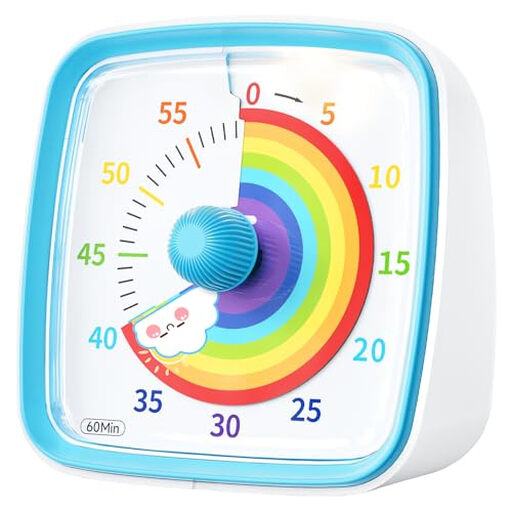 Image unavailable
Suitable if you want to keep track of a short proving stage visually and don’t need an audible reminder.
The countdown runs for up to 60 minutes and shows your progress visually. When the time is up, the night light comes on; the timer doesn’t beep.
Set a reminder for each stage according to your recipe, then check the dough when the alarm goes off. King Arthur Baking notes that recipe timings are guidelines, as kitchen conditions and the dough can vary.
That depends on the exact model. The TFA Dostmann 38.2025 needs two AAA batteries, which aren’t included; the Brabantia Tasty+ version reviewed comes with a CR2032. HEMA item 80.84.1225 requires an AAA/LR03 battery, which isn’t included.
According to ACM ConsuWijzer, for a standard online product purchase, you generally have a statutory cooling-off period of up to 14 days after delivery; check the listed exceptions too. You also have a statutory guarantee for as long as the product lasts as long as you could reasonably expect it to. A manufacturer’s warranty doesn’t determine your statutory guarantee.
That depends on the rules that apply to the exact device. The Netherlands Food and Consumer Product Safety Authority states that CE marking is compulsory for certain electrical products. Don’t assume from a product description alone, or from the absence of a mention, whether a particular timer complies. If in doubt, ask for information about the exact product.
According to the Dutch government, used batteries must not go in the bin; take them to a collection point. Old household appliances can be taken to designated collection points.