
Quick evening cook
You want to weigh rice straight into your own bowl after class, without having to work out the weight of the bowl itself.


Weigh dry rice in a bowl that you’ve first zeroed using the tare function, and choose scales whose display you can read with the bowl on top. For an everyday evening meal, ease of use and a suitable measurement increment are worth considering; limited space or poor lighting may affect your choice of size or display. A display that shows grams does not, by itself, prove that the scales measure accurately to the nearest gram.
You want to weigh rice straight into your own bowl after class, without having to work out the weight of the bowl itself.
You want to adjust the amount of uncooked rice to the number of people eating, rather than cooking by guesswork alone.
You want to clean and put the scales away easily after use, without the display disappearing from view while you weigh.
Start with the tare function and how easy the display is to see with your bowl on the scales. Then consider the measurement increment, cleaning and storage. A reading in grams describes the increments shown on the display; it does not, by itself, tell you how accurate the measurements are. The Consumentenbond assesses accuracy and consistency as separate test criteria.
| What to consider | What to look for | Who might find this more important? |
|---|---|---|
| Quick weighing in your own bowl | Check for a tare function, and make sure you can still reach the display and controls with your bowl on the scales. | If you want to weigh rice in your own bowl after class without doing any calculations, tare is a practical consideration. Around 36% of consumers prioritise quick weighing in their own bowl. |
| Getting the right amount of dry rice | Check whether the weight is displayed in grams and what measurement increment the manufacturer specifies. | If you want to adjust the amount of uncooked rice to the number of people eating, a clear weight reading can help with portioning. Around 29% of consumers prioritise portion planning. |
| Cleaning and storage | Compare the surface, dimensions and care instructions for the exact model. | If you have limited worktop space, you’ll want to be able to clean and put the scales away easily after use. Around 21% of consumers prioritise cleaning and storage. |
| Readability and batteries | Check the display’s backlight and position, the battery type, and whether batteries are included. | If you work in low light or want to know in advance which batteries you’ll need, check these details for the model you’ve chosen. Around 14% of consumers prioritise readability and power supply. |
The measurement increment shown on the display and the actual deviation or consistency are different properties.
Use the specified measurement increment to understand how the display works. Assess measurement performance separately; the Consumentenbond describes tests using standard weights.
A bowl may cover the display or controls even if it fits on the platform.
Check the position of the display and buttons against the bowl you plan to use.
The type of battery supplied varies between models. An extended warranty is most relevant when it’s clear what it adds to your statutory rights.
Check the battery type and what’s included in the packaging. If you’re considering an extended warranty, read the terms and check what additional cover it provides.
The WS305B is a slim digital scale designed for use with your own bowl.
The Tasty+ Dark Grey is a digital scale with a backlit display and a hanging option.
The slim KS 19 and the KS 25, which comes with a removable bowl, suit different preferences for using your own bowl or one supplied with the scales.
The digital kitchen scale with item number 80880037 is designed for use with your own bowl.
This selection includes digital scales, including coffee scales and models with a bowl. Check that the features and controls of each model suit your needs for weighing rice.
 Image unavailable
The product name is aimed at espresso and pour-over coffee; check whether the controls suit the way you plan to use the scales for rice.
The product information lists a timer function and switchable units, including grams and kilograms.
 Image unavailable
The product information lists a tare function, which is useful if you want to zero the scales with a bowl on top.
The description specifies 1 g increments, an LED display and a glass surface. The measurement increment does not prove the scales’ actual accuracy.
Specified dimensions: 15 × 13 × 3 cm.
 Image unavailable
The product name describes digital kitchen scales; check which features you need for weighing rice.
The title specifies a capacity of 10 kg, 1 g increments and support for several units. The description mentions app connectivity for nutritional and calorie information.
Specified dimensions: 200 × 140 × 19,5 mm. The measurement increment does not, by itself, indicate accuracy.
 Image unavailable
The product name describes digital coffee scales; check whether the specified capacity and features suit your needs.
The title specifies a capacity of 2000 g and a precision of 0.1 g. The description mentions a tare function, an LED display and USB-C charging.
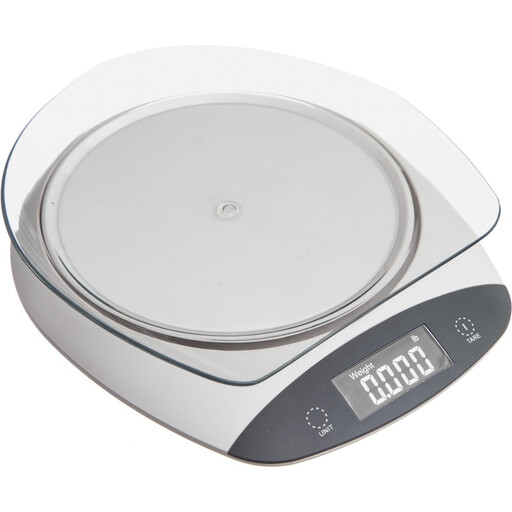 Image unavailable
The removable bowl may suit you if you prefer to use a dedicated weighing bowl; bear in mind that you’ll need space to store it.
The product information specifies a tare function and a maximum capacity of 5000 g. The scales require 2 AAA batteries, which are not included.
Weigh rice before cooking if you want to measure out an amount of uncooked rice for a recipe. The Voedingscentrum gives the example that around 75 g of uncooked rice makes around 200 g of cooked rice; the final amount depends on how it is prepared.
Place the empty bowl on the scales, use the tare function to zero the display, then add the dry rice. Before buying, check that you can see the figures and use the tare control with your bowl in place.
Don’t assume they can: follow the care instructions for the exact model. For the WS305, Inventum recommends using a slightly damp cloth and says not to immerse the scales.
The Voedingscentrum advises cooling leftovers quickly, storing them in a sealed container and not leaving them out of the fridge for longer than 2 hours. For cooked rice, the Voedingscentrum recommends keeping it for 2 days in the fridge or 3 months in the freezer; this storage advice is not a feature of the scales.
If the product is faulty, you can ask the seller to provide a product that works as it should; a manufacturer’s guarantee does not replace this right. According to the Dutch government, for an eligible online purchase from a business, you generally have a 14-day cooling-off period, subject to the stated exceptions.