
Workshop leaders dividing portions
If you weigh couscous before cooking, be sure not to confuse its dry weight with its weight after cooking. The Netherlands Nutrition Centre says couscous weighs about three times as much after cooking.


Choose a scale where the bowl and the largest quantity of couscous together stay within the stated maximum capacity. For weighing several portions, tare, an easy-to-read display and a suitable cleaning method are useful; a bowl scale can be handy if you always use the same bowl. A reading in 1 g increments is a product specification, not proof that the maximum measurement error is 1 g.
If you weigh couscous before cooking, be sure not to confuse its dry weight with its weight after cooking. The Netherlands Nutrition Centre says couscous weighs about three times as much after cooking.
When weighing ingredients in different bowls one after another, tare and a display you can read from your workstation are practical considerations. How easy a scale is to use depends on its controls and how your bowl sits on it.
If equipment is shared, you may want to choose between a wipe-clean platform and a scale with a removable bowl. Check the cleaning instructions for each model and component.
Best for: participants using their own bowls or weighing different ingredients in turn. Place the bowl on the scale and use the tare function.
Consider: you’ll need to clean the separate bowl and check that it doesn’t block your view of the display.
Best for: anyone who weighs ingredients in the same bowl each time and wants to clean it separately afterwards. Beurer states that the KS 25 has a removable, dishwasher-safe 1.2-litre bowl.
Consider: the Beurer KS 25 has a stated maximum capacity of 3 kg, so check that the bowl and ingredients together stay within that limit. Beurer says the bowl is dishwasher-safe, not the entire scale.
| What to consider | What to look for | Who is this important for? |
|---|---|---|
| Dry portions | Choose a display in grams and compare like with like: uncooked weight with uncooked weight. A 1 g graduation stated for some models does not, in itself, prove measurement accuracy. | If I want to divide dry couscous between participants, I need to be able to follow the recipe weight accurately. Around 28% of consumers prioritise portion control. |
| Bowl and quantity | Compare the maximum capacity with the weight of your bowl plus the largest quantity you want to weigh at once. If necessary, weigh a larger quantity in several batches. | When cooking for a group, I want to weigh enough couscous in one go without forgetting to account for the bowl. Around 22% of consumers prioritise having enough capacity. |
| Tare | Check that the zero or tare control is easy to reach with the bowl you usually use. Tare does not change the maximum weight the scale can support. | If I’m weighing different ingredients or bowls one after another, I want to be able to start each measurement from zero. Around 22% of consumers prioritise this. |
| Cleaning | Check the cleaning instructions for the bowl and electronic base separately. A dishwasher-safe bowl does not automatically mean the whole scale is dishwasher-safe. | When kitchen equipment is shared, I want to know how to clean the bowl and weighing surface after use. Around 17% of consumers make ease of cleaning their top priority. |
| Display visibility | Check the viewing angle and size of the digits from where you’ll be adding ingredients, with your usual bowl on the platform too. | If I want to keep an eye on the reading while adding ingredients, the position of the display matters. Around 11% of consumers prioritise ease of reading. |
A stated increment does not, by itself, tell you how accurately or consistently a scale measures. The Dutch Consumers’ Association assesses deviation and consistency separately.
If measurement reliability is essential, compare independent test results; don’t infer an exact measurement error from the scale graduation alone.
The bowl and ingredients both count towards the load on the scale. The stated maximum capacities for the HEMA, Brabantia and Beurer models mentioned are 3 kg or 5 kg.
Allow for the heaviest full weighing, and divide a larger quantity into several batches if necessary.
Beurer states this for the removable bowl of the KS 25. IKEA says to clean the glass surface of the GENOMSNITT with a damp cloth.
Follow the cleaning instructions for the bowl and electronic base separately.
HEMA’s digital kitchen scale is a flat model designed to be used with your own bowl. The product information states a maximum capacity of 5 kg, a display in grams and a tare function.
The Tasty+ Dark Grey is a flat digital scale with a glass surface. Brabantia states a maximum capacity of 5 kg, 1 g increments, a backlit display and a hanging loop.
The Beurer KS 25 has a removable 1.2-litre bowl and a backlit display. It differs from the flat KS 19; features of one model do not automatically apply to the other.
According to IKEA, the digital GENOMSNITT has a maximum capacity of 3 kg, large digits and a toughened glass top.
These Joybuy products are designed for weighing ingredients in the kitchen. Check whether each model’s controls and type of scale suit the way you’ll use it during your workshop.
 No image available
A flat model for weighing ingredients with your own bowl; the product name mentions a tare function.
The product name states a maximum capacity of 5 kg, 1 g increments and readings in grams, ounces, pounds and millilitres. The description limits its use to domestic settings and excludes commercial or industrial use.
According to the description, the surface is not dishwasher-safe and should be cleaned with a soft, damp cloth.
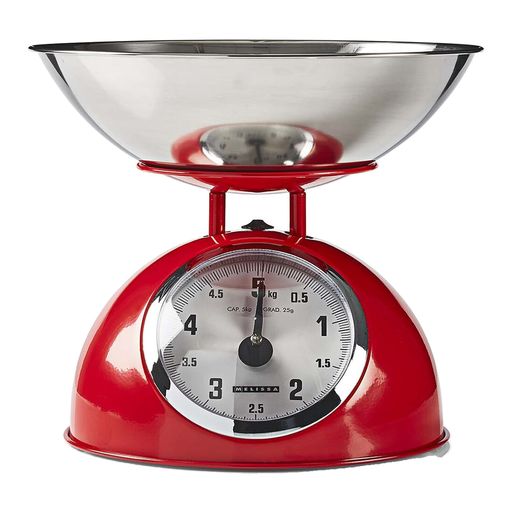 No image available
An option with a removable bowl if an analogue dial suits the way you work; this is not a digital scale.
The product name mentions a metal housing, a removable bowl and 25 g increments, with a maximum capacity of 5 kg. The description specifies domestic use and excludes commercial weighing.
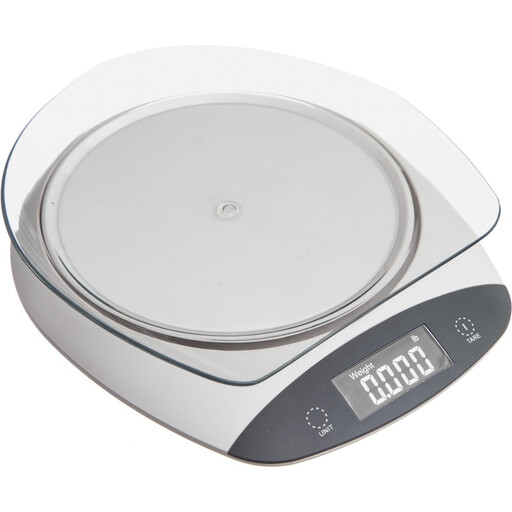 No image available
The removable bowl could be useful if you want to weigh ingredients in the same bowl each time.
The product name gives the dimensions as 20,5 × 18 × 4,5 cm. According to the product information, it requires 2 AAA batteries, which are not included.
 No image available
As well as weighing, the product name mentions nutritional information and app synchronisation. Consider these features only if you need them for your cookery workshop.
The product name mentions a nutrition database and app synchronisation. According to the product information, it requires 4 AAA batteries, which are not included.
Follow the weight specified in your recipe. If you’re adding uncooked couscous, weigh it dry; according to the Netherlands Nutrition Centre, couscous weighs about three times as much after cooking. The example of 35 g uncooked compared with around 100 g cooked is not a fixed portion for every participant.
Place the bowl on the scale and reset the display to zero before adding the couscous. Remember to include the weight of the bowl in the appliance’s maximum capacity. The product information for the HEMA, Brabantia and Beurer models mentioned lists a zero or tare function.
It depends on the model and component. Beurer says the removable bowl of the KS 25 is dishwasher-safe; IKEA recommends cleaning the GENOMSNITT surface with a damp cloth. Follow the cleaning instructions for both the bowl and electronic base.
For online consumer purchases, the Dutch Authority for Consumers and Markets’ ConsuWijzer says you generally have a statutory cooling-off period of up to 14 days after delivery, with some exceptions. Your statutory guarantee is separate from any manufacturer’s guarantee. If a product used normally does not meet what you could reasonably expect, contact the seller. Consumer rights do not automatically apply in the same way to business purchases.
Weighing recipe ingredients is different from weighing goods to set a price by weight. The Dutch Authority for Digital Infrastructure outlines rules for, among other things, scales used in commercial transactions and price setting. If you also use the scale to sell goods by weight, check that use separately against the applicable measurement regulations.