
Home cooks with their own rice bowl
If you want to weigh small amounts of uncooked rice directly into your own bowl, the tare function lets you exclude the bowl’s weight from the reading.


For small portions of rice, a flat digital scale with a tare function is handy if you already have a bowl, while a model with a bowl is a better fit if you’d prefer one included. Weigh the rice uncooked: the Netherlands Nutrition Centre says rice weighs about 2.5 times as much after cooking. A display that measures in 1 g increments does not, on its own, prove how accurately or consistently a scale weighs; the Consumers’ Association assesses these qualities separately.
If you want to weigh small amounts of uncooked rice directly into your own bowl, the tare function lets you exclude the bowl’s weight from the reading.
If you want to adjust the amount of uncooked rice you make for dinner, clear gram markings and a scale that’s easy to read are important considerations.
The position of the display, the space on the weighing platform and whether a flat model can be stored away or hung up can all influence your choice.
A good fit if: you already have a bowl and want to zero its weight using the tare function before adding rice.
Keep in mind: you’ll need to use and clean your own bowl; check that the display and controls remain visible.
A good fit if: you’d rather use a matching bowl; the Beurer KS 25 has a removable 1.2-litre bowl, a tare function and a backlit display.
Keep in mind: the bowl takes up storage space, and the KS 25 has a maximum capacity of 3 kg.
The Netherlands Nutrition Centre gives examples of 20 g, 40 g and 75 g of uncooked rice. With a flat model, check that your bowl fits on the weighing platform without covering the buttons or display.
| What matters when buying | What to look for | Which consumers it suits |
|---|---|---|
| Your own bowl and the tare function | Check that the scale has a tare function and that you can still see the display and controls with your bowl on the platform. | If I use my own bowl, I want to be able to zero its weight first. Around 36% of consumers prioritise weighing food in their own bowl using the tare function. |
| Reading small portions | Check that the display is easy to read and note the increments shown; these do not prove the scale’s actual measurement accuracy. | When weighing a small portion of rice, I want to read the gram display clearly. Around 29% of consumers prioritise being able to read small portions. |
| Space and controls | Compare the size of the weighing platform and the position of the display and buttons, as well as any hanging options, with the space in your kitchen. | If I have limited worktop or storage space, I want to be able to position and store a scale without the display or controls getting in the way. Around 21% of consumers prioritise practical space-saving design and ease of use. |
| Batteries and aftercare | Check the battery type, whether a battery is included and who the seller is. | I want to know in advance which type of battery I need and who to contact if there’s a problem with the product. Around 14% of consumers prioritise battery maintenance and aftercare. |
A display that measures in 1 g increments doesn’t tell you whether the scale will weigh a small portion accurately and consistently every time. The Consumers’ Association assesses accuracy and consistency separately using standard weights.
Compare independent test results if weighing performance is your priority; treat the increments as information about the display only.
A flat model with a tare function can weigh rice in your own bowl, while the Beurer KS 25 comes with a removable bowl.
Choose a model with an included bowl if it makes cooking easier for you. Otherwise, check that your own bowl fits comfortably on a flat model.
A battery-powered scale may need new batteries later on. The Consumers’ Association also notes that scales can differ in how they operate and switch off.
Check which type of battery you need, how to access the battery compartment, and whether the controls and auto-off time suit the way you weigh ingredients.
The HEMA item reviewed, 80880037, is a flat digital model with a tare function, an LCD display and a stated capacity of up to 5 kg.
The KS 19 Fresh is a flat model; the KS 25 comes with a removable bowl and a backlit display.
Brabantia describes the Tasty+ Dark Grey as a flat model with a backlit display and a hanging loop.
Tefal describes the Optiss BC50U0 as a flat model with a tare function, a backlit display and a pull-out hook.
This Joybuy selection includes digital kitchen and coffee scales for different weighing needs, including one model with an included removable bowl. Compare each product’s tare function, increments and any usage limitations with what you need.
 No image available
A good fit if you’re looking for a flat model with a tare function and an easy-to-read LED display to use with your own bowl.
The product description lists a capacity of up to 3 kg, 0.1 g increments and dimensions of 14,8 × 12,8 × 2 cm. The increments do not guarantee actual measurement accuracy.
 No image available
A good fit if you value the timer and heat-resistant weighing platform as well as the weighing function; these features aren’t essential for weighing rice.
The product description lists a tare function, 0.1 g resolution, an LCD screen and a capacity of 3 kg. The stated resolution doesn’t prove how accurately the model weighs.
 No image available
A good fit if you’re looking for a flat kitchen scale with a tare function and an LCD screen with large numbers.
The product description lists a maximum capacity of 5 kg and a measuring range starting at 1 g. Batteries are not included.
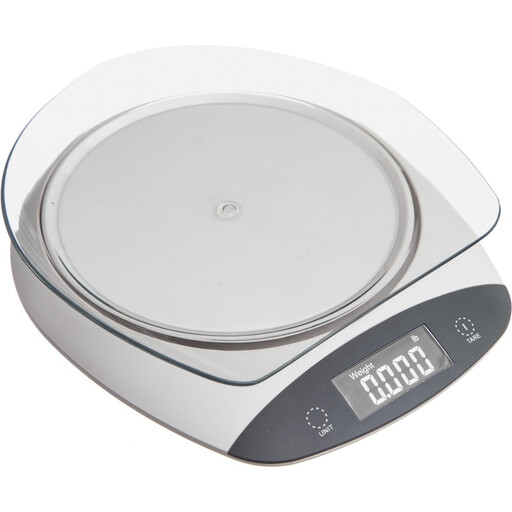 No image available
A good fit if you’d rather use an included removable bowl than your own.
The product description lists a tare function, a capacity of 5.000 g and an LCD screen with large numbers. The bowl takes up storage space, and the two AAA batteries required are not included.
 No image available
A good fit if you’re looking for a model with grams as a selectable unit and a stated minimum weighing amount of 3 g.
The product description lists a capacity of 10 kg and 1 g increments. Use the scale on a flat, stable surface and do not immerse it in water.
Weigh the rice uncooked if you want to measure the amount before cooking. The Netherlands Nutrition Centre gives the example that about 75 g of uncooked rice makes around 200 g of cooked rice; the right portion depends on your meal and needs.
Place the empty bowl on the scale, use the tare function to reset the display to zero, then add the uncooked rice. Before you start, check that you can still see the display and reach the button with the bowl in place.
No. The increments describe the display, not the actual measurement accuracy. The Consumers’ Association assesses accuracy and consistency separately using standard weights.
Milieu Centraal advises taking used batteries to a collection point in a shop or supermarket. If there’s a product problem covered by Dutch statutory warranty, the Government of the Netherlands says you should contact the seller; there is no fixed statutory warranty period for products in the Netherlands.