
Jam maker using one mixing bowl
You want to weigh the fruit and subsequent ingredients in your own bowl, one after another. A tare function and a clearly visible display can make weighing easier.


Choose a scale with a tare function if you want to weigh fruit and add the next ingredients to the same bowl one after another. Check that the bowl and its contents stay within the maximum capacity. For small recipes, a clear display and consistent readings are just as important as the scale’s increments; a finer display increment alone does not prove that a scale is accurate. A supplied bowl or a model that doesn’t need replaceable batteries is particularly handy if that convenience matters to you.
You want to weigh the fruit and subsequent ingredients in your own bowl, one after another. A tare function and a clearly visible display can make weighing easier.
You’re making a small amount of jam and want to follow the fruit weight in your recipe. Look beyond the display increment and consider how consistent the readings are.
You only use the scale now and then and want to put it away easily afterwards. A battery-free model may be worth considering if you’d rather not use replaceable batteries.
Start with the bowl and the quantities you usually weigh. Then consider how easy the display is to read, how consistent the readings are and how the scale is powered.
| What to consider | What should you check? | Who should give this more weight? |
|---|---|---|
| Weighing in one bowl | Check for a tare function, the position of the display and the maximum load, including the bowl. | I want to weigh the fruit and subsequent ingredients in the same bowl without having to keep recalculating; around 36% of consumers say weighing in one bowl is their top priority. |
| Repeating recipe weights | Check the display increment and look for information about accuracy and consistency. | I want to measure the right amount of fruit for a small recipe and don’t want to rely on the display alone; around 29% of consumers give consistent recipe portions top priority. |
| Cleaning up after weighing fruit | Check the platform material, whether the bowl is removable and how to clean the exact model. | I want to keep cleaning to a minimum after weighing; around 21% of consumers prioritise easy cleaning. |
| Storage and power | Check the dimensions, whether it can be hung up and how the model you’re considering is powered. | I only use the scale occasionally and want to store it compactly or avoid replacing batteries; around 14% of consumers say storage or power is their top priority. |
A display showing increments of 0.5 or 1 g doesn’t tell you how far a reading might be off or how consistent the results are. The Consumers’ Association assesses deviation and consistency separately.
Compare independent test information where available. You can also check whether weighing the same known weight repeatedly gives the same result.
The bowl counts towards the total load and can obscure the display on a flat model. With a scale that comes with a bowl, its volume determines how much prepared fruit will fit.
Consider your own bowl or the supplied bowl alongside the quantity of ingredients you want to weigh.
Brabantia describes the Tasty+ Kitchen Scales plus as a hand-cranked model and the Tasty+ Digital Kitchen Scale as a battery-powered model. Brabantia states that the dynamo version has a minimum weighing capacity of 5 g.
Check the full product name, power source and stated minimum weighing range before choosing a model.
The Optiss BC50U0V0 is a flat option for anyone using their own bowl and weighing ingredients one after another.
The KS 19 Vintage is a flat model for use with your own bowl, while the KS 54 comes with a bowl.
The Tasty+ Kitchen Scales plus is powered by a hand-cranked dynamo, while the Tasty+ Digital Kitchen Scale runs on batteries.
The digital kitchen scale with article number 80880037 is a straightforward model to compare with options that have other documented features.
These Joybuy options are intended for weighing fruit and other ingredients. Check that the controls, capacity and bowl suit your recipe for each model.
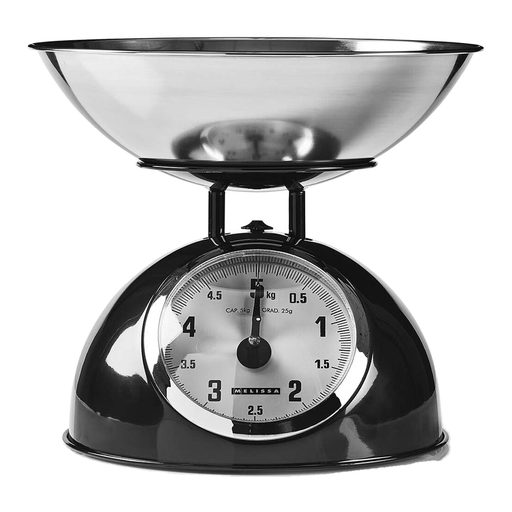 No image available
This is an analogue model; choose it only if digital controls aren’t a must-have for you.
The product name lists a metal housing, a removable bowl, a maximum load of 5 kg and increments of 25 g.
 No image available
The dual LED display is worth considering if you want to be able to read the weight clearly while weighing.
The product name lists a timer. Check the full product information for the capacity and included power supply before use.
 No image available
This could suit you if you want to weigh small amounts of additions as well as fruit; the stated increment alone doesn’t prove the scale is accurate.
The product name lists a tare function, a timer, a heat-resistant platform and a capacity of up to 3 kg.
 No image available
The stated dimensions can help you work out whether the scale will fit on your worktop and be easy to put away after use.
The product name lists dimensions of 17 × 13 × 2 cm. According to the product information, batteries are required and not included.
 No image available
The product name mentions Bluetooth and app integration; check whether these features suit the way you want to use the scale.
The product name lists a capacity of 10 kg, support for multiple units and a tempered glass surface. The stated 1 g increment doesn’t prove the scale is accurate.
Not necessarily: the Netherlands Nutrition Centre, for example, gives a recipe using 250 grams of red fruit. Also compare the consistency of readings and how easy the display is to read with your bowl in place; the Consumers’ Association assesses accuracy and consistency as separate test points.
Place a suitable bowl on the scale, use the tare function and add the prepared fruit without exceeding the maximum load, including the bowl. Clean the scale according to the instructions for your chosen model. The Netherlands Nutrition Centre also recommends thoroughly cleaning pans, jars, lids and other jam-making equipment; accurate weighing doesn’t replace good hygiene.
In the Netherlands, you may have statutory rights in addition to any manufacturer’s warranty. ACM ConsuWijzer says that, under the applicable conditions, the seller must put a faulty product right free of charge; there isn’t one fixed warranty period that automatically applies to every purchase.
According to the Dutch government, flat batteries must not go in the rubbish bin. When buying a new, similar appliance, you can use the retailer’s like-for-like take-back scheme to dispose of an old household appliance.