
Vandaag of morgen in huis

Kwaliteit gegarandeerd

Welkomstaanbiedingen ontgrendelen: GRATIS bezorging | Tot 80% korting | Gratis 30 dagen JoyPlus-proefperiode
Download de app
A digital kitchen scale can make the difference between a successful recipe and a batter that doesn't turn out right. The same goes for portions when meal prepping, making coffee, and tracking nutritional values. Yet many models look very similar. A low price or a long list of features doesn't automatically mean a scale will suit your kitchen routine.
The most important question, therefore, isn't which kitchen scale looks the most modern, but which specifications you'll actually use.
A 5 kg kitchen scale is suitable for most ingredients and bowls. A model with a 10 kg capacity can be handy when you're weighing large quantities of dough, soup, or pet food. However, the maximum capacity says nothing about the smallest measurement increment.
For baking recipes, a division of 1 gram is usually practical. For coffee or very small quantities, 0.1 gram may be more relevant. Also check the minimum weight: some models only start registering from a few grams.
A digital nutrition scale with a food database can show an estimate of calories, protein, carbohydrates, and fats. The result depends on the selected food item, brand, preparation method, and the quantity entered. According to the product description from Unique, the smart model contains a database with over 1.3 million entries and more than 80 food categories. This makes the feature useful for tracking, but the displayed values should not be taken as a medical assessment or guaranteed analysis.
If you're counting calories with a scale, it's a good idea to check the database entry and, for packaged products, compare it with the nutritional information table on the packaging.
Glass and stainless steel are easy to wipe clean, but neither material makes a kitchen scale waterproof. Liquid around the buttons, battery compartment, or sensors can cause malfunctions. Use a soft, slightly damp cloth and do not submerge the appliance. Always place the scale on a flat, stable, and dry surface.
For daily use, a capacity of 5 kg is often sufficient. Alongside the maximum, pay attention to the measurement increment:
A food scale with a 5 kg capacity and 1 gram division is a versatile choice for households. For large bowls or bulk meal prep, 10 kg may be more practical.
A kitchen scale with a tare function resets the display to zero after placing a bowl on it. This allows you to weigh multiple ingredients one after another in the same bowl. It saves on washing up and avoids having to do mental arithmetic.
Also check the available units. Grams and millilitres are handy for British recipes, while ounces and pounds can be useful for international cookbooks. Note that millilitres on some models are based on water or milk. The density of oil, syrup, or flour differs from this.
An easy-to-read LCD or VA display helps when a large bowl partially blocks your view. An automatic shut-off limits battery consumption. Check whether batteries are included and what type is needed, for example AAA or CR2032.
Bluetooth is only useful if you also want to use the accompanying app. According to the product description of the Unique Bluetooth Kitchen Scale, the model supports Bluetooth and pairing with an app. Check in advance whether your phone and the app are compatible and which data you want to sync.

Why this fits the profile: A compact model for everyday portions, simple recipes, and small kitchens. The 5 kg capacity suits most household use.
The tare function means you don't have to subtract the weight of a bowl yourself. The LCD display and automatic shut-off keep operation simple.
Stainless steel surface, 5 kg capacity, tare function, and compact size of 17 x 13 x 2 cm.
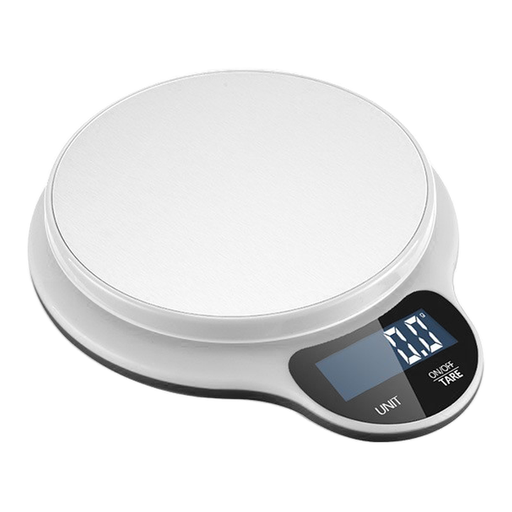
Why this fits the profile: For home bakers and meal prep users who want a finer measurement increment without switching to a coffee scale.
The 0.5 gram specification makes it clear that capacity and measurement increment should be assessed separately. Overload, low battery, and automatic shut-off are indicated.
0.5 gram measurement increment, 5 kg capacity, stainless steel platform, tare function, and two AAA batteries included.

Why this fits the profile: Aimed at coffee lovers who work with small quantities, timing, and water flow during espresso or pour-over.
The 0.1 gram measurement increment suits coffee use. The built-in timer and flow rate function focus on the brewing process, not just the total weight.
2,000 gram capacity, 0.1 gram precision, USB-C rechargeable battery, and automatic timer.

Why this fits the profile: For those who want to weigh ingredients and view nutritional data on one screen. The app and database features are especially relevant for established meal prep routines.
The product description separately lists the weighing precision of 1 gram, the 5 kg capacity, and Bluetooth 5.4. This means the features can be assessed concretely, rather than just being presented as 'smart'.
4.54-inch VA colour screen, tare function, Bluetooth 5.4, and local tracking of daily goals according to the product description.
We've put together a full, up-to-date list of products that fully meet these strict selection criteria and comply with current European safety regulations.
First, place the empty bowl on the scale and press the tare or zero button. Wait until the display shows zero. Then add the ingredient. For multiple ingredients, repeat this step after each addition. Place the scale on a stable surface and do not touch the bowl while weighing.
The lifespan depends on use, battery management, and maintenance. Avoid overloading, moisture, and hard knocks. Clean with a soft cloth and remove the batteries when you're not using the appliance for an extended period. An automatic shut-off can limit battery consumption, but the required battery life varies by model.
The ongoing running costs are usually limited to batteries or charging a built-in battery. Check at the time of purchase whether batteries are included. A model with Bluetooth may also use an app; check in advance whether that app is available without a paid subscription if that's important to you.
