
Weighing portions during the workshop
You want to weigh dry rice, couscous or other grains for each participant, excluding the bowl’s weight using the tare function. The difference between uncooked and cooked weight matters here.


Weigh dry grains in grams and use the tare function to exclude the bowl’s weight from the measurement. Then choose a scale based on the bowl you use, how easy the display is to read and how you want to clean the components. Check that the bowl and its contents together stay within the stated capacity. A 1 g increment alone does not prove measured accuracy, as the Consumers’ Association distinguishes when assessing kitchen scales.
You want to weigh dry rice, couscous or other grains for each participant, excluding the bowl’s weight using the tare function. The difference between uncooked and cooked weight matters here.
You weigh ingredients several times using bowls and want participants to be able to read the display, while keeping the used components practical to clean.
You weigh a shared quantity in a roomy bowl and want to consider both how easy the display is to read and the scale’s total capacity.
A good choice if: you weigh portions in your own bowl and want to store the scale away neatly.
Trade-off: a large bowl may cover the built-in display. Beurer does not list display illumination for the KS 19 Fresh.
A good choice if: a bowl you can clean separately is useful when weighing several portions in a row.
Trade-off: the bowl has a stated capacity and counts towards the maximum load. According to Beurer, the KS 25 has a capacity of 1.2 litres and a maximum load of 3 kg.
A good choice if: a large bowl might block the built-in display; the OXO scale has a pull-out display.
Trade-off: a pull-out screen is an additional component. An illuminated display, such as the one on the Brabantia Tasty+, does not change the screen’s position.
| What to consider | What to look for | Who it matters more to |
|---|---|---|
| Portions and repeatable gram measurements | Check the gram setting, tare function and maximum load. Don’t treat a 1 g increment as proof of measured accuracy. | I want to weigh dry grains for each participant without including the bowl’s weight. Around 36% of consumers say portions and repeatable gram measurements are their top buying priority. |
| Repeated use and cleaning | Check whether the bowl itself is dishwasher-safe and follow the appliance’s own cleaning instructions. | When several participants are weighing ingredients in turn, I want to keep the bowls and weighing surface practical to clean. Around 29% of consumers prioritise repeated use and cleaning. |
| Display visibility next to a large bowl | Compare the screen’s position and illumination with the bowl you use; also factor in the load, including the bowl. | If my bowl might cover the display, I want to be able to keep reading the weight. Around 21% of consumers put display visibility first. |
| Compact storage and power | Check the dimensions, battery type and whether batteries are included. | With limited storage space, I want to choose a model that fits and know in advance what power source it needs. Around 14% of consumers make compact storage and power their top priority. |
The Netherlands Nutrition Centre distinguishes between uncooked and cooked rice, as its weight changes during cooking. So before weighing, check which weight your recipe refers to.
The displayed increment alone doesn’t tell you how accurately or consistently a scale measures. The Consumers’ Association assesses deviation and measurement consistency separately.
Read 1 g as the stated display increment. If measured accuracy is essential, look for separate test results.
Beurer states that the KS 25 has a maximum load of 3 kg; the bowl sits on the scale too.
Check that the bowl and the largest quantity you plan to weigh together stay within the stated capacity.
Beurer lists the removable bowl of the KS 25 as dishwasher-safe, not the electronic scale.
Clean the bowl and appliance according to their separate product instructions.
The KS 19 Fresh is a flat model with a glass surface and tare function, while the KS 25 comes with a removable bowl.
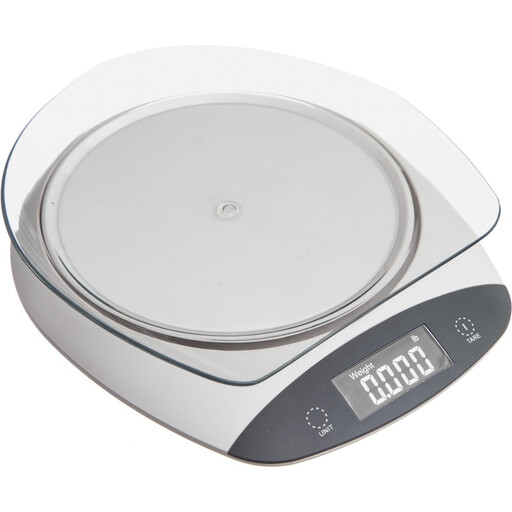
The digital kitchen scale is a straightforward model with a tare function for weighing ingredients in a separate bowl.
The Tasty+ has a flat glass platform, an illuminated display, non-slip feet and a hanging loop.
The scale with a pull-out display is a useful option if a large bowl might block the reading.
Joybuy scales for weighing with a bowl, reading the weight and measuring out portions.
 No image available
The product information mentions a tare function, so you can exclude the bowl’s weight from the measurement.
The title mentions a dual LED display, a four-point sensor and a timer.
 No image available
The product title mentions a tare function, so you can weigh ingredients in a bowl without including the bowl’s weight.
The title lists 0.1 g, a capacity of up to 3 kg, a timer, a heat-resistant platform and a rechargeable design.
 No image available
The product information mentions a tare function for weighing ingredients in your own bowl.
The title lists dimensions of 17 × 13 × 2 cm. According to the product information, batteries are not included.
 No image available
A removable bowl can be useful when you’re weighing several portions in a row.
The title lists dimensions of 20.5 × 18 × 4.5 cm. The product information mentions a tare function and says that 2 AAA batteries are required; these are not included.
 No image available
The product information lists several weight units and a tempered glass surface that can be cleaned with a damp cloth.
The title mentions Bluetooth and a capacity of 10 kg.
Weigh according to the quantity your recipe refers to: uncooked or cooked. For example, the Netherlands Nutrition Centre gives 40 g of uncooked rice as roughly 100 g cooked, and 35 g of uncooked couscous as roughly 100 g cooked. These are approximate, product-specific figures, not a fixed conversion for all grains.
Place the scale on a stable surface, put the bowl on it and use the tare function before adding the grains. Beurer says that the bowl of the KS 25 is dishwasher-safe; this does not automatically apply to the electronic scale. In a shared work space, keep the used components and surface clean.
According to ACM Consumer Information, if a product is faulty during normal use, the retailer must offer an appropriate solution, which could include a repair or replacement. Online consumer purchases generally also come with a 14-day cooling-off period after delivery, subject to legal exceptions.
That depends, among other things, on who is organising the workshop and how the materials are used. The Netherlands Food and Consumer Product Safety Authority describes food safety plans based on HACCP for businesses that handle food; the workshop setting alone does not mean that this business context applies. Rules on food contact materials apply to bowls and other items intended for direct contact with food. Weighing ingredients in a separate bowl does not automatically mean that every weighing platform must meet a separate food-contact requirement.