
Vandaag of morgen in huis

Kwaliteit gegarandeerd

Welkomstaanbiedingen ontgrendelen: GRATIS bezorging | Tot 80% korting | Gratis 30 dagen JoyPlus-proefperiode
Download de app
A digital kitchen scale may seem like a simple appliance, but differences between models can make a noticeable difference in practice. A home baker has different requirements from someone who mainly weighs out meal-prep portions. Claims such as “high precision” also mean little if the maximum capacity, increments or tare function are not clearly stated.
With this buying guide, you’ll see what to look for in a digital kitchen scale, which features suit your needs and which models are a good match for different types of user.
Online shops often list different types of digital scales alongside one another. A bathroom scale is designed for weights of up to, for example, 150 or 180 kg. A digital food scale, on the other hand, is designed for ingredients, coffee, portions or pet food.
So always check:
A bathroom scale is not suitable for weighing flour, yeast or small portions. Conversely, a kitchen scale with a 5 kg capacity cannot be used to weigh people.
A 5 kg kitchen scale is suitable for most everyday cooking and baking. Think dough, vegetables, fruit, rice and ingredients in a mixing bowl. However, maximum capacity is not the only important figure.
For small quantities, the increments matter. A kitchen scale with 0.5 g precision shows smaller differences than a model with 1-gram increments. This can be useful for coffee, herbs, baking powder or portions where you want to use the same amount every time.
Do pay attention to the difference between “accuracy” and “increments”. A product description may state that the scale measures in 0.5-gram increments, but that does not automatically mean that every measurement will be exactly accurate to within 0.5 grams under all conditions.
Flour, oil and sugar quickly end up on the weighing platform. A smooth platform made from stainless steel or toughened glass is generally easier to wipe clean than a surface with deep edges or lots of buttons.
A stainless-steel kitchen scale can be practical for everyday use, but always check the care instructions. Not every scale is waterproof or dishwasher-safe. With glass models, you should also avoid placing hot pans on them or subjecting them to hard knocks.
For baking and cooking, a range of up to 5 kg is often sufficient. If you weigh large quantities of dough or ingredients, it’s best to check that the bowl and its contents together remain below the maximum capacity.
For portion control and meal prep, 1-gram increments are usually suitable. If you weigh smaller quantities, look for a precision food scale with increments of 0.5 grams or less. There are also models designed for coffee with a lower maximum weight and finer measurement, such as the TIMEMORE Black Mirror Basic 2, which has a stated capacity of 2,000 grams and 0.1-gram increments.
A kitchen scale with a tare function resets the display to zero after you place a bowl or measuring jug on the platform. This allows you to add several ingredients one after another without having to do any calculations in between.
Check that the tare function is operated using a clearly labelled button. This is particularly useful for meal prep when you’re dividing ingredients directly into containers.
A kitchen scale with an LCD display should be easy to read from a normal working position. A large, high-contrast screen means you won’t have to keep looking over the bowl.
Many models switch between grams and ounces. A gram and ounce scale is useful when you use recipes from different countries. Some models also offer kilograms, pounds or millilitres. Bear in mind that millilitres are a calculated unit and may depend on the selected measuring programme or the density of the liquid.
A battery-powered kitchen scale is ready to use without a mains socket. Check whether the batteries are included and which type is required. Two AAA batteries are easy to replace; a CR2032 button cell takes up very little space, but is a different size.
Automatic shut-off saves energy, but can be inconvenient if you work slowly. So also check the stated shut-off time and whether there is a low-battery indicator.

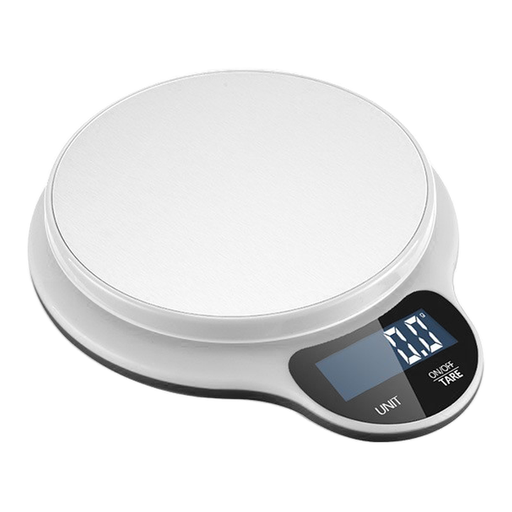
Why it suits this profile: This model offers the essential functions for baking and cooking without complicated setup. Its compact 30 mm thickness makes it easy to store in a kitchen drawer.
The product information clearly states the 5 kg maximum capacity, tare function and 1-gram increments.
Toughened glass surface, LCD display, tare function and a choice of g, kg, lb, oz and ml. Includes a replaceable CR2032 battery.
Why it suits this profile: Home bakers and families who weigh ingredients regularly get a stainless-steel platform, battery power and finer increments for everyday use.
The product description explicitly states a 5 kg capacity, 0.5 g increments, tare function and automatic shut-off. A blue protective film must be removed before use.
Stainless-steel platform, LCD display, gram, ounce and pound readings, two AAA batteries included and an overload warning.

Why it suits this profile: Ideal for coffee lovers and users who want to monitor brewing time and liquid volume as well as weighing ingredients.
The product specifications state a capacity of 2,000 grams, 0.1-gram increments and a physical on/off button. It is not designed for heavy bowls or large portions of dough.
0.1 g increments, timer, flow-rate function, g/oz conversion and rechargeable USB-C battery. Use the model on a flat, stable surface.
A protective film on a new stainless-steel platform can help prevent scratches during transport. According to the product information, the blue film on the Sparoma NS-K44 must be removed before use.
We’ve put together a complete, up-to-date list of products that fully meet these strict selection criteria and the applicable European safety regulations.
That depends on how you use it. For flour, pasta, vegetables and most meal-prep portions, 1-gram increments are often sufficient. For small quantities of herbs, coffee or baking ingredients, 0.5-gram increments may be more practical. Always check whether the product information refers to increments, resolution or accuracy.
Battery life depends on the battery type, automatic shut-off and how often you weigh ingredients. A model with two AAA batteries is easy to power again with replacements. A scale with a CR2032 battery is thinner, but uses a different type of replacement battery. Don’t leave the appliance switched on unnecessarily and follow the manufacturer’s instructions.
First check the surface, zero point and battery. A soft mat, an unstable worktop or a bowl touching the wall can affect the measurement. Always use the same location and wait until the display is stable. If the differences remain large, compare the reading with a known weight and consult the product manual.
