
Vandaag of morgen in huis

Kwaliteit gegarandeerd

Welkomstaanbiedingen ontgrendelen: GRATIS bezorging | Tot 80% korting | Gratis 30 dagen JoyPlus-proefperiode
Download de app
A digital kitchen scale may seem like a simple appliance, but the differences between models can be significant. A home baker will mainly value fine measurement increments, while someone who meal preps may benefit more from a generous capacity and a clear tare function. Coffee lovers often look for a different size and additional timer features.
Marketing copy often highlights terms such as “high precision” or “smart nutritional analysis”. Always check the actual specifications carefully. Below, you’ll find what to consider before buying a kitchen scale.
A 5 kg kitchen scale can be suitable for flour, sugar, vegetables and portions. However, a higher maximum capacity does not automatically mean that the appliance measures smaller quantities more accurately. Also check the display increment, such as 0.5 or 1 gram, as well as the minimum weighing capacity.
A model with 1-gram resolution may be suitable for everyday baking and cooking. For very small quantities, such as herbs or yeast, a separate precision scale may be more practical.
A kitchen scale with a tare function resets the scale to zero after you place a bowl or measuring jug on it. This allows you to add several ingredients one after another without having to weigh each one separately.
Check that the controls are clear and that the scale remains stable when you use a larger bowl. A compact weighing surface can be awkward if the bowl covers the LCD display.
Bluetooth, an app and a nutritional database may sound appealing, but they are mainly useful if you actually want to track nutritional values or portions. Check that the batteries, app support and measurement units suit your routine.
According to Unique’s own product information, the Smart Nutrition model contains a database with more than 1.3 million entries. This is a product specification, not a guarantee that every Dutch food packet or food item will be recognised exactly. Use nutritional information as a guide and check important details on the packaging.
The 0.5 g or 1 g marking usually refers to the smallest increment shown when the display changes. This is not the same as a guaranteed margin of error. For recipes, being able to weigh ingredients consistently is what matters most.
Also pay attention to the minimum weighing capacity. For example, the Unique Bluetooth Kitchen Scale specifies a minimum of 3 grams and a capacity of 10 kg. This makes the model versatile for both small ingredients and larger bowls, within the stated limits.
For most household recipes, 5 kg is practical. It also means you won’t need to store a larger appliance unnecessarily. Anyone weighing large batches of dough, meal-prep containers or several ingredients in one bowl may benefit from 10 kg.
Never exceed the maximum capacity. Overloading can damage the sensors and affect the measurement results.
A kitchen scale with an LCD display is generally easy to read. Look at the position of the display, the contrast and the automatic switch-off function. Useful measurement units include grams, kilograms, ounces and pounds. A millilitre setting can be handy for liquids, but check whether it is intended for water, milk or both.
A flat, dry and stable surface is essential. Glass and stainless steel are easy to clean, but electronic scales must not be immersed in water or placed in the dishwasher. With models featuring a glass platform, you should also take care to avoid hard knocks and very hot pans.

Why it suits this user profile: A straightforward model for everyday baking and cooking, with a capacity of 5 kg, 1-gram increments and app-free operation.
The specifications clearly state the 5 kg capacity, 1-gram increments and tare function. Bluetooth is not needed for basic operation.
Toughened glass, an LCD display, multiple units and a slim 17 mm design according to the product information.
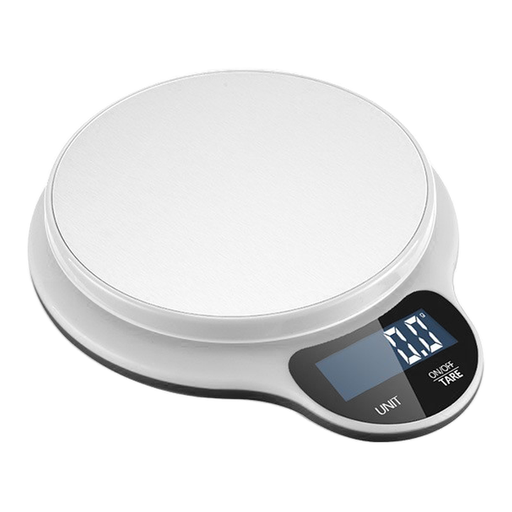
Why it suits this user profile: Designed for home bakers and anyone who wants to work with finer increments while meal prepping.
The product description specifies 0.5-gram increments and a capacity of 5 kg, rather than making only a general claim about precision.
Stainless-steel platform, LCD display, tare function and supplied 2×AAA batteries according to the listed product specifications.

Why it suits this user profile: Ideal for meal preppers, fitness enthusiasts and anyone weighing large portions or wanting to connect data to an app via Bluetooth.
The capacity, minimum weighing amount and measurement increment are listed separately: 10 kg, from 3 g and 1 g per increment. This makes it clear what the model is designed for.
Bluetooth, an LED display, 10 kg capacity and support for g, ml, oz, lb:oz and lb according to the product details.

Why it suits this user profile: For anyone who wants to track calories and nutritional information as well as weighing ingredients, using the display and app connectivity.
The additional features are clearly described: a 5 kg capacity, 1-gram increments, Bluetooth 5.4 and a screen for nutritional data.
4.54-inch VA display, local goal tracking and various units, including ml for water and milk, according to the product information.
An analogue kitchen scale works without a digital readout and often has a separate bowl. The MELISSA Retro Kitchen Scale specifies a capacity of 5 kg and 25-gram increments. This may be sufficient for rough portioning and suits a traditional kitchen style, but it is less suitable for precise baking, coffee or nutritional tracking.
For espresso and filter coffee, a compact coffee scale with a timer and flow-rate measurement is often more practical. The TIMEMORE Coffee Scale Basic 2.0 is designed for this purpose. Always check the current specifications on the product page before buying, as the included features may vary between versions.
We’ve compiled a complete, up-to-date list of products that fully meet these strict selection criteria and the applicable European safety regulations.
For most household recipes, yes. A capacity of 5 kg is suitable for flour, sugar, vegetables, portions and dough in a standard bowl. Choose 10 kg if you often use large quantities or heavy bowls.
Its lifespan depends on how it is used, battery care and protection from moisture, heat and knocks. Clean the surface with a cloth, avoid overloading the scale and store it somewhere dry. An automatic switch-off function can help reduce battery consumption.
Most models run on batteries. Consumption depends on the display, Bluetooth usage and automatic switch-off function. Check the battery type, whether batteries are included and how easy they are to replace.
