
Those organising the coffee break
You want to serve a chocolate digestive with coffee or tea. Check how many biscuits you can offer from a pack, and check the allergens before sharing them.


Choose a chocolate digestive if you want the chocolate flavour to complement your coffee or tea. For a regular office supply, compare the nutritional information and portion size on the current pack too. A plain digestive without a chocolate coating is a different option, while anyone looking for a gluten-free biscuit will need one specifically labelled gluten-free and should still check the other allergens.
You want to serve a chocolate digestive with coffee or tea. Check how many biscuits you can offer from a pack, and check the allergens before sharing them.
You buy biscuits for a team regularly and want to compare the nutritional values per 100 g and per portion. If chocolate isn’t essential, you could also consider a plain digestive.
You’re looking for a product that is specifically labelled gluten-free. Also check that the listed ingredients and allergens are suitable for the colleagues you’re buying it for.
First, decide which feature matters most for your shared coffee break. Then compare only products that meet that requirement: a plain digestive and a chocolate digestive don’t quite serve the same purpose.
| What to consider | What to check when buying | Who is this most important for? |
|---|---|---|
| Chocolate flavour | Check which chocolate variety you’re choosing, the portion per biscuit and the allergens. | If the biscuit is mainly a treat to enjoy with coffee or tea, I want to know whether it actually has a chocolate coating. This flavour preference comes first for around 36% of consumers. |
| Nutritional value for regular use | Compare sugars, saturated fat, fibre and salt per 100 g and per portion; keep chocolate varieties separate from plain digestives. | For a regular supply, I don’t want to rely on the name ‘digestive’ alone; I also want to see what one biscuit contains. Around 29% of consumers give this nutritional comparison top priority. |
| Gluten-free suitability | Look for the ‘gluten-free’ label on the current pack and read the full ingredients and allergen information too. | If someone needs a gluten-free option, I don’t want to assume it’s also free from milk, soya or other relevant allergens. This is the top priority for around 21% of consumers. |
| Stock and availability | Check the pack weight, the number of biscuits and where your chosen variety is available. | If I’m putting biscuits out for several coffee breaks, the pack needs to suit how we plan to use it. For around 14% of consumers, planning the supply is the main consideration. |
The name doesn’t tell you how the biscuit you’ve chosen is made. Jumbo lists 12.9 g of saturated fat and 27.4 g of sugars per 100 g for its dark chocolate digestive; Albert Heijn lists 1.8 g of saturated fat per 100 g for its plain digestive without a chocolate coating. These are different types of product, not a general comparison between the brands.
First, decide whether chocolate is essential. Then check the nutritional information per 100 g and per portion for the varieties you’re considering for your coffee break.
According to Jumbo, its gluten-free milk chocolate digestive contains milk, oats and soya and may contain nuts. So the gluten-free label alone isn’t enough to tell you whether everyone in the team can eat it.
Before sharing the biscuits, check the relevant allergens on the current packaging for each colleague concerned.
When you’re offering biscuits to share, the ingredients and allergens need to match the product you’ve bought. For Sondey Digestives dark chocolate, you’ll also need the physical pack to check the nutritional information.
When you buy your chosen variety, read the label and keep the packaging to hand for as long as the biscuits are available.
Albert Heijn describes McVitie's Digestives dark chocolate as a wheat biscuit coated with dark chocolate, in a 400 g pack.
AH Digestive is a plain 400 g digestive for anyone also considering a biscuit without a chocolate coating.
Jumbo offers both a 300 g dark chocolate digestive and a separate 165 g milk chocolate digestive labelled gluten-free.
Lidl Netherlands lists Sondey Digestives dark chocolate as a 300 g pack available in store.
ALDI Netherlands lists Biscotto Digestive Biscuits as plain wheat biscuits, with around 27 biscuits in a 400 g pack.
These two packs of McVitie's Digestives are a good fit for a coffee break when you’re looking for a chocolate coating: one has milk chocolate, the other dark chocolate. For a gluten-free option or a plain digestive without chocolate, choose a different product.
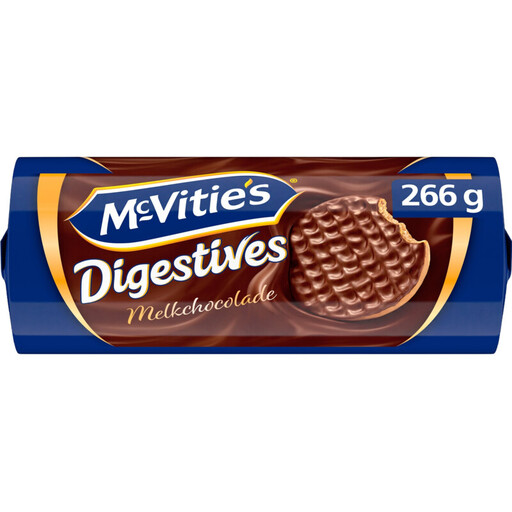 Image unavailable
An option for your coffee break if you’d like to serve a milk chocolate digestive.
Pack weight: 266 g. Check the number of biscuits on the pack when planning portions.
Not suitable for anyone needing a gluten-free option; if you have a milk, soya or wheat allergy, check the current label.
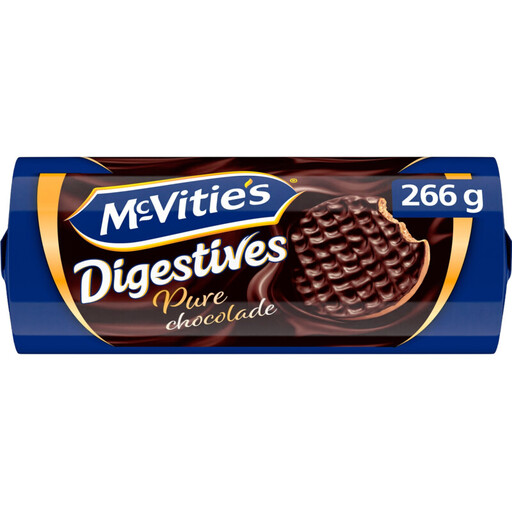 Image unavailable
An option for your coffee break if you’d like to serve a dark chocolate digestive.
Pack weight: 266 g. Check the number of biscuits on the pack when planning portions.
Not suitable for anyone needing a gluten-free option; if you have a milk, soya or wheat allergy, check the current label.
No, you can’t tell a biscuit’s nutritional value from its name alone. For a regular coffee break, compare the sugars, fats, fibre and portion size on the nutritional information for the specific products you’re considering.
Check the allergens on the current pack of each variety you choose. The chocolate digestives described here list wheat, milk or soya, among other allergens; according to Jumbo, its gluten-free milk chocolate variety contains milk, oats and soya and may contain nuts.
Yes, a product containing oats can be labelled gluten-free. For example, Jumbo lists gluten-free oat flour and gluten-free oat bran in its gluten-free milk chocolate digestive. Don’t rely on oats alone: check the gluten-free label and the other allergens on the current pack.
Follow the storage instructions on the pack of your chosen product. Jumbo recommends resealing its chocolate digestive after opening and storing it in a dark place; for AH Digestive, Albert Heijn recommends an airtight tin and a cool, dark, dry place.