Which choice is right for you?

To enjoy with coffee

If you’re looking for a biscuit to have with coffee, first decide whether you fancy the flavour of a classic digestive or a more caramelised biscuit. Then compare the packaging and, if it matters to your choice, the nutritional information.

For a cake or cheesecake base

For a crumb base, consider whether the biscuit’s flavour will work with the filling. A strongly caramelised biscuit is quite different from a digestive, so also check how much your recipe calls for.

If you have dietary restrictions

If you need to avoid an ingredient or allergen, read the ingredients list and allergen information on the exact product packaging. Biscuits in the same category can still have different ingredients.

What should you look for when choosing?

Start with how you’ll use them: as a biscuit with coffee or as the base for a crumb crust. Then compare similar products using the label. The Voedingscentrum recommends comparing nutritional values per 100 g.

What to consider What to check Who it matters to
Flavour and use Check whether it’s a digestive or another type of biscuit, and whether the flavour will work with your recipe. If I’m serving biscuits with coffee or crumbling them to make a base, I want a flavour that works for the occasion. This combination of flavour and use comes first for around 40% of consumers.
Nutritional information Compare fibre, sugars and saturated fat per 100 g in similar biscuits. People who choose based on nutritional values want to see the differences between types, rather than just reading the front of the pack. This is the main consideration for around 30% of consumers.
Ingredients and allergens Read the ingredients list, allergen information and any ‘may contain’ statement on the exact product packaging. If I need to avoid gluten or another relevant allergen, I want to know what’s listed for this particular product. Around 20% of consumers prioritise these checks.
Pack size Check the net weight and whether it’s one pack or several smaller packs. For a baking recipe or several coffee breaks, I want to choose an amount that suits how I’ll use it. This is the biggest consideration for around 10% of consumers.

Common mistakes

  • Assuming all digestive biscuits have the same nutritional values

    The name ‘digestive’ tells you little about what’s in the biscuit. For the AH Digestive wholemeal product examined, Albert Heijn lists 1.6 g of saturated fat per 100 g. For the McVitie's Original product examined, Albert Heijn lists 10 g per 100 g.

    Compare similar types per 100 g, and focus on the nutritional values that matter to you.

  • Taking ‘0% sugar’ as a reason to ignore the rest of the label

    The AH Digestive 0% sugar product examined contains polyols. Its packaging warns that excessive consumption may have a laxative effect.

    For this type too, read the full nutritional information and the warning on the packaging.

  • Confusing gluten-free with allergen-free

    The Schär Digestive Landtaler product examined is sold as gluten-free, but contains soya and may contain lupin and egg.

    For every allergen that matters to you, check the information on the exact product packaging. Don’t rely on the words ‘gluten-free’ alone.

Brands and types compared

Albert Heijn

The own-brand products examined are AH Digestive wholemeal with wheat flour and AH Digestive 0% sugar. Both come in 400 g packs.

  • For the wholemeal type, Albert Heijn lists 37% wholemeal wheat flour, 6 g of fibre and 1.6 g of saturated fat per 100 g.
  • The 0% sugar type examined contains polyols and carries a warning about excessive consumption. These details don’t apply to all Albert Heijn biscuits.

Jumbo

Jumbo Digestive Volkoren is the 400 g own-brand type examined.

  • For this type, Jumbo lists 37.3% wholemeal wheat flour, 5.8 g of fibre and 1.6 g of saturated fat per 100 g.
  • This type contains wheat and gluten. Jumbo says it may also contain barley, oats and rye.

McVitie's

The Digestives Original examined is a classic wheat biscuit, sold in a multipack of 2 × 400 g.

  • Albert Heijn lists 16% wholemeal wheat flour for this Original type.
  • The same product page lists 10 g of saturated fat per 100 g, wheat and gluten, and the possible presence of milk.

Schär

Digestive Landtaler is the gluten-free type examined. Jumbo also suggests it as a possible biscuit base for a quark tart or cheesecake.

  • The pack examined contains 3 × 50 g, which is useful if you need a specific amount for a recipe.
  • According to Jumbo, this type contains soya, may contain lupin and egg, and has 10 g of saturated fat per 100 g.

Lotus Biscoff

Lotus Biscoff is a caramelised biscuit for anyone looking for a different flavour to enjoy with coffee from that of a classic digestive.

  • Lotus Bakeries presents Biscoff as a biscuit to enjoy with coffee.
  • It’s a different type of biscuit from a digestive. If you’re making a cake base, consider whether its flavour will work with your recipe.

Classic digestives on Joybuy

This option is a 400 g pack of classic digestives to enjoy with coffee or consider as a biscuit base for a cheesecake. Compare the flavour and ingredients with what your recipe calls for.
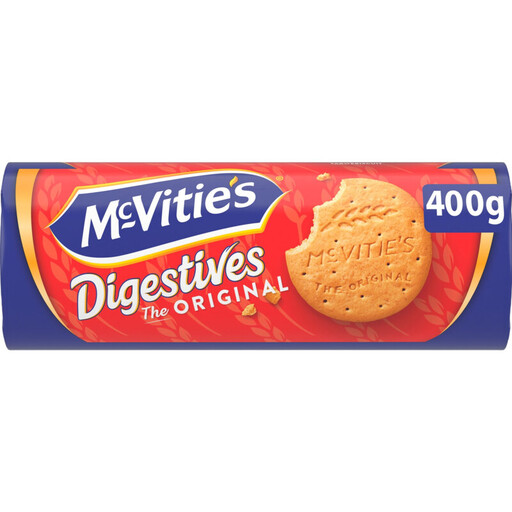
McVities Digestive Original, 400 g

McVities Digestive Original, 400 g

A classic digestive to enjoy with coffee or consider as a biscuit base for a cheesecake.

Pack size: 400 g. Check the current ingredients and allergen information if it matters to your choice.

View on Joybuy

Frequently asked questions

What does the word ‘digestive’ tell me about its nutritional values?

The name ‘digestive’ doesn’t give you a complete nutritional comparison. For similar biscuits, compare the nutritional information per 100 g. The Albert Heijn, Jumbo and McVitie's products examined differ in fibre and saturated fat, among other things.

What should I look for in a ‘0% sugar’ digestive?

Read the rest of the label too. According to Albert Heijn, the AH Digestive 0% sugar product examined contains 465 kcal and 20 g of fat per 100 g, includes polyols and carries a warning about excessive consumption.

Can I eat a regular digestive if I need to avoid gluten?

Check the exact product packaging: the standard digestives examined contain wheat and gluten. The Schär Digestive Landtaler product examined is sold as gluten-free, but you should still check for any other allergens that matter to you.

Which allergens should I check before buying?

Check the ingredients list and allergen information for the exact type, looking for any allergens you need to avoid. The products examined list wheat, milk, soya, lupin and egg among the allergens that are present or may be present.
