
Organisers of standard coffee breaks
Looking for a biscuit that can be portioned out per guest when no specific dietary requirement determines the choice.


Choose a classic digestive for a standard conference break if you want to serve one biscuit per guest, but don’t take the name as proof that it aids digestion. Compare fibre, sugars, portion sizes and allergens on the label. Arrange a separate gluten-free product if needed, and make allergen information available at the point of service when biscuits are served unpackaged.
Looking for a biscuit that can be portioned out per guest when no specific dietary requirement determines the choice.
Need up-to-date product information for biscuits served unpackaged. The Netherlands Food and Consumer Product Safety Authority (NVWA) requires information about relevant allergens to be available where the food is offered.
Compare fibre using the nutritional information or choose a separate product explicitly labelled gluten-free, rather than relying on the name digestive.
First, establish which allergen and dietary requirements you need to cater for. Then compare the nutritional information and choose a portion size and packaging format that suits the way you’ll serve the biscuits. An individually wrapped speculoos biscuit, for example, is a different type of product from a digestive.
| What to consider | What to check before buying | Who it matters most to |
|---|---|---|
| Allergens and dietary requirements | Check the ‘contains’ and ‘may contain’ statements for each product, and whether any required property, such as gluten-free, is stated explicitly. | If a guest needs to avoid certain ingredients, I want to know which biscuit is suitable before serving. Around 38% of consumers would put allergens and dietary suitability at the top of their list of selection criteria. |
| Fibre and ingredients | Compare fibre and sugars on the same basis, preferably per 100 g, and check the portion size too. | If fibre matters for what I’m serving, I want to compare the value on the label rather than rely on terms such as ‘digestive’ or ‘wholegrain’. For around 31% of consumers, this would be their top priority. |
| Portions and serving | Check how many biscuits make up a portion and whether they’re served loose or individually wrapped. | During a short break, I want to be able to hand out biscuits quickly to each guest without working out portions on the spot. Serving format and portion control would come first for around 31% of consumers. |
Fibre content varies from one biscuit to another. Jumbo’s product information for McVitie's Digestives Milk Chocolate also explicitly states that the ingredients do not contain substances that aid digestion.
Don’t use the product name as a substitute for checking the ingredients list. Compare the nutritional information per 100 g and per portion.
According to Jumbo, Jumbo Digestive Wholegrain contains gluten and wheat. Albert Heijn labels AH Digestive as lactose-free, but it also contains wheat.
Match each dietary label to the guest’s specific needs and check both ‘contains’ and ‘may contain’ on the current packaging.
According to the NVWA, information about relevant allergens must be available where unpackaged food is offered.
Keep the current packaging or product specifications to hand, and make sure guests can get the correct allergen information at every serving point.
Individually wrapped biscuits can make it easier to serve one to each guest, but that doesn’t make them a digestive with the same ingredients. The Lotus speculoos described by Albert Heijn is a different type of biscuit.
Decide whether ease of serving or a specific product composition matters most before choosing the type of biscuit and packaging format.
The Digestives Original we looked at is a 400 g wheat biscuit for a standard coffee break.
The Digestive Wholegrain we looked at is an option to compare for fibre content.
AH Digestive is an own-label variety whose product information describes it as vegan and lactose-free.
According to Jumbo’s product information, Digestive Landtaler is a gluten-free biscuit specially made for people with gluten intolerance.
The speculoos pack we looked at is designed for serving individually wrapped coffee biscuits; speculoos is not a digestive.
These products include a classic digestive, two chocolate digestives and other biscuits to serve with coffee or tea. Choose the type of product to suit your guests and how you’ll serve it; don’t treat the other biscuits as gluten-free or high-fibre alternatives to a digestive.
 Image unavailable
For a standard coffee break when you want to serve a classic digestive to each guest.
According to the product information for this Original variety, one 14.7 g biscuit is a portion; per 100 g, it contains 3.7 g of fibre and 15.1 g of sugars. Contains wheat and may contain milk.
 Image unavailable
A speculaas biscuit option to serve with coffee or tea, but not for anyone specifically looking for a digestive.
For guests with allergies, check the label: this product contains wheat, milk and egg, among other ingredients, and also lists possible allergens. Only compare fibre and sugars with other biscuits once you’ve confirmed the nutritional values are given on the same basis.
 Image unavailable
For a coffee or tea break where milk chocolate biscuits fit the bill; this isn’t a digestive.
The product information describes individually wrapped portions of two biscuits. When providing information to guests, take account of milk, wheat and soya; the product may contain nuts.
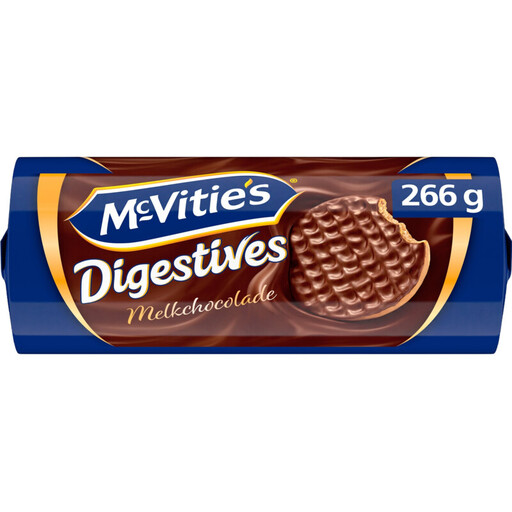 Image unavailable
A milk chocolate digestive for anyone who wants to offer a chocolate biscuit alongside the classic variety.
Contains milk, soya and wheat. Check the portion size and nutritional information on the current packaging before comparing this variety with another digestive.
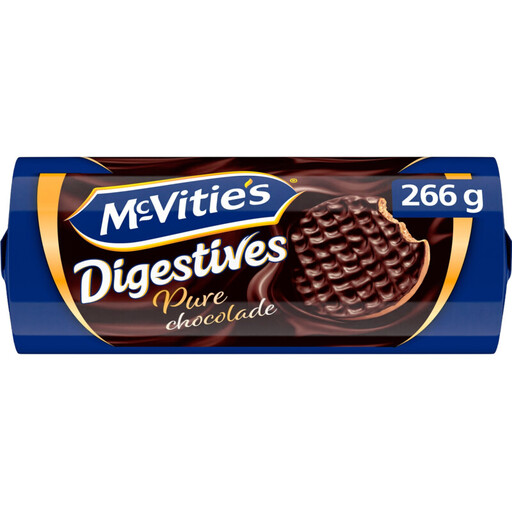 Image unavailable
A dark chocolate digestive as an alternative among the chocolate varieties for a coffee break.
Contains wheat, milk and soya. To compare portions, fibre and sugars, check the nutritional information on the current packaging.
No. The product name doesn’t prove any such effect. Compare the fibre value on the label; Jumbo explicitly states that the ingredients in McVitie's Digestives Milk Chocolate do not contain substances that aid digestion.
According to the NVWA, information about relevant allergens must be available where you offer unpackaged biscuits. Use the current product information for each biscuit. The NVWA sets requirements for how you provide this information, either in writing or verbally.
No. ‘Wholegrain’ doesn’t mean ‘gluten-free’: Jumbo states that its Digestive Wholegrain contains gluten and wheat. For a gluten-free selection, choose a product explicitly labelled as such and check for other allergens too.
Follow the storage instructions on the packaging; the digestive products we looked at should be kept in a cool, dry place. Before serving, check the best-before date and reseal any opened pack as instructed.