
Vandaag of morgen in huis

Kwaliteit gegarandeerd

Welkomstaanbiedingen ontgrendelen: GRATIS bezorging | Tot 80% korting | Gratis 30 dagen JoyPlus-proefperiode
Download de app
As a new parent, there's little as heartbreaking as a baby crying inconsolably from colic. You search for a solution and quickly encounter an abundance of baby bottles, all claiming to be 'anti-colic'. But many of these promises are based on marketing, not functional design. Before you make a choice, it's wise to know what to look for to avoid common pitfalls.
Many parents fall into the trap of an 'anti-colic' bottle with an overly complex system. These bottles often consist of many small, hard-to-reach parts. The result? They are difficult to clean, which can lead to bacterial growth and actually worsen the problems. Another misstep is ignoring ergonomics. An awkwardly shaped bottle forces you and your baby into an unnatural posture, leading to neck and back pain for you and restlessness for your child.
To find a bottle that can genuinely help, it's wise to look beyond the marketing claims and focus on a few concrete specifications. These features determine whether a bottle is suitable for your situation.
The core of an effective anti-colic baby bottle is the mechanism that prevents your baby from ingesting air while drinking. Air mixing with the milk can cause cramps, burping, and spit-up. A good baby bottle with a valve ensures a constant flow of milk without creating a vacuum. Pay attention to where the valve is located. A valve at the bottom of the bottle, far from the teat, can effectively prevent air and milk from mixing. This ensures that the milk flows continuously to the teat without air bubbles.
Safety is paramount. Always choose a BPA-free baby bottle. BPA (Bisphenol A) is a chemical that was historically used in plastic products and should be avoided. Bottles made from polypropylene (PP) and teats from silicone are a safe and standard choice.
Additionally, the shape of the bottle is important. An ergonomic baby bottle not only offers comfort for you as a parent but also promotes a natural feeding posture for your baby. A unique S-shape bottle can help with this. This shape ensures the teat remains constantly filled with milk, even when the bottle is held horizontally. This supports a more relaxed, reclined posture for you and a natural, slightly curved posture for your baby, similar to the position during breastfeeding. This makes it an interesting option for parents who are combining bottle-feeding and breastfeeding.
Based on these criteria, we have looked at products that offer a practical solution for the specific needs of parents.
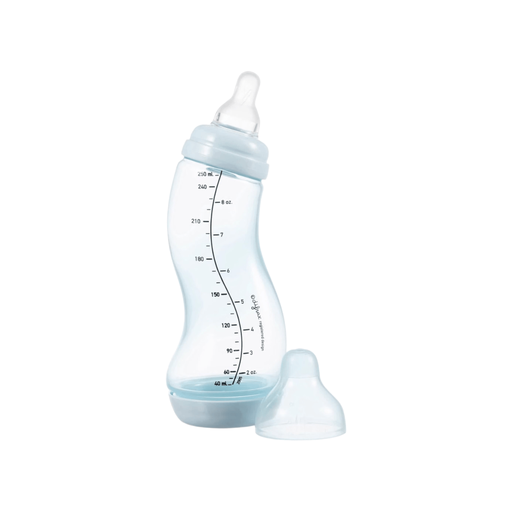
Why This Fits Their Persona: This bottle is specifically designed to reduce intestinal cramps. The unique valve in the base is intended to prevent air from mixing with the milk, which is a common cause of discomfort in babies.
Instead of a vague 'anti-colic' promise, this bottle offers a clear mechanism: the valve in the base ensures a constant flow without a vacuum, reducing the chance of swallowing air.
According to the manufacturer, the system reduces the risk of colic, spit-up, and burping. The bottle can be fully disassembled for thorough cleaning.
Why This Fits Their Persona: The S-shape is designed to encourage a natural feeding posture that mimics breastfeeding. This can make the transition between breast and bottle easier for the baby and helps prevent teat confusion.
This bottle addresses the ergonomic problem. The S-shape allows the parent to sit comfortably upright, which helps prevent back and shoulder pain during the many feeding sessions.
The ergonomic S-shape promotes a relaxed posture for both parent and child. According to the manufacturer, the bottle is ideal for combining breast and bottle feeding.
Why This Fits Their Persona: For parents who don't have time for fuss, a bottle that is easy to use and clean is essential. This bottle can be fully disassembled, including a screw-off base.
This design avoids the pitfall of complex, hard-to-clean bottles. Because the base can be removed, all corners and the valve system are easily accessible for a thorough cleaning.
The screw-off base makes filling and cleaning simple. All parts are dishwasher safe (top rack), which saves time and effort.
Not every bottle is the same, and capacity is an important factor. The Difrax S-bottle is also available in a 250 ml version, a popular choice for babies who drink larger feeds.
For good hygiene, it's important to completely disassemble the bottle: the cap, the teat ring, the teat, the S-shaped bottle, the valve, and the base. All parts can be washed with mild soap and warm water or placed in the top rack of the dishwasher on a cycle no hotter than 55°C (131°F). Before each use, check the small air hole in the silicone valve to ensure it is open.
The 250 ml Difrax bottle can be used from birth. It comes standard with a size S (Slow-Flow) teat, which is suitable for newborns. As your baby grows and needs a faster flow, other teat sizes (M and L) are available for separate purchase. This makes the bottle a sustainable choice that grows with your child.
The S-shape bottle is designed to support a more natural and comfortable feeding posture. For the baby, this means their head can remain slightly more upright, similar to the posture during breastfeeding. For you as a parent, it means you can sit more relaxed and upright, which can reduce the strain on your back, neck, and shoulders.
