Who is this desktop guide for?

Developers testing keyboard navigation

You want to move through forms, search results and other parts of your website without a mouse. Allow space for your editor and test browsers; keyboard accessibility depends on the website you build and test. The W3C Web Accessibility Initiative highlights keyboard access and visible focus as important considerations for web content.

Developers with a local development environment

You may use local services or containers alongside an editor and browsers. Choose a desktop based on the software you plan to run at the same time; the requirements for an editor alone won’t necessarily cover your whole setup. Microsoft publishes separate requirements for Visual Studio Code, while Docker documents the installation options for Docker Desktop on Windows.

Developers testing Safari and iPhone

You want to inspect web pages in Safari or debug a connected iPhone or iPad. Apple explains how to do this from a Mac, making this specific testing task relevant when choosing between macOS and Windows.

What should you look for?

Compact Windows desktop

A good fit if: you already have a monitor and use an editor, local development environment and several browsers in a small workspace.

Trade-off: check the ports, included peripherals and upgrade options for the specific configuration.

Mac mini

A good fit if: inspecting Safari or web pages on a connected iPhone or iPad is part of your testing work.

Trade-off: check that the storage is sufficient and work out which monitor, input devices and cables you’ll need. This choice doesn’t replace testing in other relevant browsers.

Larger Windows tower

A good fit if: you prefer a larger case to keeping your desk footprint to a minimum.

Trade-off: don’t assume a larger case means more upgrade options; check the configuration of the exact model.

What to consider What should you check? Who is this important for?
Keyboard and browser testing Check which browsers you plan to use and whether your keyboard, monitor and required ports are suitable. If I want to test the website I’ve built without a mouse and in the browsers my visitors use, my workspace needs to support that test environment. Around 37% of consumers put keyboard and browser testing at the top of their purchase priorities.
Local development environment Work out whether you use containers or other local services, and check the requirements for that combination. When I use an editor, browsers and possibly local services at the same time, I want to choose a configuration that can handle them. Around 27% of consumers prioritise their own local development environment when buying.
Safari and mobile Apple devices Check whether you need to inspect Safari on a connected iPhone or iPad, and which Mac configuration and peripherals will suit your needs. If I need that specific Safari or iPhone testing workflow, the inspection method I’ll need is a factor in my choice. Around 18% of consumers give this testing task their highest priority.
Complete workspace and flexibility Make a list of your monitor, keyboard and cables; compare the ports and documented upgrade options for the exact configuration. If I want to reuse existing equipment or consider upgrades later, I check the complete configuration rather than just the case. Around 18% of consumers prioritise a complete workspace and flexibility.

Common mistakes

  • Assuming a powerful PC makes a website keyboard-accessible

    Your choice of hardware doesn’t guarantee that forms can be used with a keyboard or that focus remains visible.

    Alongside choosing a desktop, plan manual keyboard tests of the actual steps users will take. The W3C Web Accessibility Initiative highlights keyboard access and visible focus as important considerations for web content.

  • Using an editor’s requirements for the whole project

    An editor, browsers and any local services may all have different requirements. A recommendation for one programme won’t necessarily describe your complete setup.

    List the software you plan to use at the same time, then check the exact PC configuration against it.

  • Comparing a mini PC without considering the rest of your workspace

    The case and available ports don’t necessarily tell you which peripherals are included with a particular configuration.

    Check the contents and ports against your existing monitor, keyboard and cables.

Brands to compare

Apple

The Mac mini is worth considering if you need macOS to inspect Safari and iPhone.

  • For the Mac mini M6 base configuration reviewed, Apple lists 16 GB of unified memory and a 256 GB SSD.
  • That combination won’t automatically suit every storage requirement. Apple’s documentation on the inspection workflow doesn’t claim that the computer makes a website accessible.

HP

The Pro Mini and Pro Tower are Windows options to compare if you’re considering a compact or larger case.

  • The HP Pro Mini 400 G9 6D494EA#ABH and Pro Tower 400 G9 99P68ET#ABH configurations reviewed each list Windows 11 Pro, 16 GB RAM and a 512 GB SSD.
  • These specifications apply to the configurations listed and shouldn’t be assumed to apply to other HP models without checking.

Lenovo

The ThinkCentre M70q Gen 5 is a compact business desktop worth comparing by configuration and ports.

  • For this product family, Lenovo documents ports including HDMI, DisplayPort, USB and Ethernet.
  • Some ports depend on the configuration, so check the connections on the exact model you’re considering.

Desktop options at Joybuy

This selection focuses on Windows desktops, from mini PCs to an all-in-one. Compare the listed configuration with your development software, test browsers and existing peripherals. A PC doesn’t replace keyboard testing of the website itself.

Panoramic desktop PC with AMD Ryzen 7 5700X, GeForce RTX 5060 Ti 8GB, 16GB DDR4 and 480GB NVMe PCIe SSD

Panoramic Gaming PC – Ryzen 7 5700X, RTX 5060 Ti 8GB, 16GB DDR4, 480GB NVMe SSD

An option to compare if you’re setting up a Windows workspace for development and browser testing. Check that the listed Windows version suits the software you use.

The description lists Windows 11 (Evaluation Version). The title names an AMD Ryzen 7 5700X, GeForce RTX 5060 Ti 8GB, 16GB DDR4 and a 480GB NVMe PCIe SSD.

View at Joybuy
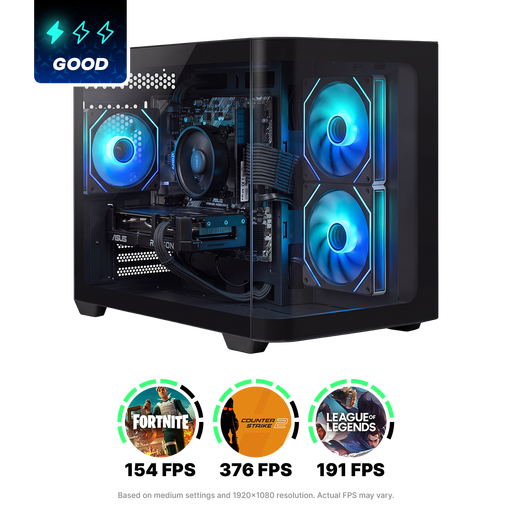
SHARK Max Bite R502 desktop PC with AMD Ryzen 5 5500, Radeon RX 9060 8GB, 16GB DDR4 and 500GB NVMe SSD

SHARK Max Bite R502 – Ryzen 5 5500, Radeon RX 9060 8GB, 16GB DDR4, 500GB NVMe SSD

Compare this compact Windows desktop if you want to run an editor and browser tests in one workspace. Check that the case and ports suit the space and peripherals you have.

The product title lists Windows 11 Home, 16GB DDR4 and a 500GB NVMe SSD. It also names an AMD Ryzen 5 5500 and Radeon RX 9060 8GB.

View at Joybuy

FIREBAT R3 Mini PC with AMD Ryzen 5 7430U, 16GB RAM and 512GB SSD

FIREBAT R3 Mini PC – Ryzen 5 7430U, 16GB RAM, 512GB SSD

A mini PC to consider if you’re looking for a compact space for your editor and browser testing. Check which ports your monitor and other peripherals need.

The product title lists an AMD Ryzen 5 7430U, 16GB RAM, a 512GB SSD, Wi-Fi 6, Bluetooth 5.2 and support for three 4K displays.

View at Joybuy
MSI CUBI NUC AI 1UMG-005EU Mini PC with Intel Core Ultra 7 155H, 16GB DDR5 and 1TB SSD

MSI CUBI NUC AI 1UMG-005EU – Core Ultra 7 155H, 16GB DDR5, 1TB SSD

This mini PC is an option to compare for a compact development and testing workspace. Check that the configuration and ports suit your monitors and everyday software.

The title lists Windows 11 Pro, 16GB DDR5 and a 1TB SSD. The product description mentions support for up to four displays and VESA mounting.

View at Joybuy

Lenovo Yoga AIO 27IAH10 F0J2001DNY all-in-one with 27-inch QHD display, Intel Core Ultra 7 255H, 16GB and 1TB SSD

Lenovo Yoga AIO 27IAH10 F0J2001DNY – 27-inch QHD, Core Ultra 7 255H, 16GB, 1TB SSD

Compare this all-in-one if you want an integrated display and an included set of input devices in your workspace. Check that the display and software configuration suit your testing plan.

The title lists a 27-inch QHD display with 120Hz, Windows 11 Home, 16GB LPDDR5X and a 1TB SSD. The product description mentions a wireless keyboard and mouse set.

View at Joybuy

Frequently asked questions

Will a particular keyboard or a fast desktop automatically make my website accessible?

No. Test the features you’ve built without a mouse. The W3C Web Accessibility Initiative highlights keyboard access, avoiding keyboard traps and visible focus as important considerations for web content. These are features of the website and how people use it, not of a desktop model.

What do I need to build and test the site locally?

Start with a code editor and up-to-date browsers; MDN Web Docs also lists a local testing server as part of a basic setup. If you also want to use Docker Desktop on Windows, check the requirements for your chosen installation and backend separately.

What should I check when buying the PC and looking at its warranty?

Before buying, check that the ports on the exact configuration suit your monitor and input devices. According to the Dutch government, if a product develops a fault, the seller must provide a solution; the manufacturer’s warranty is in addition to your statutory rights.

Does a Dutch lost property website have to comply with accessibility rules?

That depends on who runs it and what service it provides. DigiToegankelijk explains the obligations that apply to government websites covered by the Decree on Digital Accessibility of Government. Ondernemersplein outlines rules for certain consumer services and the conditions under which they apply. The subject of lost property alone doesn’t determine whether either set of rules applies. Designing and testing for keyboard accessibility is still worthwhile.

Can I publish names, contact details or recognisable photos of lost property without permission?

Don’t assume that you can. According to the Dutch Data Protection Authority, processing personal data requires an applicable legal basis under the GDPR; identifiable people in photos count as personal data. Consider which details the site really needs and which legal basis applies to the specific use.
