
Editor working with demanding footage
You want to compare your editing software’s requirements with the memory, graphics configuration and storage of a specific desktop. Adobe recommends 32 GB or more for Premiere at 4K and higher resolutions.


Choose a desktop based on your source files, editing software and planned screening. Then check that the memory, storage and connections suit that combination. A compact desktop may be suitable if its specific configuration meets your needs, while a tower gives you more configuration options. Proxy files can help with demanding footage, but require extra file management. For a neighbourhood screening, also check the rights to any music and the use of footage featuring identifiable people.
You want to compare your editing software’s requirements with the memory, graphics configuration and storage of a specific desktop. Adobe recommends 32 GB or more for Premiere at 4K and higher resolutions.
You’re looking for a compact, permanent editing setup and want to check in advance that your chosen configuration, screens and connections suit your files. Apple’s Dutch Mac mini specifications list hardware acceleration for formats including H.264, HEVC and ProRes.
You want to keep your source files, working files and screening version organised. For the screening, you’ll also need to consider identifiable people and the rights to any music used.
Choose this option: if you want to use macOS and your chosen configuration and connections suit your project. Apple lists hardware acceleration for formats including H.264, HEVC and ProRes.
Keep in mind: check the exact configuration and factor in whether you’ll also need a screen, input devices or external storage.
Choose this option: if you want to compare specific combinations of memory, graphics card and storage for your software. Dell and Lenovo offer different configurations in their tower ranges.
Keep in mind: a product range name doesn’t tell you which components are included in a specific model. Adobe recommends 32 GB or more for Premiere at 4K; this is a recommendation for that software and resolution, not a requirement for every editing project.
Choose this option: if your editing software supports proxy files and you can edit using lighter copies of your footage. Adobe describes proxies as lighter copies of high-resolution video files.
Keep in mind: you’ll need to manage the proxy files and keep the originals available for the final export.
| What to consider | What to look for when buying | Who is this important for? |
|---|---|---|
| Smooth editing | Compare your software, resolution and codec with the processor, memory and graphics configuration of the model you’ve chosen. Adobe recommends 32 GB or more for Premiere at 4K and higher resolutions. | If I want to edit my own files smoothly, I compare the configuration with my source footage and software. Around 40% of shoppers give editing speed the highest priority. |
| Space for project files | Check the size of your footage, SSD capacity, available connections for external storage and space for any proxy files. | I want to be able to store and find my source footage, working files and screening version. Around 30% of shoppers put file management first. |
| Fits your workspace | Check the desktop’s dimensions and display connections, as well as the ports you need for other equipment. | If my editing space is limited, I want to know in advance whether the computer will fit alongside my existing equipment. Around 20% of shoppers prioritise a compact setup. |
| Total cost and service | Compare the components actually selected, the equipment included and the service terms. Consider any service offered separately from your statutory rights against the seller. | I want to know the full cost before buying and where to go if something goes wrong. Around 10% of shoppers pay the most attention to total costs and aftercare. |
Configurations can vary within the same product range. For example, Lenovo lists ThinkStation P3 Tower Gen 2 configurations with different amounts of memory, so the model name alone doesn’t tell you which components are included in the version you choose.
Compare the components actually selected with the requirements of your software and source footage. Adobe recommends 32 GB or more for Premiere at 4K, but that recommendation doesn’t automatically apply to every editing project.
You may need to upgrade the memory, graphics card or storage later.
Whether a compact desktop is right for you also depends on the storage and connections you need for your project.
Make a list of the equipment you already have and check what’s included with the specific model.
You may need to buy a screen, input devices or extra storage separately.
Adobe describes proxies as lighter copies for editing. You’ll still need the originals for the final export.
Keep your source files and check which files your editing software is using before exporting the screening version.
Managing proxy and source files takes extra time and storage space.
Footage of identifiable people is personal data, as the Dutch Data Protection Authority explains. How privacy rules apply depends, among other things, on how and with whom the film is shared. Copyright applies separately to protected music.
Before screening or sharing the film further, consider both footage featuring identifiable people and the rights to any music used.
The Mac mini is a compact macOS desktop worth comparing if you can choose the configuration you want in advance.
The Pro Max Tower T2 is a tower range with configuration options for buyers who want to compare components.
The ThinkStation P3 Tower Gen 2 is a configurable workstation range to compare with the requirements of your editing software.
The Z2 Tower G1i is a tower range worth comparing if the support on offer is also a factor.
This selection includes Mac mini configurations and gaming desktops to compare with your editing software, project files and connection requirements.
 No image available
Compare this compact desktop with the connections you need and the size of your project files.
The product title lists an M6 chip with a 12-core CPU and 12-core GPU, 16 GB of memory and a 256 GB SSD.
The product description lists Thunderbolt 4, USB-C and HDMI; check that these connections suit your screen and storage.
No image available
This compact desktop is worth comparing if you’re looking for a permanent editing setup and your project files will fit in the listed storage.
The product title lists an M6 chip with a 12-core CPU and 12-core GPU, 16 GB of memory and a 512 GB SSD.
The product description lists Thunderbolt 4, USB-C and HDMI; check that your screen and external storage can connect to them.
No image available
Compare this compact desktop with your editing software’s requirements and check that the listed storage is enough for your files.
The product title lists an M6 chip with a 12-core CPU and 12-core GPU, 16 GB of memory and a 512 GB SSD.
The product description lists Thunderbolt 4, USB-C and HDMI; check which connections your existing equipment requires.
 No image available
Compare the listed components with your editing software’s requirements and consider whether you’ll also use this gaming desktop as your permanent workstation.
The product description lists a Ryzen 7 7800X3D, GeForce RTX 5080 with 16 GB and 32 GB DDR5 memory.
The description lists a 1 TB NVMe SSD and Windows 11 Trial.
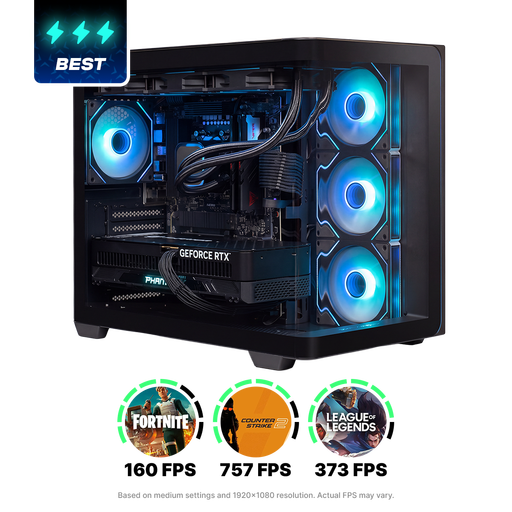 No image available
Compare this desktop configuration with your software requirements and the space you need for project files.
The product description lists a Ryzen 9 9900X3D, GeForce RTX 5090 with 24 GB and 32 GB DDR5 memory.
The description lists a 2 TB NVMe SSD; check that the operating system version and connections suit your needs.
No, the film itself doesn’t determine that. Adobe recommends 32 GB or more for Premiere at 4K and higher resolutions, and 16 GB for HD. Check which software version and source footage you’re using.
If your editing software supports proxy files, you can edit using lighter copies. Keep and relink the originals for the final export; Adobe describes this workflow for Premiere.
You don’t need an extended warranty to have statutory consumer rights. ACM ConsuWijzer explains that the seller is responsible if a purchase doesn’t meet what you could reasonably expect under normal use. Compare additional service separately, including its cover and terms.
You can’t determine this based on the screening alone. The Dutch Data Protection Authority considers footage of identifiable people to be personal data. Whether and what GDPR legal basis is needed depends, among other things, on who made the film and how and with whom it is shared. Consider these circumstances before screening or sharing the film further.
According to the Dutch government, you need permission from the creator to use or make protected music available to the public. Check the rights for the specific music and planned screening before showing or sharing the film.