
4K video editors
If you want to edit 4K footage or work with multiple video layers, check the requirements of your editing software and the exact memory and graphics configuration. For Premiere on Windows, Adobe recommends 32 GB RAM or more for 4K.


Start with the resolution and codec of your footage, the requirements of your editing software and the export file you need. A more modest setup may be suitable for HD; for 4K, multiple video layers or demanding effects, pay extra attention to memory, graphics and fast storage. A compact desktop takes up less desk space, while a tower may offer more room to upgrade. Always check the specifications of the exact model.
If you want to edit 4K footage or work with multiple video layers, check the requirements of your editing software and the exact memory and graphics configuration. For Premiere on Windows, Adobe recommends 32 GB RAM or more for 4K.
If you collect a lot of source footage, it helps to plan how you’ll organise your project files, media and cache. For Premiere, Adobe recommends fast SSD or NVMe storage for media and cache.
A compact desktop may be a good fit when desk space is limited. Check in advance which connections you need and whether your monitor, input devices and any project storage will fit your setup.
| What to consider | What should you check? | Who is this important for? |
|---|---|---|
| Smooth editing at your chosen resolution | Check the resolution, codec, editing software and exact configuration. For Premiere on Windows, Adobe recommends 16 GB RAM for HD and 32 GB or more for 4K. These are recommendations, not universal minimum requirements. | If I’m editing 4K footage or working with multiple layers, I want a setup that suits my software and codec. Editing performance is the top priority for around 36% of consumers. |
| Space for video files | Compare the SSD capacity with the amount of source footage and the number of project copies you need. Check the connections if you plan to use external storage; Adobe recommends fast storage for media and cache in Premiere. | With lots of footage, I want enough room for source files, cache and project copies. Storage capacity is the top priority for around 29% of consumers. |
| Room to upgrade later | Check the available memory slots, drive bays and upgrade options for the exact model. Options within a product family are not automatically included. | If I want to adapt my desktop for future projects, I check which components can actually be upgraded. Upgradeability is the top priority for around 21% of consumers. |
| A complete editing setup | Check the connections for your monitor and peripherals, and see whether a monitor, keyboard and mouse are included. Make sure the export format is also compatible with the equipment used to show the film. | With limited desk space, I want to know whether the computer, monitor and connections I need will all fit into my workspace. Workspace setup is the top priority for around 14% of consumers. |
A product family may offer different memory, storage and graphics options. The model you’re looking at may have different specifications. For example, a Lenovo ThinkStation P3 Tower Gen 2 model reviewed had 32 GB RAM, integrated graphics and a 256 GB SSD.
Compare the exact model or article number with the specifications of the version on offer.
A compact desktop isn’t automatically a complete editing setup. A monitor, input devices and, if needed, external project storage may all need to be bought separately.
Check which peripherals you already have and make a list of the connections and storage you’ll need.
Remember to allow space and connections for any external storage in your setup.
The Government of the Netherlands distinguishes between personal use and using or making copyright-protected material available to the public. You may need permission from the creator to use protected work.
Before your community screening, check which music and images you’re allowed to use and what permissions or arrangements are required.
Mac mini models may suit a compact editing setup if you want to use macOS. Check the memory and storage configuration you choose.
The ThinkStation P3 Tower Gen 2 is a configurable Windows tower. The components included depend on the version supplied.
HP highlights the Z2 Mini G1i and Z2 Tower G1i for video editing, with suggested uses for HD and HD/4K respectively.
ASUS describes ProArt as a range for creative workflows, including desktop computers.
This selection includes compact desktops and desktop PCs with a range of memory, storage and graphics configurations. Compare the specifications listed with your editing software, footage and available workspace.
 No image available
A compact Mac mini model to consider if you’re looking to create a small editing setup.
24 GB memory and a 512 GB SSD.
The product description lists a 12-core CPU, a 12-core GPU, and HDMI and Thunderbolt 4 connections.
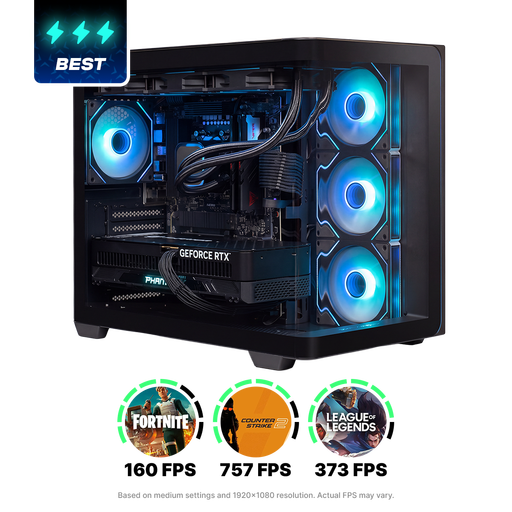 No image available
Compare this desktop PC with the requirements of your editing software and the size of your project files.
Ryzen 9 9900X3D processor, 32 GB DDR5 and 2 TB NVMe storage.
The product description lists an RTX 5090 with 24 GB graphics memory and Windows 11 Home.
 No image available
Check this Windows 11 Home configuration against the requirements of your project and editing software.
Intel Core Ultra 7 265F and 32 GB DDR5.
The product description lists 1 TB PCIe 4.0 NVMe storage and an RTX 5070 with 12 GB graphics memory.
No image available
Compare this version with the requirements of your editing software and the amount of storage you need.
Intel Core Ultra 5 225F and 32 GB DDR5.
The product description lists 1 TB PCIe 4.0 NVMe storage and an RTX 5070 with 12 GB graphics memory.
 No image available
A compact mini PC to consider if desk space is an important factor.
AMD Ryzen AI 9 365 with 10 cores and 20 threads, 24 GB DDR5 and a 1 TB SSD.
The product description lists Radeon 880M graphics, USB4, HDMI 2.1 and support for four 4K displays.
In Premiere, you can use proxy files: Adobe describes these as lower-resolution copies that can make editing source video easier. Also check that your computer, storage and export settings can handle your entire workflow.
For Premiere, Adobe recommends fast SSD or NVMe storage for media and cache, and describes using separate drives as one possible setup. Consider the size of your source footage and project copies, and check which connections you’ll need for external storage.
Ask the organiser which playback device and settings are needed for the screening. Premiere offers export settings for format, resolution, frame rate and codec, among other things; there’s no single presentation format that suits every screening.
According to the Government of the Netherlands, you may need the creator’s permission to use or make copyright-protected music available to the public. If an organisation films identifiable people and publishes the footage, the Dutch Data Protection Authority says there must be a lawful basis under the GDPR. Consent is one possible basis, but not the only one. What you need to arrange depends on the material and how you show or publish the film.
For a consumer purchase, the Government of the Netherlands says the retailer is your point of contact if the product develops a problem. An additional warranty is most relevant when it gives you extra rights.