
Editors working with demanding footage
Choose a desktop to suit your source footage, effects and editing software. Adobe recommends different amounts of memory for HD and 4K in Premiere.


First, choose a desktop that suits your footage and editing software. Then check that the exact configuration supports both screens at the resolutions and through the connections you need. A compact Mac mini could be a good fit if your software runs on macOS and its storage is sufficient. With a Windows tower, you can choose components more precisely, but check exactly what’s included in the version on offer.
Choose a desktop to suit your source footage, effects and editing software. Adobe recommends different amounts of memory for HD and 4K in Premiere.
If you want your timeline on one screen and another work window on the second, check the outputs on the exact desktop model and the connections on both screens. Apple and Lenovo list the connection options for their named models, while Microsoft Support explains how to configure separate displays in Windows.
A compact desktop can save space, but check in advance how much storage is included and whether you’ll need any additional components. Apple lists the storage for the Mac mini M6; ASUS says that memory and storage aren’t included with the NUC 15 Pro kits reviewed here.
Start with the requirements of your editing software and source footage. Then check the monitor connections and the components you need for your files and software.
A good fit if: your editing software runs on macOS, your screens connect to the available outputs and you choose enough storage. Apple says the Mac mini M6 supports up to three external displays.
Bear in mind: the base model has 16 GB of unified memory and a 256 GB SSD. Apple’s specifications don’t indicate how quickly it will handle your editing project.
A good fit if: you use Windows software or want to tailor the memory, storage and graphics card to your editing needs. Lenovo lists different memory configurations in the ThinkStation P3 Tower Gen 2 range.
Bear in mind: a tower takes up more space, and the workstation name or an optional graphics card doesn’t tell you which components are included in the version you choose. For Premiere 26.x on Windows, Adobe recommends 32 GB of RAM or more and 8 GB of GPU memory for 4K or higher.
A good fit if: a compact setup and several physical video outputs are important to you, and you want to configure the system yourself. ASUS lists two HDMI outputs and two Thunderbolt 4 ports with DisplayPort functionality for the NUC 15 Pro.
Bear in mind: ASUS says that memory, storage and a pre-installed operating system aren’t included with the kits reviewed here. The number of outputs alone doesn’t indicate editing performance.
| What to consider | What should you check? | Who is this important to? |
|---|---|---|
| Source footage and editing software | Note the resolution, codec and editing software, then compare them with the operating system, memory and graphics card in the exact configuration. For Premiere 26.x on Windows, Adobe recommends 32 GB of RAM or more and 8 GB of GPU memory for 4K or higher. | If I want to edit my mill footage smoothly, I need a configuration that suits my footage and software. Around 29% of consumers prioritise editing performance suited to their own source footage. |
| Two screens | Compare the inputs, resolutions and refresh rates you need on both monitors with the video outputs on the exact computer or graphics card. | If I want to use my timeline and another work window side by side, I need to know whether both screens can be connected at the same time. Around 29% of consumers prioritise connecting two screens. |
| Storage for projects | Work out how much footage and how many projects you’ll store locally, then compare that with the included SSD and the available upgrade options. | If I want to store footage, cache and projects on my desktop, I need to know how much space is available in advance. Around 24% of consumers prioritise storage space. |
| Software and included components | Check software and operating system compatibility, and whether memory, storage and any other components you need are included. | If I want to use my editing software straight away, I need to know which components still need to be chosen or installed. Around 18% of consumers prioritise software compatibility and a complete configuration. |
The Lenovo ThinkStation P3 Tower Gen 2 range includes models with 8 GB and 16 GB of RAM. Adobe’s recommendations for Premiere also differ between HD and 4K.
Compare the full model number and the components actually selected with your editing software and source footage.
Whether two screens work together also depends on the exact computer, the available connections and the screen specifications.
Check each monitor against the video outputs on the version you’ve chosen, then make sure you have the right cables or adapters.
For the ASUS NUC 15 Pro kits reviewed here, ASUS says that memory and storage aren’t included and that no operating system is pre-installed.
Compare configurations only after you’ve worked out which components and installation you’ll need.
The Mac mini M6 is a compact macOS desktop. Choose screens and storage to suit your setup.
The ThinkStation P3 Tower Gen 2 is a configurable Windows tower, so compare the specific model each time.
The NUC 15 Pro is a compact mini PC kit that you configure yourself.
The Pro Max Tower T2 is a configurable Windows tower.
The Z2 Tower G1i is a Windows workstation range with different configurations.
This selection includes compact desktop options, including Mac mini configurations, as well as a mini PC and an all-in-one. For each model, check that the storage, software and connections suit your editing work and second screen.
 No image available
A good fit for a compact setup if your editing software runs on macOS. Apple says it supports up to three external displays.
Apple M6 chip with 12-core CPU and 12-core GPU; 16 GB of memory; 256 GB SSD.
No image available
A good fit for a compact setup if your editing software runs on macOS. Apple says it supports up to three external displays.
Apple M6 chip with 12-core CPU and 12-core GPU; 16 GB of memory; 512 GB SSD.
No image available
A good fit for a compact setup if your editing software runs on macOS. Apple says it supports up to three external displays.
Apple M6 chip with 12-core CPU and 12-core GPU; 24 GB of memory; 512 GB SSD.
 No image available
A compact option if you’re looking for a mini PC. The product name lists support for three 4K screens, but check the connections for your monitors.
16 GB RAM; 512 GB SSD; Wi-Fi 6; Bluetooth 5.2.
 No image available
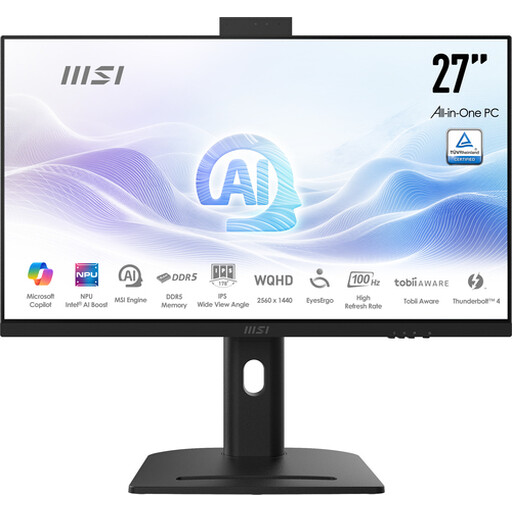
An all-in-one combines the computer and a 27-inch QHD screen. For a second screen, check which video output is available on this model.
Intel Core Ultra 5 125H; 27-inch screen with 2560 × 1440 pixels; 16 GB DDR5 memory; 1 TB SSD.
Check the outputs on the exact computer and the inputs on both monitors. Apple describes supported combinations using Thunderbolt and HDMI for the Mac mini M6; Lenovo lists DisplayPort and HDMI among the connections on the ThinkStation P3 Tower Gen 2. Microsoft Support explains how to set up connected screens separately in Windows.
For Premiere 26.x on the specified Windows systems, Adobe lists 8 GB as the minimum for HD, recommends 16 GB for HD and recommends 32 GB or more for 4K and higher. This advice applies to that version of Premiere and isn’t a general guideline for every editing programme or project.
For the ASUS NUC 15 Pro kits reviewed here, ASUS says that memory and storage aren’t included and that no operating system is pre-installed. Check the exact kit and work out which compatible components and installation you’ll need.
For eligible online consumer purchases, the Dutch government says you generally have 14 days to change your mind; exceptions and the status of the seller may be relevant. There’s no fixed statutory guarantee period for all products in the Netherlands, but you’re entitled to a product that works as it should, and the seller is your point of contact if something goes wrong.
Check the applicable compliance information for the specific desktop, including a CE mark if one is required for that product group. The Dutch government and the European Commission describe the applicable requirements for electrical and electronic equipment; a product family name alone doesn’t confirm that a specific model meets them.