
Student working on large film-scoring sessions
You mix multiple tracks alongside large source files or sample libraries, and want to choose a configuration that suits the sessions you actually work on.


First, choose a desktop that works with your DAW, plug-ins and audio interface. Then compare the processor, memory and storage of the exact configuration with your sessions and source files. A compact Mac, a configurable Windows tower and a custom audio PC are different options, each with its own trade-offs around desk space, configuration and the peripherals you’ll need. Manufacturer specifications aren’t a performance test of your film-scoring session.
You mix multiple tracks alongside large source files or sample libraries, and want to choose a configuration that suits the sessions you actually work on.
You already have a DAW, plug-ins or an audio interface, and want to check first that they work with the desktop’s operating system and connections. Steinberg publishes separate system and hardware requirements for Cubase.
You’re looking for a desktop for a small desk and also need to allow for an external display, peripherals and storage.
Suitable for: limited desk space, provided your DAW, plug-ins and interface work with the macOS version you choose.
Trade-off: Apple lists different memory and storage configurations; check the external display and connections too.
Suitable for: anyone who wants to keep using existing Windows software or equipment, and compare memory and storage options when ordering.
Trade-off: Dell offers several memory and SSD options for the Tower ECT1250; a different configuration may affect the price and delivery date.
Suitable for: anyone who wants to take large source files, sample libraries or specific DAW and interface requirements into account.
Trade-off: HP lists 32 GB RAM and a 1 TB SSD for the Z1 configuration reviewed; with a custom build, you’ll need to check the components and connections.
First decide which concern matters most for your sessions, then compare the complete configuration and the equipment you’ll need for your workspace.
| Consideration | What to look for when buying | Who should prioritise this? |
|---|---|---|
| Mix processing | Compare the exact processor with your DAW’s requirements and, where possible, assess it using a representative session. | If I want to mix lots of tracks and effects at once, I want to choose a computer that suits my DAW and session. Around 25% of consumers give mix processing their highest priority. |
| Source files and recovery | Allow for your project files and the free space you want; also plan recoverable copies in a separate location. | If you work with large source files or samples, you’ll want enough local storage as well as a separate copy of your projects. Around 25% of consumers prioritise storage and recovery. |
| Compatibility | Check the versions of your DAW, plug-ins, interface and drivers, as well as the operating system and available ports. | If my existing software and audio interface are essential, I want to know before buying whether they’ll work with the system I choose. Around 20% of consumers put compatibility first. |
| Workspace and connections | Check the case, display connections, available ports and included peripherals for the exact configuration. | With limited desk space, I want the computer and the display and audio equipment I need to fit into my workspace. Around 15% of consumers prioritise the space available to them. |
| Total setup cost | Compare the complete configuration with the storage, peripherals and any service options you need. | As a student weighing up the cost of a complete, usable setup, I don’t want to look at the desktop alone. Around 15% of consumers prioritise the total budget. |
If your work files and their only copy are on the same computer, extra internal storage alone doesn’t give you a separate recovery point.
Keep recoverable copies in another location and check that you can restore your files.
A separate backup destination requires extra storage or a service, as well as time to check that recovery works.
A Mac mini or Dell Tower may be available with different memory and storage options. The specifications for one configuration don’t automatically apply to another.
Compare the exact model name and chosen configuration, and note them down as you compare.
A desktop won’t necessarily suit your workflow if the required software, drivers or audio hardware don’t work with the system.
Before buying, check the software versions, operating system requirements, drivers and connections for your own setup.
The Mac mini is a compact macOS option; compare the specifications of your chosen M6 configuration with your software and projects.
The Tower ECT1250 is a configurable Windows desktop that lets you weigh up memory and storage options when ordering.
The Z1 Tower G1i is a useful comparison for a Windows tower with specified memory and storage.
Configurable Pro Audio PCs are an option if you want to tailor the components to your DAW and audio interface.
These desktops have a range of configurations for anyone comparing computers for audio and video projects. For each model, check that it works with your DAW and equipment, and that its memory, storage and required peripherals suit your workspace.
 No image available
A compact desktop to compare if you have a small workspace and the chosen macOS configuration works with your DAW and interface.
The product title lists an M6 chip with a 12-core CPU and 12-core GPU, 24 GB memory and a 512 GB SSD.
 No image available
A Windows desktop to compare if you’re considering large source files and multiple tasks running at once; check that it works with your DAW and audio equipment.
The product title lists RTX5090, 32 GB memory and 2 TB storage.
 No image available
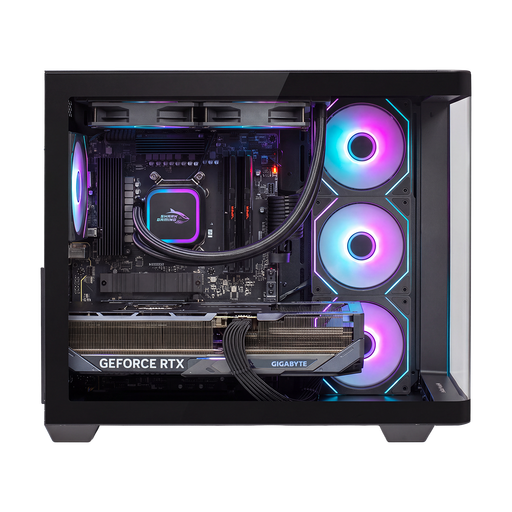
A tower to compare if you’re looking for a Windows desktop with room for large project files; check compatibility with your DAW and interface.
The product title lists an Intel Core Ultra 7, 32 GB DDR5, a 1 TB PCIe 4.0 SSD and an NVIDIA GeForce RTX 5070.
 No image available
A compact desktop to compare if you have limited workspace; check beforehand that the available connections suit your display and audio equipment.
The product title lists a Ryzen 5 7640HS, 24 GB LPDDR5 memory and a 512 GB PCIe 4.0 SSD.
 No image available
An all-in-one to compare if you’re looking for a desktop with an integrated display; check that the connections and DAW compatibility suit your setup.
The product title lists an Intel Core Ultra 7 255H, 16 GB LPDDR5X memory and a 1 TB SSD.
Not always. Avid recommends a higher buffer for larger Pro Tools mixing sessions, giving the computer more time to process the audio. When recording live, a lower buffer can help reduce noticeable latency. This advice doesn’t automatically apply to every DAW.
That depends on your DAW’s capabilities and the video file. Avid describes video import in Pro Tools; check which formats your software supports and match the session frame rate to the video. Having a video port on your computer doesn’t in itself confirm file compatibility.
Keep recoverable copies somewhere other than your working SSD. Backblaze describes the 3-2-1 method: three copies on two types of media, with one stored off-site. This is backup advice, not a legal requirement.
No. According to the Dutch government, there is no fixed statutory warranty period in the Netherlands. You’re entitled to a product that works as it should for a period based on what you can reasonably expect. If there’s a problem, the seller must provide a solution. A manufacturer’s warranty is separate from this.
In many cases, online purchases from a business come with a 14-day cooling-off period, according to the Dutch government. Check the applicable exceptions and the seller’s information; this doesn’t mean every order can be returned without exception.