What should you consider when choosing?
Compact Mac desktop
Suited to: a compact workspace, if your DAW, plug-ins and audio interface support macOS.
Consider: compare the exact memory and SSD configuration with your samples and source files. A compact case doesn’t, by itself, tell you how much capacity you need.
Configurable Windows tower
Suited to: a Windows workflow, or when you want to tailor the computer and storage to your project.
Consider: check the specific SSD, connections and interface driver. A workstation or GPU configuration doesn’t, by itself, prove it will benefit your mix.
Higher-spec Mac Studio
Suited to: projects that need the higher-memory configuration you’ve chosen for your Mac Studio.
Consider: also allow space for source files and backups. The extra capacity doesn’t automatically make this the right choice for a student.
Start by checking software and interface compatibility, then compare the specific memory and storage configuration with your own project.
| What to consider |
What should you check? |
Who should pay particular attention? |
| Memory and SSD space |
List your samples and source files, then compare them with the exact memory and SSD configuration. Check the connection if you plan to use an external SSD. |
If you use lots of samples at once and want to manage large files locally, make space a priority. Around 33% of consumers make memory and storage their top priority in this situation. |
| Processing headroom for the mix |
Compare the system requirements for your DAW and plug-ins with the exact processor and memory configuration. Assess what you need using a representative project. |
If your mix contains lots of tracks or plug-ins, you’ll want to match the configuration to your own workload. Around 27% of consumers prioritise mix workload. |
| Software and video |
Check which operating systems your DAW and plug-ins support. If you import video into Cubase Pro, match the project frame rate to that of the video file. |
If you work with animation footage while composing, you’ll want your software and video workflows to suit your system. Around 20% of consumers make compatibility their top priority. |
| Connections and backups |
Check the ports and driver required by your audio interface. Plan for sample storage and a separate backup destination. |
If you want to connect your existing interface and external storage, and be able to recover project files, factor connections and backups into your choice. Around 20% of consumers prioritise these points. |
Windows desktops on Joybuy
These product picks are Windows desktops with listed memory and storage capacities. Compare the exact configuration with your DAW, audio interface, samples and large source files.
 No image available
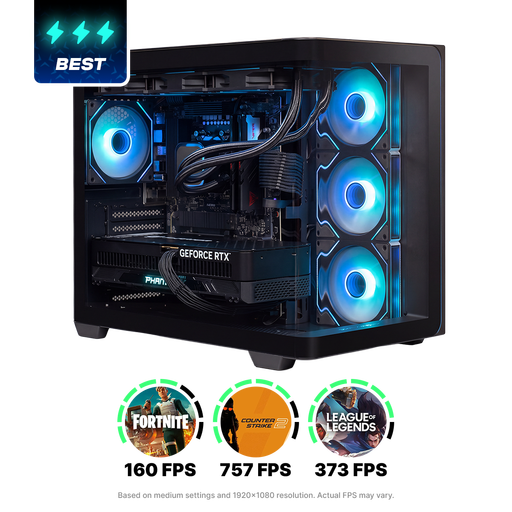
Gaming Desktop PC Ryzen 7 7800X3D, 32GB DDR5, 1TB NVMe SSD
The listed 32GB DDR5 and 1TB NVMe storage may be relevant when considering memory and space for large files. Also check compatibility with your DAW and interface.
The product name lists a Ryzen 7 7800X3D, GeForce RTX 5080 and Windows 11 Trial. The product description refers to Windows 11 Evaluation Version.
View on Joybuy
 No image available
Almighty Shark R900 Gaming Desktop PC, 32 GB RAM, 2 TB SSD
The listed 32 GB RAM and 2 TB storage are useful specifications to compare with your samples and source files. Check that the software and interface you use are supported.
The product name lists an RTX 5090 and Ryzen 9.
View on Joybuy
 No image available
Lenovo Legion T5 30IAX10, Intel Core Ultra 7, 32GB DDR5, 1TB PCIe 4.0 SSD
The listed 32GB DDR5 and 1TB SSD give you specific capacities to compare with your sample and project files. Also check compatibility with your DAW and audio interface.
The product name lists an NVIDIA GeForce RTX 5070, Wi-Fi 7 and Windows 11 Home.
View on Joybuy
Frequently asked questions
Is the minimum RAM requirement for Cubase enough for my animation score?
Not necessarily. Steinberg lists 8 GB of RAM as the minimum system requirement for Cubase 15; this doesn’t guarantee it will be enough for a large project. For the described scenario of an advanced student with more complex sample projects, Spitfire Audio recommends 32 GB or more. Compare this guidance with your own files and instruments.
How can I keep the audio and animation in sync?
If you import video into Cubase Pro 15, Steinberg says the project frame rate should match that of the video file to ensure the time display corresponds. Also check the import and playback using a representative file from your course.
What should I look for in an external SSD for samples?
Check the connection and keep sample storage separate from your backup. For its libraries, Spitfire Audio describes APFS as the optimal format for macOS and NTFS for Windows. Plan the formatting in advance, as it can delete existing files.
How can I protect project files on a Windows desktop?
Microsoft describes File History as a way to save and restore files on an external drive or network location. Check that all the project folders you want to restore are included in your backup settings.
Does buying from a Dutch online shop always come with a fixed statutory guarantee period?
No. According to the Dutch government, products are covered by a statutory guarantee, but there is no fixed statutory guarantee period in the Netherlands. Any additional guarantee is separate; check the terms and contact the seller if a product is faulty.


