Start by matching your desktop to the size of your design files and the software you use. If you work with lots of large images and layers, memory and available SSD space are important considerations. A compact desktop takes up little room, while a configurable tower can give you more choice over its components. In either case, assess the monitor and colour management separately.
Who is this choice relevant to?
Designer working with large image files
If you work with lots of photographic references, layers or complex documents, memory and available storage should be your main considerations. Adobe highlights these points for Photoshop, particularly when working with large or complex files.
Designer who needs to match colours
If you assess colours on screen and need to match them with others or with a print provider, the monitor is a separate choice from the computer. Adobe explains that colours can look different on another screen or in print.
Community group with a permanent workspace
For a permanent design workspace, consider the desk space available, the monitor setup you want and the configuration you choose. Apple Netherlands’ Mac mini specifications and Lenovo Netherlands’ ThinkStation configurations show a range of desktop formats and options.
What should you look for when buying?
Compact desktop with a separate monitor
Best for: a small, permanent workspace where you want to choose your own configuration and monitor.
Bear in mind: check the memory, storage and connections in advance; you’ll need to assess the monitor separately.
Configurable tower or workstation
Best for: anyone who wants to tailor the components, connections and storage to their workload.
Bear in mind: configurations can vary within a product range; Lenovo and Dell offer different configuration options.
Don’t choose based only on the product range or a general claim about graphics performance. For the version of Photoshop reviewed, Adobe lists 8 GB RAM as the minimum and recommends 16 GB or more. These figures aren’t a performance threshold for every design project.
| Consideration |
What to look for |
Who is this important for? |
| Large files |
Check the RAM configuration, available SSD space and how your software handles temporary files. |
If I work with large files or use several applications at once, I want to avoid memory or temporary storage holding me back. Around 36% of consumers put large files first. |
| Colour and detail |
Assess the monitor and colour profiles separately, and agree with your print provider how colours will be checked. |
If I need to match colours with others, I want to know how the design will be assessed on different screens. Around 29% of consumers prioritise colour assessment. |
| Workspace setup |
Check which monitors and connections you need, and what’s included with the configuration you choose. |
If my desk space is limited or I want to view references alongside the design, I’m looking for a setup that suits these needs. Around 21% of consumers choose workspace setup as their first consideration. |
| Configuration and lifespan |
Compare the exact amount of memory and SSD storage, and factor in any peripherals you’ll need. |
If I’m choosing a computer for a specific project, I want to match the configuration and components to my needs. Around 14% of consumers prioritise configuration and long-term value. |
Common buying mistakes
-
Choosing a workstation without checking the configuration
Workstation models in the same range can have very different combinations of memory and storage. The workstation name alone doesn’t tell you which configuration you’ll get.
Compare the configuration you’ve chosen with your software requirements and the size of your project files.
-
Assuming the computer is a complete design workspace
The computer alone won’t tell you whether the monitor is suitable for the way you assess detail and colour.
Consider the monitor, connections and included accessories as separate purchasing decisions.
-
Looking only at the total SSD capacity
Project files, software and temporary files all use storage space. The listed capacity doesn’t tell you how much room you’ll have left for your work.
Estimate the size of your source images and projects, and allow for the space required by software and temporary files.
Brands to consider
Apple
The Mac mini is a compact desktop option if you want to use macOS with a separate monitor.
- Apple Netherlands lists different combinations of unified memory and SSD storage.
- Check the configuration you choose and assess the monitor separately.
Lenovo
The ThinkStation P3 Tower Gen 2 is a configurable tower option.
- Lenovo Netherlands offers different combinations of memory and SSD storage.
- Check the specific configuration: the workstation range name doesn’t mean there’s just one fixed setup.
Dell
The Dell Pro Max Tower T2 is a tower option with a choice of configurations.
- Dell lists options including the processor and operating system.
- Dell says that changing the configuration can affect other specifications, so check the specific setup you choose.
HP
HP offers models including the Z1 Tower and Z2 Mini for different creative workloads.
- HP positions the Z1 Tower for 2D design and lists graphics card options.
- Check the memory, storage and monitor configuration for the design work you have in mind.
Desktops at Joybuy
Joybuy desktop picks for designing a mural using image references.
 No image available
Mac mini, Apple M6 chip, 12-core CPU and 12-core GPU, 24 GB, 512 GB SSD
A compact desktop option if you want to set up a permanent workspace with a separate monitor.
Apple M6 chip; 12-core CPU and 12-core GPU; 24 GB memory; 512 GB SSD.
View at Joybuy
 No image available
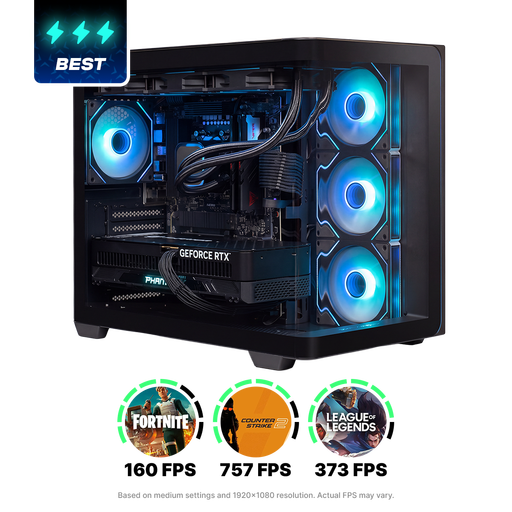
Almighty Shark R900 Gaming Desktop PC, Ryzen 9, RTX 5090, 32 GB RAM, 2 TB SSD
A tower option to consider if you’re looking for a configuration with 32 GB RAM and a 2 TB SSD for large design files.
Ryzen 9; RTX 5090; 32 GB RAM; 2 TB SSD.
View at Joybuy
 No image available
ASUS ROG G700TF-07265F666W, Intel Core Ultra 7 265F, 32 GB DDR5, 1 TB SSD, NVIDIA GeForce RTX 5070 12 GB
A desktop PC to consider if you’re looking for a configuration with 32 GB DDR5 memory and a 1 TB SSD.
Intel Core Ultra 7 265F; 32 GB DDR5; 1 TB SSD; NVIDIA GeForce RTX 5070 with 12 GB.
View at Joybuy
 No image available
FIREBAT F1 Mini PC, AMD Ryzen 5 7640HS, 24 GB RAM, 512 GB PCIe 4.0 SSD
A compact PC option if you’re looking for a small computer and want to choose a separate monitor.
AMD Ryzen 5 7640HS; 24 GB LPDDR5 RAM; 512 GB PCIe 4.0 SSD; Radeon 760M graphics. According to the product name, this model supports output to three monitors.
View at Joybuy
 No image available
Lenovo Yoga AIO 27IAH10 F0J2001DNY, 27-inch QHD 120 Hz, Intel Core Ultra 7 255H, 16 GB, 1 TB SSD
An all-in-one to consider if you want the computer and monitor together in one setup.
27-inch QHD screen; 120 Hz; Intel Core Ultra 7 255H; 16 GB LPDDR5X; 1 TB SSD.
View at Joybuy
Frequently asked questions
Is 8 GB RAM enough for designing in Photoshop?
For the version of Photoshop reviewed, Adobe lists 8 GB as the minimum and recommends 16 GB or more. With large, complex files or several demanding applications, meeting the minimum doesn’t guarantee smooth performance. Check the requirements for your own software and files.
Does a large mural design always need to be 300 ppi?
No, not in every situation. Adobe describes 300 ppi as typical for prints viewed up close, while a lower resolution may be sufficient for large-format printing viewed from further away. Agree the scale and level of detail with the person producing the design. The resolution of your reference photos won’t automatically be the same as that of the final design.
What can I do if colours look different on other screens?
Agree on a colour management process and check the monitor and document profiles. Adobe explains that devices can display colours differently; a more powerful computer won’t make them match automatically.
Do I need permission or a permit for a community mural?
It depends on the location, the work involved and the materials you use. The Environment and Planning Permit Check (Vergunningcheck) can give you an initial indication, but it can’t guarantee the outcome. For certainty, contact your local council. If you want to use copyright-protected photos or other people’s work in a public design, check the rights and get any necessary permission.


