
Testing iOS apps locally
If you need to run iOS or iPadOS simulators locally in Xcode, you’ll need to match the required macOS and Xcode versions. Apple Developer describes these simulators as part of Xcode on macOS.


Choose a Mac if you need to run iOS or iPadOS simulators locally in Xcode. If you’re using Android Studio without local Xcode testing, a suitable Windows desktop may be enough. Match the memory, storage and connections to the number of virtual and physical devices you’ll use at the same time: a compact case or high processor specification alone doesn’t prove that a configuration is right for you. For a specific model sold in the Netherlands, also check the applicable conformity documentation.
If you need to run iOS or iPadOS simulators locally in Xcode, you’ll need to match the required macOS and Xcode versions. Apple Developer describes these simulators as part of Xcode on macOS.
If you mainly test Android apps on a local virtual device, the desktop’s supported software environment, memory and storage are important factors to consider. Google recommends 16 GB of RAM for a good emulator experience.
If you want to run several virtual devices at once or connect physical phones as well, match the available capacity and connections to your setup. Google recommends around 4 GB of memory per Android Virtual Device (AVD) running at the same time, although requirements can vary by system.
First decide which testing environment you need. Then match the memory and storage to the number of devices you’ll use, and check that you have the right connections for your desk.
| What to consider | What should you check? | Who is this important for? |
|---|---|---|
| Local iOS testing | Required Xcode version and compatible macOS version. | If I want to run iOS or iPadOS simulators locally, my choice needs to support Xcode on macOS. Around 31% of consumers say local iOS access is their main purchasing concern. |
| One Android emulator | Supported operating system and processor architecture; installed RAM. | For Android Studio with one local virtual device, I want a configuration that suits the task. Around 31% of consumers name a single Android emulator as their primary purchasing concern. |
| Multiple Android emulators | Number of AVDs running at the same time, memory and available SSD space. Google recommends around 4 GB of memory per AVD running at the same time and possibly up to 6 GB of extra storage per additional AVD. | If I use several virtual devices at once, I need enough room for their additional memory and storage requirements. Around 23% of consumers prioritise capacity for parallel Android testing. |
| Connections at your desk | Required video outputs and USB data ports; also check what’s included with the model. | If you want to connect an existing monitor and physical test phones, you’ll need suitable outputs and ports. For around 15% of consumers, their home working setup is their main purchasing concern. |
Apple provides iOS and iPadOS simulators within Xcode on macOS. A Windows PC therefore can’t replace that local simulator environment.
Before choosing an operating system, decide whether you need iOS simulators locally, then check which macOS and Xcode versions suit your workflow.
Google recommends 16 GB of RAM for a good Android emulator experience and around 4 GB of memory per AVD running at the same time. These are different considerations, not a guarantee that a particular desktop will run several emulators without issues.
Work out how many devices you’ll use at once, then check the memory configuration and upgrade options for the exact model.
According to the Dutch government, if a product is faulty, the seller must provide a solution. A manufacturer’s guarantee or additional service plan doesn’t replace your statutory rights.
Read the terms of any additional plan separately and compare them with your statutory rights. If there’s a problem with the product, also check what the seller is responsible for.
A relevant option if you want to use local iOS or iPadOS simulators through Xcode.
The ThinkCentre M75q Gen 5 Tiny is a compact Windows desktop range for Android-focused testing.
The Dell Pro Micro QCM1250 is a configurable compact Windows desktop for Android testing.
The OmniDesk Mini range is worth considering if you want to explore memory and storage upgrade options for testing.
This selection includes Mac mini models for local iOS testing and Windows desktops for Android testing. For each specific model sold in the Netherlands, check the applicable conformity documentation and make sure the configuration suits your testing setup.
 No image available
The product description lists Windows 11, which suits the Android testing route if you don’t need local Xcode simulators. Google’s 16 GB RAM recommendation for a good emulator experience isn’t a performance guarantee for running several emulators at once.
The product name lists an AMD Ryzen 7 5700X, 16GB DDR4 RAM and a 480GB NVMe PCIe SSD.
 No image available
This Mac mini suits the local iOS or iPadOS simulator route: Apple provides these simulators within Xcode on macOS. Check that the macOS and Xcode versions are suitable for your tests.
The product name lists an M6 chip with a 12-core CPU and 12-core GPU, 16GB of memory and a 256GB SSD.
No image available
This model is suitable for local iOS or iPadOS simulators if the required Xcode version runs on the chosen macOS version. When choosing, allow for the storage space needed for your projects and simulator runtimes.
The product name lists an M6 chip with a 12-core CPU and 12-core GPU, 16GB of memory and a 512GB SSD.
No image available
This configuration is an option for local iOS or iPadOS simulators when macOS and the required Xcode version are compatible. The listed memory capacity alone doesn’t guarantee that a setup with several Android emulators running at once will meet your requirements.
The product name lists an M6 chip with a 12-core CPU and 12-core GPU, 24GB of memory and a 512GB SSD.
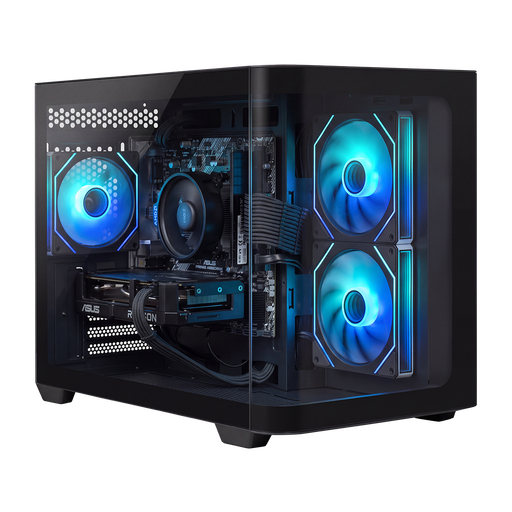 No image available
This Windows 11 Home desktop is suitable for Android testing if you don’t need local Xcode simulators. Its 16 GB RAM matches Google’s recommendation for a good emulator experience, but doesn’t prove that several emulators will run well at the same time.
The product name lists an AMD Ryzen 5 5500, Radeon RX 9060 8GB, 16GB DDR4 and a 500GB NVMe SSD.
You need macOS to run local iOS or iPadOS simulators through Xcode. Apple Developer describes these simulators as part of Xcode. Before buying, check which macOS version is compatible with the Xcode version you need.
No, an emulator isn’t necessary for every Android test. Google also describes testing on a physical Android device or through Device Streaming. Match the desktop configuration to the testing method you actually use.
This depends, among other things, on how many AVDs you run at once. Google recommends around 4 GB of memory per AVD running at the same time and possibly up to 6 GB of storage per additional AVD. You’ll also need to allow for the operating system, editor and your projects.
According to the Dutch government, the seller must provide a solution if a product is faulty; a manufacturer’s guarantee doesn’t replace your statutory guarantee. For eligible distance purchases, a 14-day cooling-off period often applies. Check the terms that apply to your purchase.
Applicable European requirements apply to electrical and electronic equipment placed on the market in the Netherlands. Business.gov.nl explains that, when a product conforms, the manufacturer must affix a CE mark and draw up and sign an EU declaration of conformity. Check the documentation for the exact model; a CE mark isn’t an independent quality assessment.