Choose a desktop based on your illustration software, the size of your files, and the screens and drawing tablets you want to connect. A compact computer may suit a fixed workspace with a separate monitor. For large raster files or several programmes running at once, it’s worth comparing the memory and storage configurations carefully. A more powerful desktop is no substitute for a suitable, well-profiled monitor.
Who is this desktop guide for?
Illustrators working with large image files
If you work with large raster files or several creative programmes at once, compare the memory and available SSD space with the requirements of your own software. Adobe distinguishes between minimum and recommended specifications for Photoshop.
Portfolio creators who assess colour
If you want to assess the colours of the sky, sand and vegetation before a portfolio review, consider your monitor and its profile as part of your workspace. Adobe warns that an inaccurate monitor profile can lead to misleading colour adjustments.
Creators with an existing workspace
If you already have a monitor or drawing tablet, compare its connections with the included components of the exact desktop configuration. A product family name doesn’t tell you which ports, amount of memory or storage your configuration has.
What should you look for when buying?
Compact desktop with a separate monitor
A good fit if: you already have a suitable monitor or want to choose one yourself, and desk space matters. Apple lists 16 GB of memory and HDMI and Thunderbolt ports among the specifications for the Mac mini M6.
Keep in mind: the monitor and any connection accessories you need are part of the complete workspace; the Mac mini configuration mentioned has 256 GB of SSD storage.
Windows desktop with more memory and storage
A good fit if: you create large raster illustrations or use Photoshop alongside other programmes. The HP OmniDesk M02-0640nd reviewed here lists 32 GB of RAM and a 1 TB SSD.
Keep in mind: more memory isn’t automatically necessary for every project, and it’s no substitute for a suitable, profiled monitor.
Windows configuration with 16 GB of RAM
A good fit if: you’re adding to an existing workspace and want to check first whether 16 GB of RAM and a 512 GB SSD will suit your software and files. These are the listed configurations for models including the HP OmniDesk M03-0610nd and Lenovo ThinkCentre neo 50q Gen 5 13B9009EEZ.
Keep in mind: specifications alone can’t predict how your files will perform; also check the connections for your monitor and drawing tablet.
| What to consider |
What should you check? |
Who should pay particular attention? |
| Memory and storage |
Compare your software’s requirements with the RAM, SSD capacity and available space of the exact configuration. For Photoshop 27.x or later, Adobe lists 8 GB of RAM as the minimum, 16 GB or more as recommended, and 100 GB of available disk space as recommended. |
If you work with large raster files or several creative programmes, you’ll want to know how much space your files and software take up. Around 33% of consumers give work files top priority. |
| Colour assessment |
Check which monitor you use and how you can calibrate and profile it for colour-critical work. Adobe explains that an inaccurate profile can lead to misleading colour adjustments. |
If you want to assess colours on screen before a portfolio review, the display matters at least as much as the computer. Around 27% of consumers put colour assessment at the top of their list. |
| Connections and workspace |
Compare the ports, operating system and box contents of the exact configuration with your monitor and drawing tablet. Check with the tablet manufacturer that your model is supported. |
If you already have a monitor or drawing tablet, you’ll want to know whether you can keep using it and whether the desktop will fit on your desk. Around 20% of consumers prioritise connections and workspace. |
| Total budget and file protection |
Check which components are included and, as well as automatic recovery, make a separate backup of your portfolio. Adobe describes operating-system-level backups as an additional safeguard. |
If you want to keep your existing workspace complete and protect your files before a review, factor in the monitor, peripherals and backup too. Around 20% of consumers put total budget and file protection first. |
Common buying mistakes
-
Choosing a desktop based on its processor and forgetting about the monitor
For colour-critical work, an inaccurate monitor profile can lead to incorrect adjustments, whatever the desktop configuration. Adobe explains the importance of calibration and profiling.
Factor the monitor into your choice, check that it can connect to the desktop and set up its profile for your work.
A separate monitor or the connection accessories you need may be part of your complete workspace.
-
Assuming every configuration in a product family has the same specifications
The HP OmniDesk and Lenovo ThinkCentre configurations reviewed here differ in memory and storage. So check the exact model or product code and its corresponding configuration.
Compare the configuration you’re actually considering, not just the product family name.
-
Relying on automatic crash recovery as the only copy of your portfolio
Adobe describes Photoshop recovery settings separately from operating-system backups, so crash recovery alone isn’t the same as having a separate backup.
Make an extra backup before your review and check that you can restore your files from it.
A separate backup solution also takes time to save your files and restore them when needed.
Brands to consider
Apple
The Mac mini M6 is a compact macOS option for anyone who wants to use a separate monitor.
- For the configuration described, Apple lists 16 GB of unified memory, a 256 GB SSD, and HDMI and Thunderbolt ports.
- Check the storage option you choose and how your peripherals connect; these specifications don’t tell you how quickly your files will be processed.
HP
The OmniDesk configurations reviewed here give you specific options for comparing memory and storage.
- The M03-0610nd lists 16 GB of RAM and a 512 GB SSD; the M02-0640nd lists 32 GB of RAM and a 1 TB SSD.
- These specifications apply to the configurations listed, not every OmniDesk.
Lenovo
The ThinkCentre neo 50q Gen 5 is a compact Windows desktop range that Lenovo positions for small and medium-sized businesses.
- The configuration with product number 13B9009EEZ lists 16 GB of RAM and a 512 GB SSD.
- Other configurations in the same product family may have different specifications, so check the product number.
Dell
Dell Pro includes compact desktops and larger cases for anyone comparing size and expansion options.
- Dell describes the Pro Slim QCS1250 as compact and expandable, with DDR5 and up to three PCIe slots in the range listing.
- Check which expansion options and components are actually included with each configuration.
Desktop options at Joybuy
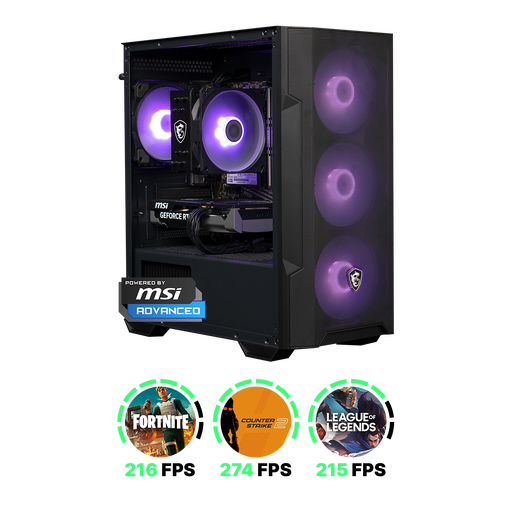
These desktop options are aimed at illustration work, comparing memory and storage, and connecting to an existing workspace. Before choosing, check the configuration and any limitations of each model.
 No image available
Shark Max Bite R500 Gaming PC RTX 5060 / Ryzen 5 / 16 GB / 500 GB
A Windows desktop to compare if you’re adding to an existing workspace and considering storage for your illustration files too.
The product information lists a Ryzen 5 5500, GeForce RTX 5060 with 8 GB, 16 GB DDR4 and a 500 GB NVMe SSD. Compare these details with the requirements of your own illustration software.
View at Joybuy
 No image available
RGB Gaming PC RTX 5060 Ryzen 5 16 GB 480 GB SSD Windows 11 (not activated)
This configuration may suit anyone comparing a Windows desktop with 16 GB of RAM and SSD storage for an existing workspace.
The product information lists a Ryzen 5 5500, RTX 5060 with 8 GB, 16 GB DDR4 and a 480 GB SSD. Windows 11 Home is listed as pre-installed but not activated; check whether this condition suits your needs.
View at Joybuy
 No image available
Panoramic Gaming PC Ryzen 7 5700X RTX 5060 Ti 8 GB 16 GB DDR4 480 GB SSD
Compare this configuration with your software requirements and the other options as you weigh up memory and storage for illustration work.
The product name lists a Ryzen 7 5700X, RTX 5060 Ti with 8 GB, 16 GB DDR4 and a 480 GB NVMe PCIe SSD. Windows 11 Home is listed as pre-installed but not activated.
View at Joybuy
 No image available
Apple Mac mini M6 12-core CPU and GPU 16 GB 256 GB SSD
A compact desktop to consider if you want to choose a separate monitor and the storage in this specific configuration suits your files.
The product name lists an M6 chip with a 12-core CPU and 12-core GPU, 16 GB of memory and a 256 GB SSD. Check that your monitor and other peripherals can connect to the configuration you choose.
View at Joybuy
No image available
Apple Mac mini M6 12-core CPU and GPU 16 GB 512 GB SSD
This compact configuration is worth considering if you want to use a separate monitor and compare more SSD storage than the 256 GB option described above.
The product name lists an M6 chip with a 12-core CPU and 12-core GPU, 16 GB of memory and a 512 GB SSD. Check the monitor and peripheral connections for your workspace.
View at Joybuy
Frequently asked questions
Do you need to buy a separate graphics card for illustration?
Not based on your illustration work alone. Check the graphics requirements of your own programme and compare them with the exact desktop configuration; the specifications listed don’t, by themselves, prove that your files will perform better.
What should you set up before assessing the colours in your portfolio?
Calibrate and profile your monitor for colour-critical work. Adobe explains that an inaccurate profile can lead to misleading colour adjustments, so don’t assess the display based on the desktop specifications alone.
How can you reduce the risk of losing work just before a review?
Save your files carefully and make a separate backup. Adobe describes both automatic crash recovery in Photoshop and backups through the operating system; crash recovery alone isn’t a complete backup strategy.
If you buy a desktop online in the Netherlands, do you have a cooling-off period and a legal guarantee?
According to ACM ConsuWijzer, online consumer purchases generally come with a statutory cooling-off period of up to 14 days after delivery, subject to exceptions that you should check before buying. The statutory guarantee is separate from any manufacturer’s or seller’s guarantee; contact the seller if a product used normally doesn’t do what you could reasonably expect of it. Your exact rights depend on the purchase and circumstances.


