What should you look for when buying?
Expandable Windows workstation
A good fit if: you regularly render complex 3D scenes or want the option to upgrade components later. Check the GPU supplied, graphics memory, RAM and expansion options.
Consider: a tower takes up more space, and the word ‘workstation’ doesn’t prove that every base configuration will suit your projects.
Compact Windows workstation
A good fit if: desk space is limited but your workflow calls for a dedicated GPU. Compare the specifications of the exact configuration.
Consider: check expandability and noise levels separately under sustained rendering workloads.
Compact Mac desktop
A good fit if: your animation programmes and plug-ins run on macOS, and a small computer is a priority. Compare the memory and storage in your chosen version.
Consider: unified memory is not directly equivalent to a separately stated amount of graphics memory. Don’t assume it will run quietly under rendering workloads either.
For the Windows requirements consulted, the Blender Foundation recommends 32 GB RAM and 8 GB graphics memory. These are recommendations, not universal buying requirements. The percentages below offer a cautious indication of priorities in the buying scenarios described.
| Consideration |
What to look for |
Who is this important for? |
| 3D rendering |
Check the exact GPU, graphics memory and supported rendering technology; compare the RAM with your software’s requirements. |
If I render complex 3D scenes, I want the GPU and graphics memory to suit my renderer. Around 40% of consumers make 3D rendering their main buying priority. |
| Space and noise |
Check the dimensions, ventilation clearance and noise information under a relevant rendering workload. |
If I share my desk with colleagues, I want a desktop that fits the available space and doesn’t cause unnecessary disruption while I work. Around 30% of consumers prioritise workplace comfort. |
| Memory and storage |
Check the RAM, SSD capacity, software and plug-in support, and connections for your displays. |
When I switch between animation, previews and other programmes, I want enough memory and storage, and the right connections for my workflow. Around 20% of consumers make this their main priority. |
| Upgrades and service |
Find out which components can be changed and what service arrangements apply to the exact configuration. |
If I need to keep working on my computer, I want to know in advance what support is included and whether upgrades are possible later. Around 10% of consumers prioritise management and service. |
Joybuy desktops for animation
These Joybuy options are gaming desktops with the RTX graphics cards and configurations named in their product titles. Check that the exact components and operating system are compatible with your animation software. For the Windows requirements consulted, the Blender Foundation recommends 32 GB RAM and 8 GB graphics memory; these aren’t performance guarantees for other software or scenes.
 No image available
Gaming Desktop PC Ryzen 7 7800X3D, GeForce RTX 5080, 32 GB RAM, 1 TB SSD
Worth considering for animation work if you’re looking for a desktop with a dedicated GPU. Check your renderer’s support and noise levels during sustained workloads.
The product details list 32 GB DDR5 RAM, a GeForce RTX 5080 with 16 GB graphics memory and a 1 TB NVMe SSD. Windows 11 is listed as a trial version.
View at Joybuy
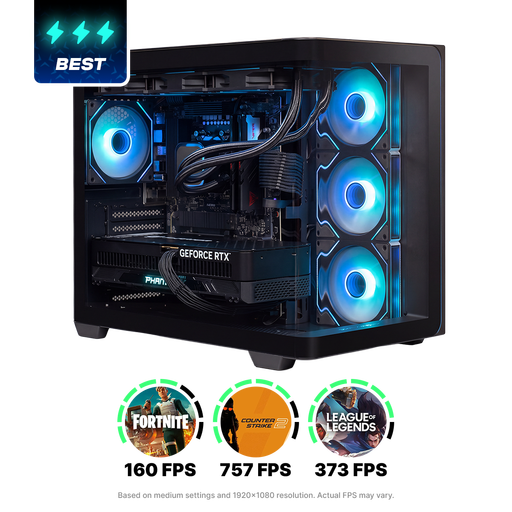 No image available
Almighty Shark R900 Gaming Desktop, RTX 5090, Ryzen 9, 32 GB RAM, 2 TB SSD
May suit a workflow that calls for a desktop with a dedicated GPU. Check compatibility with your software and renderer before choosing.
The product details list a Ryzen 9 9900X3D, RTX 5090 with 24 GB graphics memory, 32 GB RAM and a 2 TB SSD. The listed components don’t indicate noise levels or rendering performance.
View at Joybuy
 No image available
ASUS ROG G700TF-07265F666W, Core Ultra 7 265F, RTX 5070, 32 GB RAM, 1 TB SSD
Consider it for animation work that’s compatible with this Windows desktop. Also check your display connections and noise levels in the office.
The product title lists an Intel Core Ultra 7 265F, 32 GB DDR5 RAM, an RTX 5070 with 12 GB graphics memory and a 1 TB SSD. Windows 11 Home is listed.
View at Joybuy
No image available
ASUS ROG G700TF-05225F170W, Core Ultra 5 225F, RTX 5070, 32 GB RAM, 1 TB SSD
Worth considering if you’re looking for a Windows desktop with a dedicated GPU. Check the configuration against your animation software and noise levels under rendering workloads.
The product title lists an Intel Core Ultra 5 225F, 32 GB DDR5 RAM, an RTX 5070 with 12 GB graphics memory and a 1 TB PCIe 4.0 SSD. Windows 11 Home is listed.
View at Joybuy
 No image available
Lenovo Legion T5 30IAX10, Core Ultra 7, RTX 5070, 32 GB RAM, 1 TB SSD
Worth considering for an animation workflow if your software supports the listed Windows configuration. Check the exact connections and allow enough space for ventilation when positioning the desktop.
The product details list an Intel Core Ultra 7, 32 GB DDR5 RAM, an RTX 5070 with 12 GB graphics memory and a 1 TB PCIe 4.0 SSD. Wi-Fi 7 and Windows 11 Home are also listed.
View at Joybuy
Frequently asked questions
Is 32 GB RAM essential for every animation computer?
No, it depends on the software and projects you use. In the Windows requirements consulted, the Blender Foundation recommends 32 GB system memory and lists 8 GB as the minimum. Check the requirements for your own programmes and scenes.
How do you enable GPU rendering in Blender?
Select a supported render device in the Cycles preferences, then set the scene to use GPU rendering. Whether this works depends on the GPU, operating system and available memory, as described in the Blender manual.
What should you check when setting up at a shared workplace?
Check that your displays connect to the ports on your chosen version, and that there’s enough room around the computer for ventilation. Also ask for verifiable information about noise during your rendering work; a compact case doesn’t automatically mean a quiet computer.
What warranty applies to a purchase in the Netherlands?
For consumer purchases, the product must meet what you can reasonably expect of it; the seller is responsible for the legal guarantee. Compare any manufacturer’s or service warranty offered separately. For a business purchase, check the applicable contractual terms separately. ACM ConsuWijzer explains consumer rights.
Can I always return a custom-built computer bought online within 14 days?
Not in every case. The applicable cooling-off period depends, among other things, on how the computer was configured. The ACM gives computers assembled to order from the options offered as examples that may be covered by a cooling-off period, but also notes an exception for products made to individual specifications. Before placing a custom order, check which situation applies; this isn’t a general conclusion for business orders.


