
Photographer working with large exposure brackets
You regularly merge several landscape shots and want to assess how file sizes, RAM and storage affect your photo-editing software.


Choose a desktop based on your photo-editing software, file sizes and whether you want a separate or built-in screen. Then consider the RAM and SSD capacity, and compare noise measurements under load for the same configuration. A compact case alone is no guarantee that a computer will stay quiet during longer editing sessions.
You regularly merge several landscape shots and want to assess how file sizes, RAM and storage affect your photo-editing software.
You want to know how the fans behave during longer editing sessions, not just how a computer sounds when it is idle.
You’re choosing between a separate screen and an all-in-one, while considering connections, original file storage and backups.
Start with your photo-editing software and files. Then assess noise under load, before choosing a screen setup and storage to suit your workspace.
| What to consider | What to look for when buying | Who should pay particular attention? |
|---|---|---|
| Smooth merging and editing | Check the requirements for your software version, the exact amount of RAM and the available SSD capacity. Adobe recommends at least 16 GB of RAM for Photoshop 27.x; this is not a general minimum requirement for every photo-editing programme. | When I merge large exposure brackets, I want the memory and workspace to suit my files and software. For around 36% of consumers, smooth merging and editing is the top buying priority. |
| Quiet operation under sustained load | Look for a noise measurement of the exact configuration under comparable load, and check the measurement distance and background noise. | In a quiet study, I want to know whether the fans become audible during a longer editing session. Around 29% of consumers prioritise noise under load. |
| Photo storage and backups | Choose SSD capacity to suit your archive, and make separate backups of your catalogue, originals and exports. Adobe notes that a Lightroom Classic catalogue backup contains only the catalogue file. | If I want to keep my originals and exports, my storage and backup plan needs to cover those files separately. For around 21% of consumers, storage and keeping photos safe come first. |
| Screen and workspace | Check whether you already have a suitable screen, whether the video outputs are compatible, and which components are included with the exact configuration. | When setting up a permanent workstation, I want to know whether my current monitor will connect or whether a built-in screen would better suit my setup. Around 14% of consumers consider the screen and workspace their main priority. |
A computer can behave differently during a longer editing session than when it is idle. An independent test of one ThinkCentre M75q Gen 5 configuration illustrates this difference, but its results are not a noise rating for every configuration.
Only compare measurements when the load, measurement distance and configuration are known and comparable. Use results from other configurations as a prompt to investigate further, not as a guarantee for the model you are considering.
According to Adobe, a Lightroom Classic catalogue backup contains only the catalogue file, so your originals and exports need to be backed up separately.
Plan backups for both your catalogue and photo files before moving your archive to a new desktop.
Memory, storage and graphics options can vary by configuration. For example, the HP Z2 Mini G1i configuration listed here has integrated graphics.
Check the full order number and compare the components in that configuration with your software requirements and working files.
The Mac mini is designed to be used with a separate screen, while the iMac has a built-in screen.
The ThinkCentre M75q Gen 5 Tiny is a compact Windows desktop. Compare configurations by their order number.
The Z2 Mini G1i is a compact Windows workstation range to consider if the configuration and support suit your work.
Dell’s Dutch Pro range includes micro and slim desktops, giving you a choice of case sizes to compare.
These desktop options include compact systems used with a separate screen, as well as desktop PCs with memory and storage configurations to consider for your photo-editing work.
 No image available
For a compact workspace with a separate screen; check noise measurements under load for the exact configuration.
This configuration lists 16 GB of unified memory and a 256 GB SSD. Adobe recommends at least 16 GB of RAM for Photoshop 27.x.
No image available
For a compact workspace with a separate screen; check noise measurements under load for the exact configuration.
This configuration lists 16 GB of unified memory and a 512 GB SSD. Adobe recommends at least 16 GB of RAM for Photoshop 27.x.
No image available
For a compact workspace with a separate screen; check noise measurements under load for the exact configuration.
This configuration lists 24 GB of unified memory and a 512 GB SSD. Adobe recommends at least 16 GB of RAM for Photoshop 27.x.
 No image available
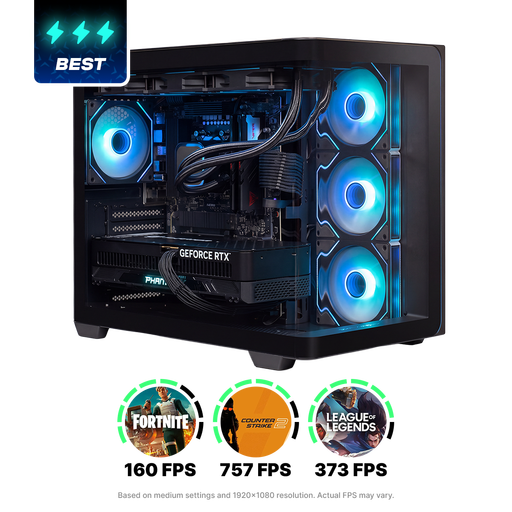
The product listing is aimed at gaming and content creation. Check whether the listed configuration suits your photo-editing software, and check noise levels under sustained load.
The description lists 32 GB DDR5, a Ryzen 7 7800X3D processor, RTX 5080, a 1 TB NVMe SSD and a 360 mm liquid cooler.
 No image available
The description mentions gaming, content creation and productivity tasks. Check your photo-editing software’s requirements and ask about noise levels under sustained load.
The product information lists 32 GB DDR5, a Ryzen 9 9900X3D processor, RTX 5090, a 2 TB NVMe SSD and a 360 mm liquid cooler.
Not based on the task alone. Check the GPU requirements for your photo-editing software and the exact version. Photoshop 27.x lists GPU requirements, but that doesn’t mean a dedicated graphics card is needed for every photo-editing workflow.
Back up your original and exported photos separately. According to Adobe, a backup that Lightroom Classic makes of the catalogue contains only the catalogue file.
No. A compact form factor doesn’t tell you how loud a computer will be under sustained load. In an independent test of a ThinkCentre M75q Gen 5 with a different configuration, ServeTheHome measured 47–48 dBA at 1 metre after more than two minutes under load, with background noise at 34 dBA. Treat this as a reason to check the exact configuration, not as a prediction of how loud it will be.
For a standard online consumer purchase, you generally have a statutory cooling-off period of up to 14 days after delivery. ACM ConsuWijzer lists exceptions, including certain products made to the consumer’s specifications. You also have a legal guarantee if a product does not do what you could reasonably expect under normal use. This is not automatically a fixed two-year guarantee period; the retailer is your point of contact.