First, choose a desktop that can run your operating system, compiler and any containers you use. Then compare its processor, installed memory and SSD with the demands of your own builds. A compact PC takes up less desk space, while a tower may offer more scope for future upgrades. Extra graphics hardware is not automatically an advantage for compiling.
Who is this relevant to?
Builder of large projects
If you regularly compile large codebases or run lots of build tasks in parallel, compare the processor and memory with the demands of your own project before choosing a compact or larger case. For example, the Linux kernel documentation describes a build process using parallel tasks.
Developer using containers
If you keep an IDE, containers and possibly a Linux workspace open at the same time, check the installed memory, SSD space and requirements of your container environment. Docker Docs sets out the requirements for Docker Desktop and WSL 2.
Developer with a small desk
If you’re looking for a desktop computer with a small footprint, also consider the tools you need, the available connections and the scope for future upgrades. Manufacturers such as Lenovo and Acer offer compact models in a range of configurations.
What should you look for?
Upgradeable tower
Choose this option: if you have the space and work on large projects, or want to upgrade the memory and storage later.
Bear in mind: a tower takes up more space. Check the upgrade options for the exact configuration.
Compact PC
Choose this option: if desk space is limited and the configuration you choose meets your software and workflow requirements.
Bear in mind: a small case tells you nothing about build speed or whether you can replace components later.
First decide which requirement matters most for your day-to-day work, then check the full configuration.
| What to consider |
What to look for when buying |
Who is this important for? |
| Parallel builds |
Compare the exact CPU model with your project; test your own build where possible. |
If my builds often run in parallel, I want to match the processor to my project; around 36% of consumers prioritise build times when compiling in parallel. |
| Memory and storage |
Check the installed RAM, free SSD space and upgrade options. |
When I use an IDE, containers and files at the same time, I want to know how much memory and storage is available; around 29% of consumers prioritise space for development tools running simultaneously. |
| Software compatibility |
Check the operating system, versions and virtualisation against the official requirements for your tools. |
If my work depends on specific development tools, I want to know they’ll run on the computer before I buy; around 21% of consumers prioritise this compatibility. |
| Space and upgradeability |
Check the dimensions, connections and upgrade options for the complete model. |
With a small desk, I want to know whether the computer will fit and whether I can upgrade components later; around 14% of consumers give the most weight to space and upgradeability. |
Common buying mistakes
-
Relying on one minimum requirement for your whole working day
The minimum requirements for a single development programme don’t necessarily reflect the combined demands of an IDE, containers and builds running at the same time.
Compare your full workflow with the installed configuration, and check whether you can upgrade the memory and storage later.
If upgrade options are limited, it may be harder to address an undersized memory or storage configuration later on.
-
Choosing a PC mainly for its dedicated graphics card
A build guide in the Linux kernel documentation describes parallel tasks running through the processor; this doesn’t prove that a dedicated graphics card will speed up compiling.
Check separately whether your other development tasks need graphics processing power.
-
Overlooking the exact configuration of a compact PC
Models in the same product range can differ in memory, storage and included components. A barebone version, for example, may be sold without RAM, an SSD or an operating system.
Check the full model number, installed components and upgrade options on the product details page.
-
Assuming the manufacturer’s warranty covers all your consumer rights
ACM ConsuWijzer distinguishes between a commercial warranty and your statutory rights. If a product is faulty, the seller is responsible for providing an appropriate solution.
Keep your proof of purchase and contact the seller if a product doesn’t meet the expectations you were entitled to have.
Brands to compare
HP
HP offers Z1 and Z2 towers, as well as Z2 Mini workstations. Compare the full configuration with your build.
- For selected Z1 and Z2 configurations, HP lists 32 GB or 64 GB RAM and a 1 TB SSD.
- These specifications apply to specific configurations and, on their own, tell you nothing about compile speed.
Lenovo
The ThinkStation P3 Tiny Gen 2 is a compact workstation range with a variety of configurations.
- For one configuration, Lenovo lists 32 GB RAM, a 1 TB SSD and integrated graphics.
- Another listed configuration has 8 GB RAM and a dedicated graphics card, so the range name alone won’t tell you which configuration you’ll get.
Acer
Acer offers compact Veriton models and towers; the exact version determines the configuration.
- For the Veriton N Pro VN6710G, Acer lists a configuration with 32 GB RAM and a 1 TB SSD.
- Acer states that this configuration supports up to 64 GB RAM; check the options for the exact model.
Dell
Dell offers Pro Max Tower and Pro Precision workstation ranges, among others, for comparing tower configurations.
- Dell lists Windows 11 Pro or Ubuntu Linux as options for the Pro Max Tower T2.
- Check the processor and memory configuration of the version you choose; don’t assume the entire range has one standard specification.
Joybuy desktops
This selection of Joybuy products includes desktops and compact PCs for software development at home. Check whether each configuration suits your workflow.
 No image available
Ryzen 7 7800X3D gaming desktop PC
A configuration to compare if you want to match the processor, memory and local storage to your build.
AMD Ryzen 7 7800X3D with 8 cores; 32 GB DDR5; 1 TB NVMe SSD; GeForce RTX 5080.
The operating system is listed as Windows 11 Evaluation Version. A dedicated graphics card is not, in itself, proof of an advantage for compiling.
Joybuy
 No image available
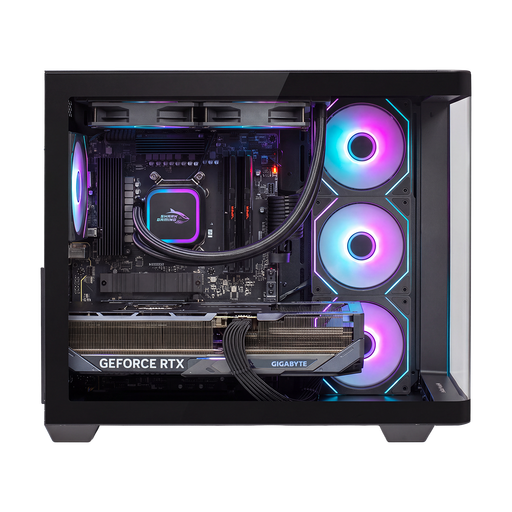
AlmightyShark R700 desktop PC
Compare this stated processor, memory and storage configuration with the requirements of your own development environment.
AMD Ryzen 7 9800X3D with 8 cores and 16 threads; 32 GB DDR5; 2 TB NVMe SSD; Windows 11 Home.
Joybuy
 No image available
Lenovo Legion T5 30IAX10
This tower is worth comparing if you want to upgrade the memory or storage later; check the options for this version.
Intel Core Ultra 7; 32 GB DDR5; 1 TB PCIe SSD; Windows 11 Home.
The product description states support for up to 64 GB memory and upgrades with multiple M.2 SSDs.
Joybuy
 No image available
FIREBAT AM02L mini PC
Its compact design could suit a small desk. Compare the stated configuration with your software requirements and expected workflow.
AMD Ryzen 5 6600H; 16 GB LPDDR5; 512 GB M.2 NVMe SSD; Windows 11 Home.
Connections listed include HDMI 2.1 and DisplayPort 1.4.
Joybuy
 No image available
FIREBAT F1 mini PC Ryzen 5 7640HS
Compare this compact configuration with the memory and storage needs of your local projects and development tools.
AMD Ryzen 5 7640HS with 6 cores and 12 threads; 24 GB LPDDR5; 512 GB PCIe 4.0 SSD.
Connections listed include USB 4.0, HDMI 2.1 and 2.5G Ethernet.
Joybuy
Frequently asked questions
Do I need a dedicated graphics card to compile software?
Not just for compiling. The Linux kernel documentation describes parallel build tasks that run through the processor; check separately whether other software you use requires graphics processing power.
Can I use Linux containers on a Windows desktop?
Yes. Docker documents a WSL 2 backend for this, among other options. Before installing, check the requirements for your version of Windows, WSL and hardware virtualisation; these depend on the Docker installation you choose.
How much SSD space do I need for build files?
It depends on your project and build process, so check how much free space you’ll need for source code, dependencies and build files. The Linux kernel documentation specifies 12 GB of free space in the home directory for the build process described there; this isn’t a general requirement for every project.
What warranty rights do I have as a Dutch consumer?
According to ACM ConsuWijzer, you have statutory rights as well as any commercial warranty if a product used normally doesn’t meet the expectations you were entitled to have. The seller is then responsible for providing an appropriate solution; the length of a commercial warranty doesn’t automatically determine the full duration of your statutory rights.


