
3D animator
You create or render 3D scenes and want to match the GPU support, video memory and RAM of the exact configuration to your software and scenes.


First, choose a desktop that suits your animation software and the type of work you do: motion graphics or rendering complex 3D scenes. A compact computer frees up space on a shared desk, but check the exact GPU, memory, connections and upgrade options. A larger tower offers different configuration choices and needs more room. Manufacturer specifications are not independent performance comparisons.
You create or render 3D scenes and want to match the GPU support, video memory and RAM of the exact configuration to your software and scenes.
You put animations together and create previews. The software, plug-ins and storage you need may matter more than a GPU geared mainly towards 3D rendering.
You want to free up space and be able to use or adjust the screen and input devices easily when someone else takes over the workspace.
A good fit if: your workflow and plug-ins work on macOS and you’re looking for a small computer.
Bear in mind: check the exact model, storage and software compatibility. Don’t infer Blender performance from the number of GPU cores.
A good fit if: Windows software and a small form factor are your priorities.
Bear in mind: the Lenovo ThinkStation P3 Tiny Gen 2 configuration reviewed has 4 GB of video memory; Blender recommends 8 GB VRAM for Windows. This is worth considering for demanding 3D scenes, but it isn’t a universal buying requirement.
A good fit if: configuration options or room for more demanding 3D projects matter more than the smallest footprint.
Bear in mind: check the full configuration and measure the available space. Maximum specifications listed for a product range don’t apply to every configuration.
| What to consider | What should you check? | Who should pay particular attention? |
|---|---|---|
| 3D rendering and GPU | Check the exact GPU, video memory and support for the rendering method you use. Blender recommends 8 GB VRAM for Windows; scenes and workflows vary. | If I mainly render 3D scenes, I want to know whether the GPU I choose suits my software and projects. Around 36% of consumers prioritise GPU suitability for rendering. |
| Animation and previews | Check the requirements for your programmes and plug-ins on the operating system you’ve chosen, and look at the RAM in that exact configuration. | If I create animations and previews, I want a configuration that suits my software and way of working. Around 29% of consumers prioritise animation work and previews. |
| Space and workspace | Measure the space on your desk and check that the computer has the connections you need for separate screens and input devices. | If I share a desk, I want to leave enough room and be able to adjust the set-up easily. Around 21% of consumers prioritise keeping desk space clear. |
| Storage and configuration | Check the SSD capacity, connections and which peripherals are included. Don’t treat configurable maximums as standard specifications. | If I store project files locally or need to complete a workspace set-up, I want to know exactly what the configuration includes. Around 14% of consumers prioritise storage and customisation options. |
The case doesn’t tell you which GPU is inside. According to Lenovo, the Lenovo ThinkStation P3 Tiny Gen 2 configuration reviewed has 4 GB of video memory; Blender Foundation recommends 8 GB VRAM for Windows. Check the exact GPU and the requirements of your software and scenes.
A configuration that doesn’t suit your workflow could mean changing your rendering approach or replacing the computer.
HP lists configurable maximums for the Z2 SFF G1i, including up to 256 GB DDR5; that doesn’t mean the model on offer comes with those specifications. Dell notes that the options selected can change the specifications of the Pro Max Tower T2.
So check the full configuration, including memory, GPU, storage and connections, before comparing models.
For the Lenovo ThinkStation configuration reviewed, the screen, keyboard and mouse are optional and sold separately, according to Lenovo. Don’t assume other configurations include the same items.
Check what’s included and consider the complete workspace. Dutch regulations for display screen work also apply to employees.
If the workspace isn’t set up yet, you may need to arrange a separate screen and input devices.
Mac Studio is a compact macOS desktop for animation workflows that work with the software and plug-ins you need on that platform.
The ThinkStation P3 Tiny Gen 2 is a Windows workstation in a compact case.
The Z2 range includes small form factor (SFF) and tower workstations to suit different space and configuration needs.
The Pro Max Tower T2 is a larger, configurable desktop for those who aren’t just looking for the smallest case.
This selection includes Windows desktops for animation work, from configurations with a dedicated graphics card to a compact mini desktop. For each configuration, check that the GPU, memory, storage and connections suit your software and shared workspace.
 No image available
A Windows desktop with a dedicated graphics card, for anyone who wants to assess a 3D workflow based on the exact GPU and memory configuration.
Intel Core Ultra 7 265F, 32 GB DDR5, 1 TB SSD, NVIDIA GeForce RTX 5070 with 12 GB of video memory and Windows 11 Home.
Blender Foundation recommends 32 GB RAM and 8 GB VRAM for Windows; also check the requirements of your own software and scenes.
No image available
This Windows desktop combines a dedicated graphics card with 32 GB of RAM. Check that the processor suits your animation software.
Intel Core Ultra 5 225F, 32 GB DDR5, 1 TB PCIe 4.0 SSD, NVIDIA GeForce RTX 5070 with 12 GB of video memory and Windows 11 Home.
Blender Foundation recommends 32 GB RAM and 8 GB VRAM for Windows. This doesn’t replace checking the requirements of your own workflow.
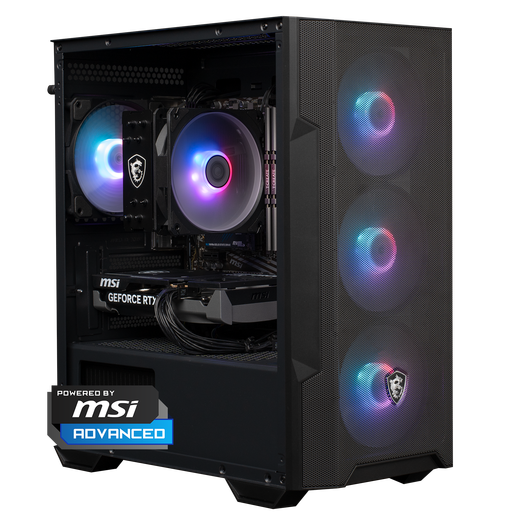 No image available
A Windows desktop with a dedicated graphics card. Compare the RAM with the needs of your animation software.
RTX 5060 with 8 GB of video memory, 16 GB RAM and 1 TB SSD. The product name mentions Ryzen 5.
Blender Foundation recommends 32 GB RAM for Windows. The listed 16 GB is below that; consider what this difference means for your own projects.
 No image available
A Windows desktop with a dedicated graphics card. Check that the storage and RAM suit your projects.
Ryzen 5, 16 GB RAM, 480 GB SSD, RTX 5060 with 8 GB of video memory and a USB Wi-Fi adapter included.
Blender Foundation recommends 32 GB RAM for Windows. The listed 16 GB is below that; check whether it suits your workflow.
 No image available
A compact mini desktop to consider if desk space and your screen set-up are important. Check that its graphics capabilities suit your animation software.
Intel Core Ultra 5 325, 16 GB LPDDR5X, 512 GB PCIe 4.0 SSD, Intel Graphics, Wi-Fi 7 and Windows 11 Home. The description states that it supports up to four screens.
The product description states that the RAM is soldered. Blender Foundation recommends 32 GB RAM for Windows; this configuration has 16 GB.
Start with the requirements for the version of Blender you use. For Windows, Blender Foundation recommends, among other things, 32 GB RAM and 8 GB VRAM. Also check whether the exact GPU supports the Cycles rendering method you want to use. These aren’t general minimum requirements for every animation workflow.
Dutch regulations on display screen work apply when the desk is a workplace for employees. Arboportaal notes, among other things, the need to alternate screen work with other tasks or breaks, as well as rules for setting up a workstation when someone works at a screen for more than two hours a day. Consider this as a question about the whole workspace; one desktop model won’t solve it on its own.
Check what comes with the configuration you choose. For the Lenovo ThinkStation P3 Tiny Gen 2 configuration reviewed, Lenovo states that the screen, keyboard and mouse are optional and sold separately. Don’t assume other models include the same items.
According to ACM ConsuWijzer, online consumer purchases generally come with a statutory 14-day cancellation period after delivery, subject to exceptions. The statutory guarantee also applies: if there’s a fault with a product that you were legally entitled to expect to be in good working order, the seller must resolve the problem. Check which rules and exceptions apply to your purchase, and distinguish between a consumer purchase and a business purchase.