
Vandaag of morgen in huis

Kwaliteit gegarandeerd

Welkomstaanbiedingen ontgrendelen: GRATIS bezorging | Tot 80% korting | Gratis 30 dagen JoyPlus-proefperiode
Download de app
A cluttered desk can seriously disrupt your concentration. Whether you work from home, study, or have an office space, a good desk organizer is an essential tool. It not only helps you find your belongings but also creates a calmer, more productive work environment. However, the market offers an overwhelming number of choices, and not every organizer is practical. Many models look great in photos but turn out to be clumsy or of poor quality in practice.
As a Joybuy Product Recommendation Officer, I'm here to help you cut through the marketing jargon. In this guide, we'll discuss the most common pitfalls and the key specifications to look for, so you can make an informed decision that suits your workspace.
Before you make a purchase, it's wise to know what often goes wrong. Many organizers end up unused in a closet after just a few months. These are the three main reasons:
To avoid the problems mentioned above, it's important to look at a few concrete features. These determine whether a desk organizer will be truly functional for your situation.
The material determines not only the look but also the lifespan and ease of use.
Think carefully about what you need to store. Do you mainly have loose papers? Then a letter tray or a vertical document holder is essential. Do you work with many small items? A desk organizer with a drawer is a great solution to keep everything neatly out of sight. A modular desk shelf that you can customize offers flexibility as your needs change.
Measure the available space on your desk before you buy anything. An organizer that is too large will take up valuable workspace, while a model that is too small won't provide enough storage. Note the total dimensions (length x width x height) and check if the base is wide and stable enough. A good office supply organizer stays firmly in place, even when fully loaded.
To help you get started, we have selected a few organizers that align well with specific needs and work styles.
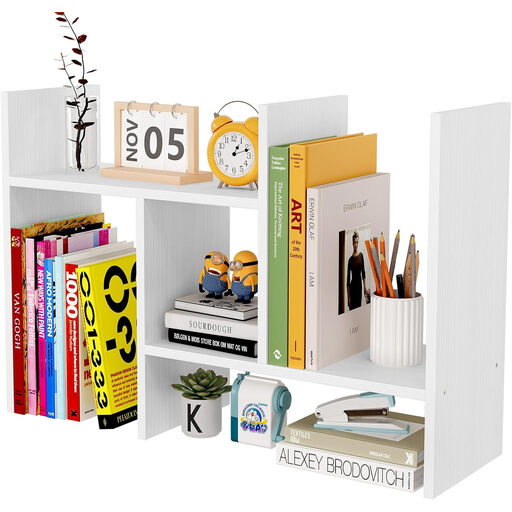
Why This Fits Their Persona: Ideal for those who need to build vertically rather than horizontally. This adjustable shelf adapts to the available space and creates extra storage levels without cluttering the desktop.
This model avoids the 'impractical layout' pitfall because its width is adjustable (from 41 to 73 cm). This makes it flexible enough for various desk sizes and storage needs.
Adjustable design: Adapts to your space. Vertical storage: Uses height to free up desk space.
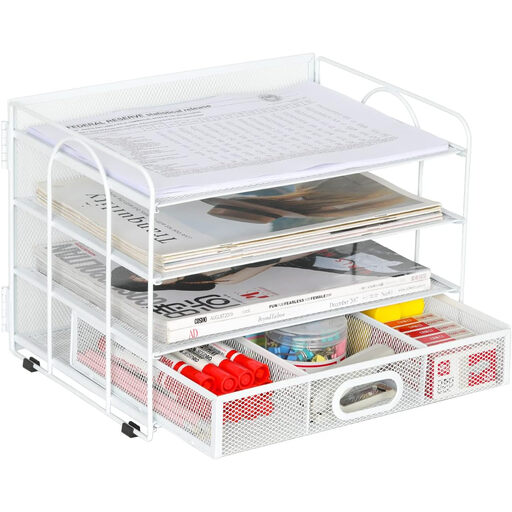
Why This Fits Their Persona: For those who work with stacks of paperwork, folders, and files daily. This metal organizer combines four spacious A4 trays with a convenient drawer for small office supplies.
The robust, powder-coated metal construction avoids the 'unstable construction' pitfall. The L-shaped supports provide extra sturdiness, ensuring the trays won't bend under the weight of documents.
All-in-one solution: Four A4 trays plus a drawer. Stable and durable: Made of metal with anti-slip feet.
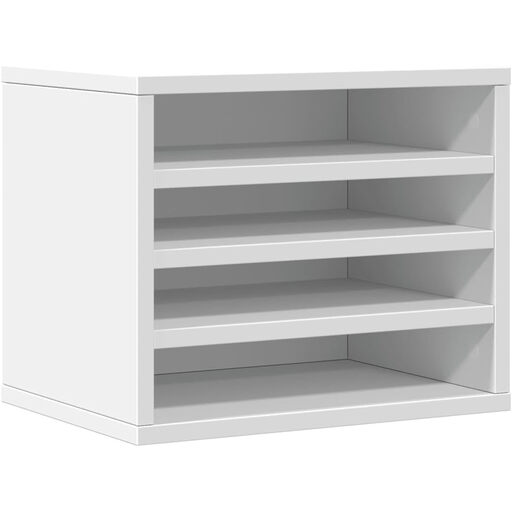
Why This Fits Their Persona: A dorm room or studio apartment calls for smart, affordable solutions. With its clean, white design, this compact model made of engineered wood offers a neutral and tidy look that fits into almost any interior.
This model tackles the 'impractical layout' pitfall by offering a mix of different compartment sizes. There is space for A4 documents, books, and smaller compartments for pens and notepads.
Versatile storage: Multiple compartments for various items. Compact and stylish: Has a small footprint and a minimalist look.
A tidy desk is a personal matter. If the suggestions above don't quite match what you're looking for, or if you want to explore other materials and layouts, be sure to check out our full range.
That depends on the material. A wooden desk organizer or one made of MDF is best wiped with a slightly damp cloth. Avoid aggressive cleaning agents. A metal desk organizer can usually be dusted with a dry cloth. Plastic is the easiest to clean, often with a solution of mild soap and water.
Although the terms are sometimes used interchangeably, a document holder (or magazine holder) is typically a vertical holder where you can stand up folders, magazines, or files. A letter tray is traditionally a horizontal, often stackable, tray for loose A4 documents. Many modern organizers combine both functions.
Absolutely. A desk organizer with a drawer is very practical for storing small items that can quickly create a cluttered look, such as paper clips, staples, USB drives, or business cards. This way, you keep them neatly out of sight but always within reach.
