
People who only need to warm themselves
You want short-term, local warmth at your desk, without making the rest of the shared lounge warmer.


If you mainly want to warm yourself for a short time, consider an infrared heater that directs warmth towards your seat; it won’t automatically heat the whole lounge. If other people also need warmer air, compare a convector with a fan or ceramic heater, taking noise, space and running time into account. Check the instructions and safe connection requirements for every model. Milieu Centraal describes infrared as local radiant heat, while the Netherlands Fire Service recommends plugging electric heaters directly into a wall socket.
You want short-term, local warmth at your desk, without making the rest of the shared lounge warmer.
You want to position and connect a heater without bringing cables, heat or airflow uncomfortably close to other people and belongings.
You need warmth for several people and are weighing up how well warm air spreads against noise and air movement.
| What to consider | What should you look for? | Who should pay particular attention? |
|---|---|---|
| Warmth at your desk | Check whether you can direct the heat towards your seat, and whether the recommended installation and clearance requirements can be met there. | If I mainly want to keep my own space warm, targeted heat is my first consideration. Around 25% of consumers put this need first. |
| Safe positioning and connection | Check the clearance, stability and model-specific safety features. Ideally, plug an electric heater directly into a wall socket. | In a shared space, I want to keep cables and heat safely away from people and belongings. Around 25% of consumers prioritise safe positioning and connection. |
| Energy use while running | Compare the stated power rating and expected running time, as well as any timer or thermostat, with how you plan to use the heater and your electricity tariff. | If I use the heater during working hours, I want to weigh its energy use against how long it will be running. Around 20% of consumers put running costs first. |
| Noise and air movement | Check whether the heater has a fan. Only compare noise figures when they relate to the same operating mode and test conditions. | When other people are working or talking nearby, I want to minimise disruption from noise or airflow. Around 15% of consumers prioritise keeping things comfortable for other users. |
| Warmth for several seating areas | Decide which areas need heat, then compare how convectors and fan heaters work and where they can be positioned. | If several people need warmer air, I’m looking for a solution that covers more than just my desk. Around 15% of consumers put warmth for several seating areas first. |
Infrared warms a specific area, but that doesn’t automatically make it the most energy-efficient choice for every situation. The balance changes if you use it for longer or want to heat the whole lounge.
Start by asking which seating area needs to be warm. Then compare the power rating, running time and your own electricity tariff.
Tip-over or overheat protection doesn’t replace the clearance a heater needs, or make every setup suitable.
Read the instructions for the exact model and check the space around the desk, furniture and cables before using the heater.
An infrared panel directs heat towards a specific area; it won’t automatically warm the air around other seating areas.
Agree whether you want to heat one desk or several seating areas before choosing a type of heater.
If the whole lounge needs to be warm, you may need a second heating solution or to run the heater for longer.
ETHERMA describes the LAVA DESK 2.0 as an infrared heater for desk or table mounting.
The Eurom Safe-t-Heater 2000 is a portable ceramic fan heater.
According to Duux, the Edge range includes convector models with different power ratings.
The Instant Comfort Compact SO2330F2 is a portable fan heater with selectable settings.
This selection includes ceramic fan heaters, an infrared heater and a ceramic convector. Choose according to the type of heat you want, the shared space and the instructions for positioning and use.
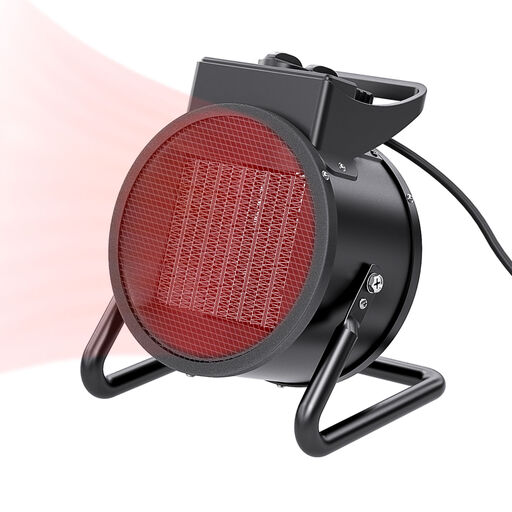 Image unavailable
An option if you want warm air at your workspace and the ability to choose different settings. In a shared lounge, bear in mind that the fan may make some noise.
The product name lists a thermostat, three heat settings and a PTC heating element.
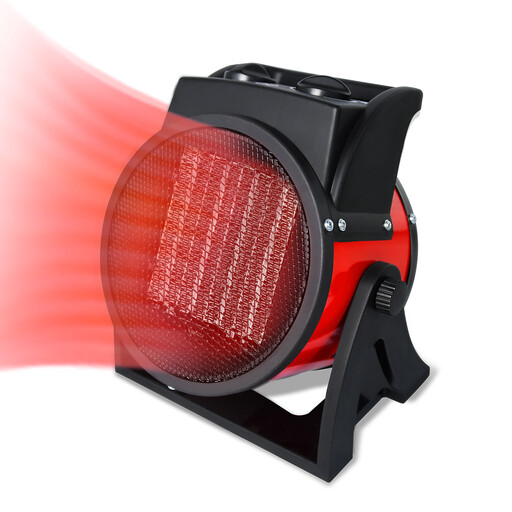 Image unavailable
A ceramic heater to consider if you’re looking for adjustable warmth in a workspace. Check that the instructions allow you to use it in your chosen spot in the lounge.
The product name lists a PTC heating element, thermostat and three heat settings.
 Image unavailable
A portable ceramic heater to consider if adjustable warmth and control over running time matter to you.
The product name lists a thermostat, five heat settings, and overheat and tip-over protection.
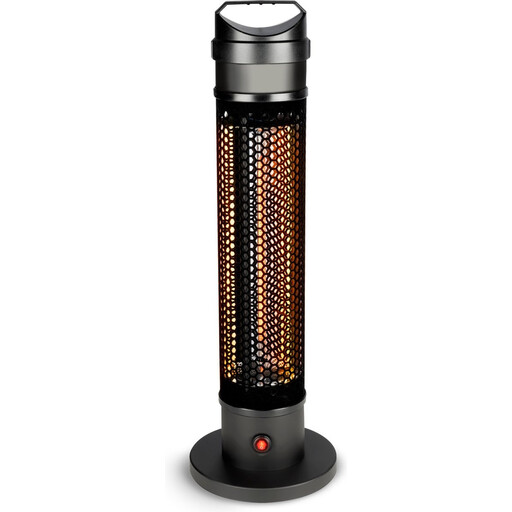 Image unavailable
An infrared option to consider if you want warmth at a specific workspace. Check the recommended distance and positioning requirements for the exact version.
The product name lists a power rating of 800 W.
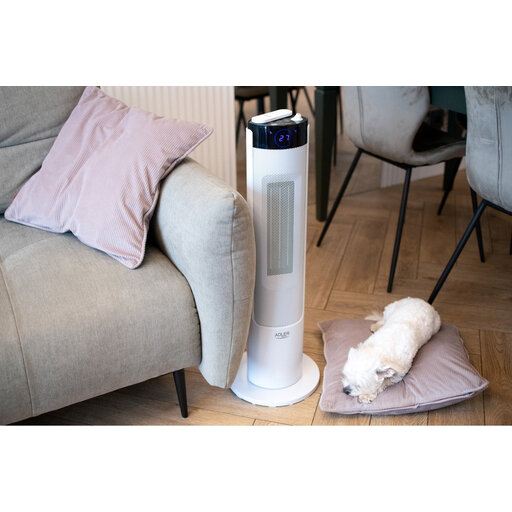 Image unavailable
A convector to compare if you want to heat the air rather than just one seating area. Check the positioning and usage instructions for the lounge.
The product name identifies this as a ceramic convector tower heater.
An infrared panel directed towards your seat may work well for short-term, personal heating. Don’t expect it to warm the whole lounge or other seating areas too, and check that it can be installed in your chosen spot in accordance with the instructions.
The Netherlands Fire Service recommends plugging high-power appliances such as electric heaters directly into a wall socket wherever possible. Follow the instructions for your chosen heater too; this advice is not, by itself, a general legal ban on multiway adaptors or cable reels.
Multiply the power rating in kilowatts by the number of hours the heater is actually switched on to calculate its consumption in kilowatt-hours. An 80 W heater left on continuously for five hours uses 0.4 kWh; a thermostat or timer may change the actual time it is switched on.
If you bought the product as a consumer in the Netherlands, you can hold the retailer responsible under the legal guarantee if the product does not meet what you were entitled to expect. Depending on the circumstances, the retailer may need to put things right free of charge, for example by repairing or replacing the product. The Netherlands has no fixed statutory guarantee period; an additional guarantee does not replace your legal rights.
According to the Netherlands Food and Consumer Product Safety Authority, electric heaters placed on the Dutch market as electrical consumer products must carry the CE mark. The mark is the manufacturer’s declaration that the product complies with the applicable EU rules; it is not proof that every individual heater has been independently tested. Additional rules may apply to heaters with Wi-Fi or Bluetooth.