What should you look for?
Focused infrared heat
A good fit if: you usually sit in the same place and want warmth at your desk. Milieu Centraal says infrared is suitable for providing supplementary heat in a specific spot for shorter periods.
Keep in mind: check the instructions to see whether the panel can be mounted on your desk or in the intended location. The heat is focused on the area covered by the panel.
Ceramic fan heater
A good fit if: you want warmth to spread quickly around your workspace and are happy to accept fan noise.
Keep in mind: compare the heat settings and stated noise level for the exact model. An eco-mode claim does not prove that electric resistance heating is generally more efficient.
Convector heater
A good fit if: you want to heat a larger part of your home office for several hours and are looking for a heater without a fan. Qlima positions the ECH 4020 as suitable for heating a room for several hours.
Keep in mind: you’ll heat more of the room’s air than with focused radiant heat, so consider the power, how long it will be on and how the thermostat works together.
| What to consider |
What should you look for? |
Who is this important for? |
| Focused warmth |
Check the direction of the heat, permitted mounting locations and controls; make sure they suit where you sit and your working hours. |
If I mainly want to keep my regular workspace warm rather than heat the whole room, I look for warmth that reaches where I sit. Around 40% of consumers give focused warmth at their regular seat top priority. |
| Quiet room heating |
Check whether the heater uses convection without a fan, and look at its stated power and thermostat. |
When I work in the same room for hours, I want to warm the air without fan noise. Around 30% of consumers prioritise quietly heating a larger part of the room. |
| Spreading warmth quickly |
Compare the adjustable heat settings and stated noise level for the exact model. |
If I mainly want extra warmth quickly at the start of a work session, a fan setting may suit me if the noise is acceptable. Around 20% of consumers put rapid heating first. |
| Safe positioning |
Follow the placement instructions and check the cable length and available sockets; plug the heater directly into a socket. |
At my desk, I want to know whether the furniture, cables and socket allow me to set the heater up safely. Around 10% of consumers say safe positioning is their most important selection criterion. |
The Dutch Fire Service advises plugging high-power appliances, including electric heaters, directly into a socket rather than using a cable reel or extension block. For appliances covered by the EU Low Voltage Directive, check the conformity documents and required CE marking for the specific model.
Joybuy products
These products are electric fan and ceramic heaters for supplementary warmth at a workspace or in a small room. Before use, check that the stated purpose, positioning and safety instructions are suitable for your home office.
 No image available
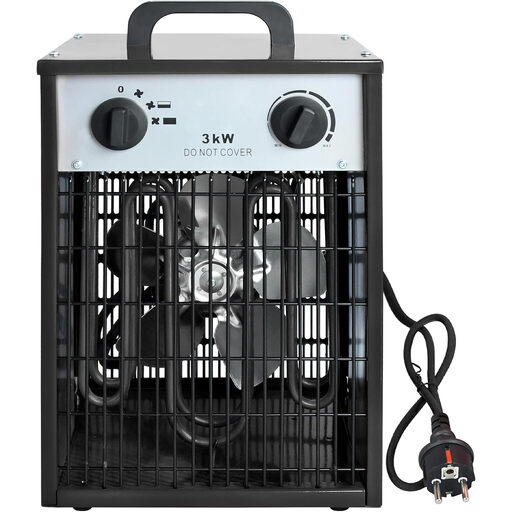
3 kW electric fan heater, 4 heat settings
The title describes a fan heater for workshops, garages, warehouses and building sites; check whether the instructions permit the intended use and positioning at a desk.
The product title lists 3 kW, four heat settings and overheat protection.
View at Joybuy
 No image available
Philips 2000 Series CX2120/01 ceramic heater
According to the product information, this compact ceramic heater is intended for indoor use; the description says it is suitable for rooms up to 15 m².
The title lists 1.500 W and three settings. The product description states 24 dB(A); leave at least 1 metre of clear space around the heater and keep it away from curtains, furniture and other flammable materials.
View at Joybuy
 No image available
OmniHeat 1.800 W ceramic fan heater
The product description lists offices as a suitable use and says the heater oscillates to spread the warmth.
The title lists four heat settings and an adjustable thermostat. The description mentions a 24-hour timer, a remote control and noise levels of 38 to 50 dB. Keep the heater at least 1 metre away from flammable materials and do not cover it.
View at Joybuy
 No image available
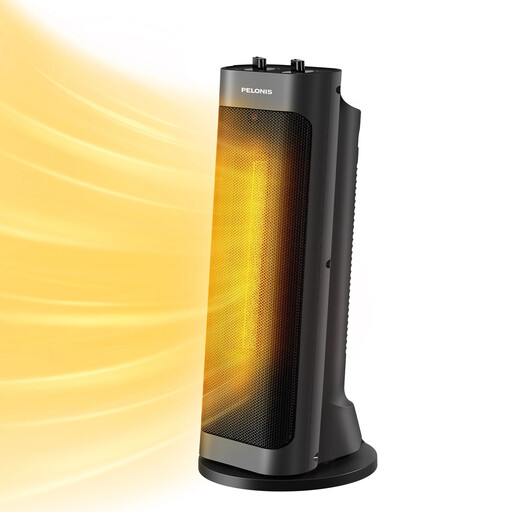
PELONIS 2.000 W PTC ceramic fan heater
The product title describes a portable heater for rooms up to 15 m² and lists 70° oscillation.
The title mentions heating up in 3 seconds, tip-over shut-off and overheat protection; the description states 50 dB. Place the heater on a stable surface, do not cover it and keep it at least 1 metre away from flammable materials.
View at Joybuy
Frequently asked questions
Is an infrared panel at my desk automatically more economical than every other electric heater?
No. Milieu Centraal says infrared is suitable for short periods of warmth in one occupied spot; this does not prove that a panel uses less electricity when heating a whole room for a long time. The right choice also depends on the space being heated and how long you use it.
How should I plug in an electric heater at my desk?
Plug it directly into a socket, not an extension block or cable reel. The Dutch Fire Service advises this for high-power appliances such as electric heaters. Also follow the instructions for positioning and maintenance for the exact appliance.
How do I work out the electricity cost during my working hours?
Multiply the power in kW by the actual number of hours the heater is switched on and your electricity rate per kWh. A 1.000 W appliance uses one kWh when it heats at full power for an actual hour; a thermostat can change how long it is switched on. Milieu Centraal recommends using a plug-in energy meter to measure consumption.
What warranty and cancellation period apply to online purchases in the Netherlands?
For online purchases, you generally have a statutory 14-day cancellation period from delivery, subject to applicable exceptions. You also have a statutory guarantee: if a product does not do what you could reasonably expect when used normally, the seller is responsible for providing an appropriate solution. ACM ConsuWijzer explains these rights.
What product requirements should I check for an electric heater used on the Dutch mains supply?
For the specific model, check the conformity documents and required CE marking if the appliance is covered by the EU Low Voltage Directive. According to Netbeheer Nederland, the Dutch household electricity supply is approximately 230 V. A CE marking is not an independent performance test.


