
Vandaag of morgen in huis

Kwaliteit gegarandeerd

Welkomstaanbiedingen ontgrendelen: GRATIS bezorging | Tot 80% korting | Gratis 30 dagen JoyPlus-proefperiode
Download de app
Buying a desk seems simple, until you discover that many models offer less space than you expected, wobble on an uneven floor or don’t suit the way you work. A compact desk can be handy in a student room, but may become impractical if you also need space for a large monitor, keyboard and documents. A desk with drawers can provide storage, but often needs extra attention when it comes to wall fixing and stability.
As a Joybuy Product Recommendation Officer, I assess product information for practical details. So don’t focus only on colour or appearance: pay particular attention to dimensions, materials, assembly and what the desk is designed for.
A desk that’s 80 or 90 cm long may seem suitable for a small room. However, depth determines how much space you really have for your arms, screen and accessories. A 40 cm-deep desktop works for a laptop or writing, but is limiting for a computer desk with a large monitor and keyboard.
Before you buy, measure not only the available wall space, but also:
A desk with storage, drawers or open compartments can help keep a room tidy. However, extra components add weight and can change the centre of gravity. Some models must be fixed to the wall to prevent them from tipping over. Check whether fixing materials are included and whether it’s safe to drill into your wall.
A desk with drawers isn’t automatically suitable for heavy folders or equipment. Check whether the product information states a maximum load. If it doesn’t, don’t use the desktop for heavy equipment without making further checks.
A height-adjustable desk or sit-stand desk lets you switch between sitting and standing. That doesn’t automatically mean every user will find the right working height or that the desk can be adjusted continuously without a break. Check the height range, maximum static load and motor instructions.
For example, the product information for some electric models in this selection states that an overheating protection feature may activate after prolonged, continuous operation. It also advises waiting before using the desk again. In addition, don’t position the desk right up against a wall while adjusting its height.
For a small desk in a corner or student room, dimensions of around 80 to 102 cm wide and 40 to 50 cm deep are practical. A 90 x 40 cm desk takes up little floor space, but is best suited to a laptop, writing or a limited amount of equipment.
If you use two screens, documents or a docking station, a desk measuring around 120 x 60 cm or 160 x 70 cm may work better. With a larger desktop, remember to allow for clear walkways and space for cables.
Many models are made from engineered wood or chipboard with a steel frame. Look out for the difference between a smooth finish and information about the actual load capacity. A moisture-resistant surface isn’t the same as being waterproof: clean the desk with a soft, slightly damp cloth, then dry it.
The electric models in this selection have a maximum static load of 70 kg. This is a product specification, not a recommendation to load the desk up to this limit for long periods. Spread heavy equipment evenly across the desktop.
Almost all the desks mentioned require assembly. Before you start, check that you have enough time, tools and space to lay out the parts. A stable, level surface is important. For models with drawers or shelves, follow the safety instructions and don’t skip any required wall fixings.
A white desk, black-and-brown desk or grey oak desk differs mainly in appearance. Colour tells you nothing about stability, load capacity or ease of assembly. Compare these details separately.
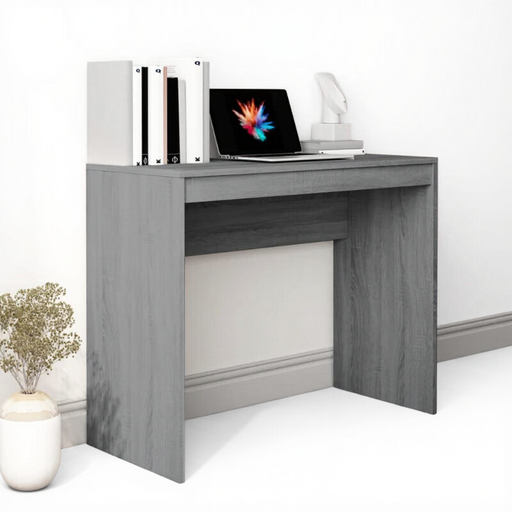
Why it suits this profile: At 90 cm wide and 40 cm deep, this compact desk takes up little space. It’s a good fit for a laptop workstation, writing nook or small student room.
The dimensions are clearly stated, so you can check in advance whether a depth of 40 cm will be enough. There are no drawers taking up extra space.
Engineered wood, grey oak appearance, 90 x 40 x 72 cm, and a surface that the product information says can be cleaned with a damp cloth.
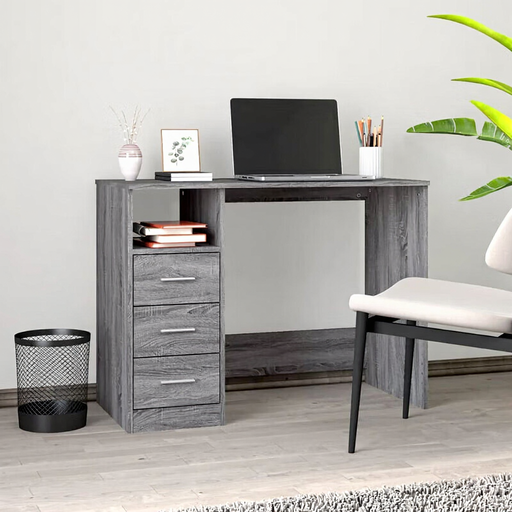
Why it suits this profile: The 102 x 50 cm desktop, three drawers and an open compartment make this a good choice for home workers who want to keep documents and accessories out of sight.
The storage is clearly described. The product information also states that permanent wall fixing is needed to prevent the desk from tipping over.
Three drawers, one open compartment, a product weight of 29.56 kg and an engineered wood surface with a grey oak finish.
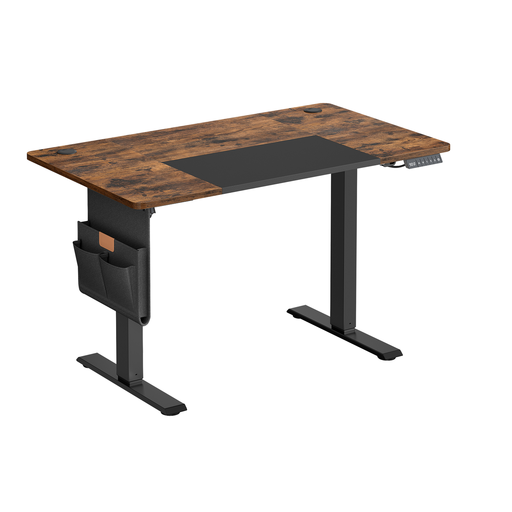
Why it suits this profile: This sit-stand desk is designed for people who regularly switch between sitting and standing, and need a 120 x 60 cm desktop.
The height range of 72 to 120 cm and maximum static load of 70 kg are specified. The product information also mentions overheating protection and a waiting period after prolonged operation.
Electric height adjustment, memory function, USB-C port, cable management and a steel frame.
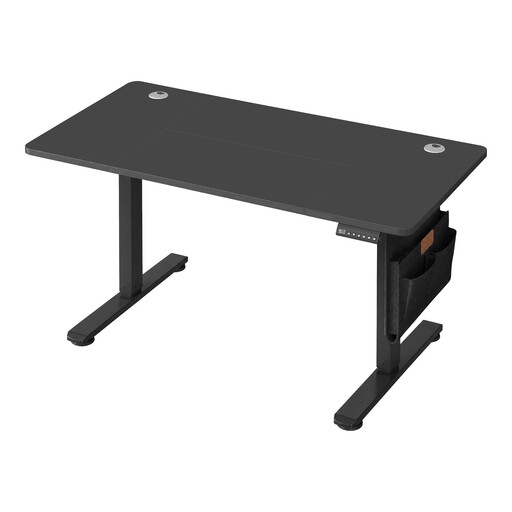
Why it suits this profile: The wide 160 x 70 cm desktop has room for several screens, documents and accessories. That makes it suitable for long days working from home or studying with lots of equipment.
The product specifications give a height range of 72 to 120 cm and a maximum static load of 70 kg. Adjustable feet help you level the desk on an uneven floor.
160 x 70 cm desktop, memory function, two cable ports, USB-C connection and a steel frame.
We’ve put together a complete, up-to-date list of products that meet these strict selection criteria and the applicable European safety regulations.
A depth of 40 cm may be enough for a laptop and writing. For a monitor, keyboard and mouse, 50 to 60 cm is more practical. If you use several screens, a desktop around 70 cm deep may be useful, provided you have enough room.
A desk’s lifespan depends on its materials, assembly, load and use. Check the screws and wall fixings regularly. Don’t use the desk as a step and don’t exceed the stated maximum load. For electric models, keep cables and motor components dry and clear of obstructions.
Power consumption depends on how often and for how long you use the motor. The motor only runs while you adjust the height; when the desk is stationary, it typically doesn’t move continuously. For exact figures, check the technical information for the specific model and use only the supplied or specified adapter.
