
Vandaag of morgen in huis

Kwaliteit gegarandeerd

Welkomstaanbiedingen ontgrendelen: GRATIS bezorging | Tot 80% korting | Gratis 30 dagen JoyPlus-proefperiode
Download de app
A desk should suit your room, posture and everyday needs. Yet many buyers focus mainly on colour or price. As a result, they sometimes end up with a desk that’s too deep, too narrow or not stable enough for a computer and accessories.
The main pitfalls when choosing a desk are:
Checking dimensions without allowing room to move around
A 90 cm desktop can be practical, but only if there’s also enough room for a chair and for opening drawers or doors.
Confusing storage space with workspace
A desk with drawers gives you more options for storing things, but the drawers also take up space beneath the desktop. So check where your legs and desk chair will go.
Interpreting material claims too broadly
Terms such as “strong”, “stable” or “moisture-resistant” appear in product descriptions, but they don’t automatically tell you the maximum load. Look for specific measurements, construction details and a stated load capacity.
The right size depends on how you’ll use it. For a laptop and writing, a compact desk around 90 cm wide may be enough. A depth of 40 cm does call for an efficient layout: there’s usually room for a laptop, notebook and lamp, but a large monitor and keyboard can feel cramped.
Keep these points in mind:
For a desk for small spaces, a narrow desktop and simple shape are often more practical than a large corner model. If you regularly work with several screens, consider a larger computer desk or home office desk.
A desk made from engineered wood usually has a smooth surface and is easy to clean with a slightly damp cloth. The product information for the vidaXL models lists engineered wood as the material. Don’t use abrasive products, harsh solvents or excessive water, as these could damage the finish.
Before buying, check:
For models with drawers, wall fixing is especially important. The product descriptions for the vidaXL desks with drawers state that they need to be fixed to the wall to prevent them from tipping over. Don’t let children hang from the drawers or climb onto the desktop. After assembly, regularly check that the screws and fixing points are still secure.
A modern desk doesn’t have to be complicated. A simple finish, straight legs and a desktop without unnecessary features often make it easier to make good use of the space available. For example, a Sonoma oak desk in a warm wood tone works well with light walls and neutral furniture, while a grey Sonoma finish creates a cooler look.
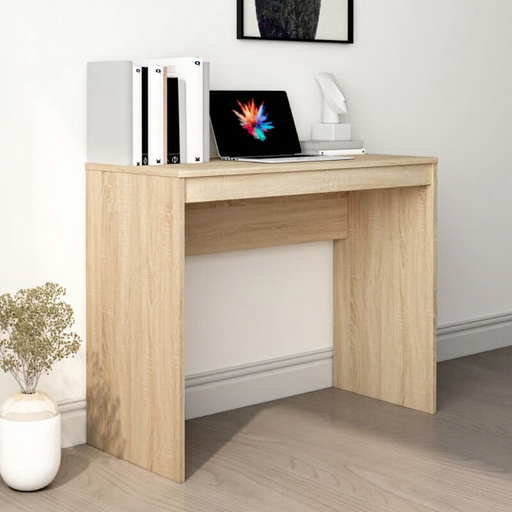
Why it suits this profile: This narrow desk is designed for students, laptop users and anyone with limited floor space. It measures 90 x 40 x 72 cm.
Its fixed dimensions make it easy to see in advance how much space the desk will take up. That makes it less likely that a larger model will dominate the room.
Engineered wood construction, a Sonoma oak finish and a surface that, according to the product information, can be cleaned with a damp cloth.
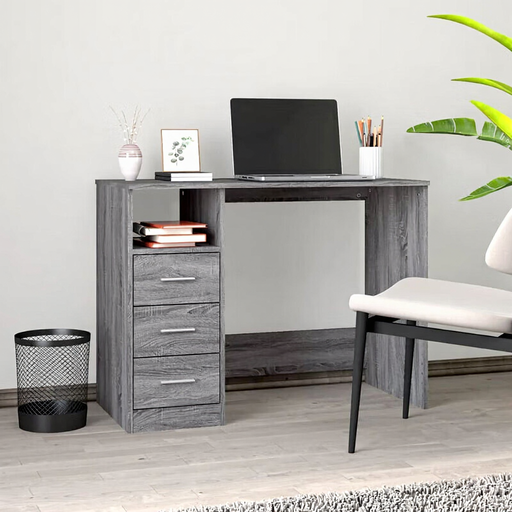
Why it suits this profile: If you value a tidy workspace, this desk gives you a 102 x 50 cm desktop and, according to the product description, three drawers and an open compartment.
The storage space helps keep books and stationery from taking over the desktop. Wall fixing is still essential.
Three drawers, an open compartment, a smooth surface and a grey Sonoma oak finish. Assembly is required.
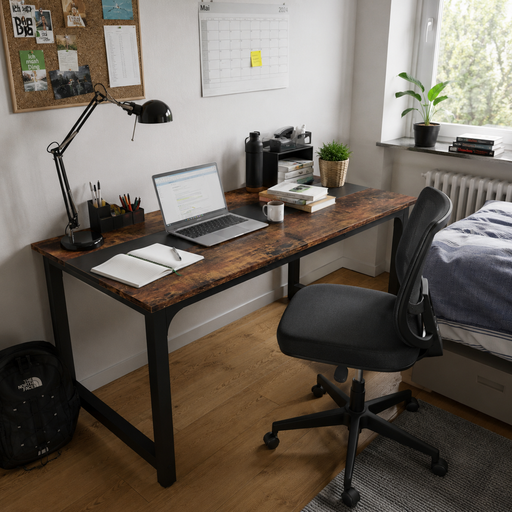
Why it suits this profile: This large desktop is designed for intensive computer use, several devices, writing or a shared workspace.
The generous dimensions help prevent your monitor, printer and documents from competing for space. Just check that 160 x 80 cm will fit in your room.
Steel frame, adjustable foot caps and a maximum load capacity of 400 kg, as stated in the product information.
We’ve put together a complete, up-to-date list of products that meet these strict selection criteria and the applicable European safety regulations.
A depth of 40 cm may be enough for a laptop alone. If you use a monitor, keyboard and mouse, 50 cm gives you more room to move. For several screens or a printer, a deeper desktop of around 80 cm is more practical.
How long it lasts depends on assembly, load, moisture and everyday use. Place the desk on a level surface, follow the assembly instructions and avoid harsh cleaning products. If the model needs wall fixing, don’t skip that step.
A standard desk without lighting, a motor or built-in electronics doesn’t use electricity itself. The energy costs come from connected devices such as a laptop, monitor or desk lamp. So check that the desk has enough room for cable management and a safe place for extension leads.
