
People with a cold spare room
If you rarely heat the room, measure its temperature and check that it falls within the model’s operating range. The Consumers’ Association considers desiccant dehumidifiers suitable for cold rooms.


If your spare room is often cold or unheated, a desiccant dehumidifier could be a suitable choice. The Consumers’ Association considers this type suitable for cold rooms, although it uses more electricity than a compressor model. If the room usually stays above 15 °C, compare a compressor model too, and factor in how often you expect to use it. If damp keeps coming back, tackle the cause first and continue to ventilate the room: a dehumidifier is no substitute for that.
If you rarely heat the room, measure its temperature and check that it falls within the model’s operating range. The Consumers’ Association considers desiccant dehumidifiers suitable for cold rooms.
If you want to control humidity over a longer period, compare electricity consumption and running time. According to the Consumers’ Association, desiccant models use more electricity than compressor models.
If you also sleep or work in the room, check the noise level for each fan setting and how often you’ll need to empty the tank. The Consumers’ Association includes noise measurements at different settings in its testing method.
First, measure the room’s usual temperature. Then compare electricity consumption, noise levels during use and the options for draining the water.
| What to consider | What should you check? | Who is this important for? |
|---|---|---|
| Performance at low temperatures | Measure the room temperature and check the operating range, as well as the conditions specified for the exact model’s stated capacity. | If my spare room is often cold, I want to know whether the appliance will operate within its specified range. Around 36% of consumers focus mainly on dehumidifying at low room temperatures. |
| Electricity consumption | Compare the stated power, humidity controls and expected running time. Use your own kWh tariff to work out the cost. | If I’m using it for long periods, I want to factor in electricity use as well as its suitability for a cool room. Around 29% of consumers prioritise electricity use when an appliance is used repeatedly or for long periods. |
| Noise | Check the noise level for each fan setting and note the conditions under which it was measured. | If I sleep or work in the room, I want to assess the noise level for the setting I’ll be using. Around 21% of consumers focus mainly on noise in a spare room or workspace. |
| Water drainage | Check the tank capacity, whether there’s a hose connection and whether you can drain the hose where you want to. | If I don’t check the room often, I want to avoid having to empty the tank by hand too frequently. Around 14% of consumers focus mainly on the tank or continuous drainage. |
How much moisture an appliance removes depends partly on the temperature and humidity. A capacity measured under different conditions doesn’t automatically tell you what to expect in your spare room.
Compare the temperature and relative humidity specified for the stated capacity with the conditions in your room.
A dehumidifier won’t fix a leak or a structural damp problem, and it won’t remove polluted indoor air. The Haaglanden Public Health Service advises tackling the cause of damp; the Dutch Government describes ventilation as a way to remove damp and polluted air.
Investigate recurring damp or mould, and continue to ventilate in line with the Dutch Government’s advice.
The Consumers’ Association says desiccant models use more electricity than compressor models. If you use one for long periods, this difference could affect your choice.
If the room usually stays warm, compare a suitable compressor model too, and work out the cost using your own tariff and expected running time.
Qlima describes the DD 808 as a desiccant dehumidifier for colder rooms. It may be worth considering if your spare room is often cool.
Wood’s describes the WDD80 as a desiccant model with a tank and hose connection. This may be relevant if you’re considering drainage and how often you’ll need to empty it.
The DD8L Junior is a desiccant model with automatic humidity control, for anyone who also uses the room for sleeping or working.
The DD1 Classic MK6 is another desiccant option, with published temperature and capacity figures. EcoAir’s product page relates to a UK listing.
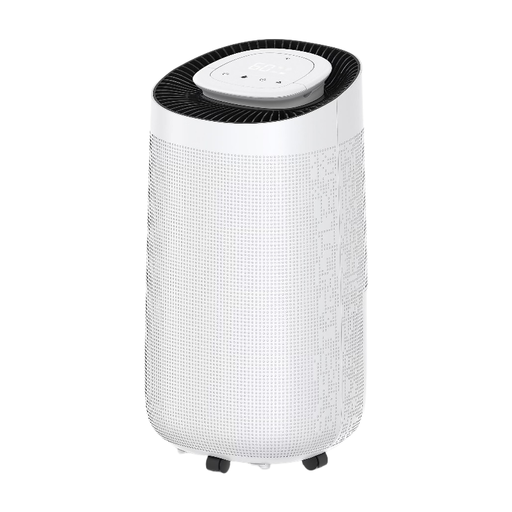
This selection features dehumidifiers for managing humidity in rooms. According to the product information, the CONOPU 16L is a compressor model, so it may be particularly relevant if your spare room usually stays warm.
 No image available
An option to compare if you want to reduce damp in the room and empty the tank by hand less often.
The product name lists 16 L/day, a 3.2 L tank and a filter. The product information also mentions a timer, a drain hose and automatic shut-off when the tank is full; check which parts are included with the version on offer.
 No image available
Could be a good fit if you want to compare Wi-Fi control or a sleep mode as well as humidity control.
The product information lists a 1.8 L tank, a stated coverage area of up to 24 m², three settings and two drainage options. The product name lists 32 dB; check the conditions under which this noise level was measured. A drain hose isn’t listed as an included part.
 No image available
An option to consider if you’re looking for a dehumidifier for a room that’s also used for sleeping.
The product information lists a stated coverage area of up to 40 m², a 2.5 L tank and three settings, including a sleep mode. The product name lists 35 dB; check the conditions under which this noise level was measured.
 No image available
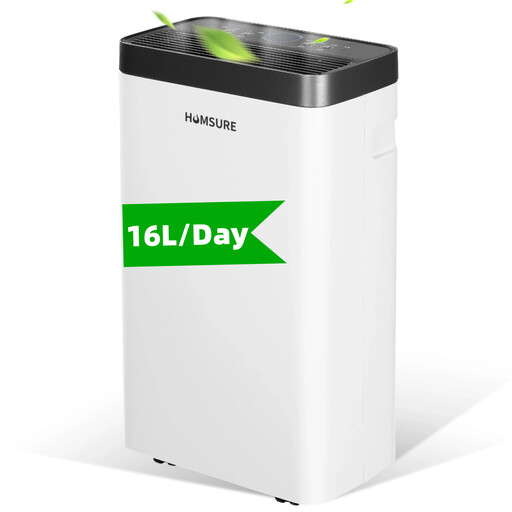
Could be relevant if you want to compare the stated daily capacity and drainage options with the conditions in your room.
The product name lists 16L/Day, a 1.4 L tank and coverage of up to 25 m². The product information mentions a timer, automatic defrost, shut-off when the tank is full and an included drain hose. The stated capacity depends on the conditions.
 No image available
According to the product information, this is a compressor model. The Consumers’ Association considers compressor models mainly suitable for rooms that usually stay above 15 °C, so it’s worth comparing this one if your spare room is generally warm.
The product name lists 16L and a 2.5 L tank. The product information mentions a timer and two drain hoses; check which parts are included with the version on offer.
Not as a substitute for tackling the cause. The Haaglanden Public Health Service lists leaks, cold surfaces and everyday moisture production among the possible factors; according to the Dutch Government, ventilation removes damp and polluted air. So investigate recurring damp or mould first.
Compare the temperature and relative humidity specified for the stated capacity with the conditions in your room. For example, EcoAir lists 7.5 litres per day for the DD1 Classic MK6 at 20 °C and 60% relative humidity; that result doesn’t automatically apply in different conditions.
Follow the manual for the exact version for installation, use and filter maintenance. If you use a hose, check that you can drain it where you want to. The Wood’s WDD80 manual advises unplugging the appliance before cleaning the filter or carrying out maintenance.
According to ACM ConsuWijzer, the retailer is responsible for the statutory guarantee. If the product doesn’t meet the expectations you were entitled to have, the retailer may have to repair or replace it, or refund your money; a shorter manufacturer’s warranty doesn’t take away that right.
The Dutch Government says that electronic appliances placed on the market in the EU must have a CE marking. Check the marking and the instructions for the specific version on offer.