Start with ventilation: Milieu Centraal recommends increasing ventilation while you shower and afterwards. A dehumidifier is not a substitute for ventilation. If your home remains damp after you have dealt with the source of the moisture, a desiccant dehumidifier may be worth considering in a cool space. In a heated room, a compressor dehumidifier is an alternative to compare, taking power consumption into account and following the instructions for safe placement in the manual for the exact model.
Who is this relevant to?
People whose homes stay damp after showering
If damp lingers after you shower, you’ll want to know whether ventilation is clearing it effectively and whether you need a dehumidifier as well. Milieu Centraal recommends increasing ventilation while you shower and afterwards.
People living in a cool flat
If you want to use an appliance in a cool space, you can compare desiccant technology with other types. The Dutch Consumers' Association describes desiccant dehumidifiers as suitable for cold or unheated spaces.
People with limited space for an appliance
In a small flat, you’ll need to find a suitable spot away from splashing water, while also considering noise, dimensions and emptying the tank. Check the manual for the exact model for guidance.
What should you look for when buying?
When dealing with damp after showering, ventilation comes first. Only then should you consider a dehumidifier, choosing a type that suits the temperature and the space available for safe placement.
The percentages in each row show the proportion of consumers for whom that need is the deciding purchase priority.
| What to consider |
What to look for |
Who is this important for? |
| Damp that lingers |
Check the air supply and extraction; compare capacity only when the stated temperature and relative humidity are the same. |
If I still notice damp after showering, I first want to know whether the ventilation and source of moisture have been addressed. Around 31% of consumers say lingering damp after showering is their main reason for buying. |
| Power consumption |
Compare the power rating for each setting, expected running hours and controls; use your own electricity tariff. |
If I use it regularly, I want to weigh up the potential electricity costs against how many hours it is likely to run. Around 25% of consumers say running costs are their top purchase priority. |
| Noise and safe placement |
Check the noise levels for each setting, the dimensions and the placement instructions for the exact model. |
With limited space and a living or sleeping area nearby, I want to know in advance where the appliance can be placed safely and how noisy the chosen setting is. Around 19% of consumers say noise and placement are their top priority. |
| Performance in a cool space |
Compare the stated operating temperature and capacity at the same temperature and relative humidity. |
If the space available stays cool, I want to know whether the chosen type can operate there under the stated conditions. Around 13% of consumers say performance in cold conditions is their top priority. |
| Water collection and maintenance |
Check the tank capacity, hose drainage and whether the drainage route is suitable according to the manual. |
If I don’t want to empty the appliance often, I look at the tank capacity and whether I can safely run a hose to a drain. Around 12% of consumers say water collection and maintenance are their top priority. |
Common buying mistakes
-
Thinking a dehumidifier can replace ventilation
A dehumidifier does not remove polluted air in the way ventilation does. Recurring mould may be linked to leaks or inadequate ventilation, according to Milieu Centraal.
Check your ventilation first and deal with any persistent source of moisture. Use a dehumidifier only as an additional measure if needed.
-
Taking a litres-per-day rating as the drying time after one shower
The stated capacity depends on temperature and humidity. Capacity figures for different models are only comparable when the conditions are the same.
Check the stated test conditions and monitor how damp your own home gets. A maximum rating in l/24 hours does not tell you how quickly a room will dry after showering.
-
Assuming desiccant technology is automatically the most energy-efficient
According to the Dutch Consumers' Association, desiccant dehumidifiers are suitable for cold spaces, but this technology uses more electricity than condensation dehumidifiers.
In a heated room, compare the two types based on power rating, controls, expected running hours and your own electricity tariff.
-
Assuming a compact appliance can go next to the shower
Safe placement varies by model. The Meaco DD8L Zambezi Z2 manual prohibits use in the bathroom; that instruction does not automatically apply to other models. The Wood’s WDD80 manual requires the appliance to be kept away from water sources.
Before buying, read the manual for the exact model and check whether there is a suitable spot away from splashing water.
Brands to compare
Trotec
Trotec lists the TTR 57 E as a desiccant model for rooms up to 20 m². It could be worth comparing if space for the appliance is limited.
- Trotec lists a 5 l tank and a capacity of 9 l/24 hours for the TTR 57 E.
- These are the manufacturer’s figures, not a measure of drying time after a shower. Check safe placement and power consumption for the model.
Wood’s
The WDD80 is a desiccant model to compare if you’re considering a cool space or drainage by hose.
- Wood’s manual lists 8 l/24 hours and 650 W at 20 °C and 60% relative humidity, a 2 l tank and an operating range from 1 °C.
- The manual requires the appliance to be kept away from water sources. A stated operating range does not mean that it can be placed next to the shower.
EcoAir
EcoAir describes the DD1 Classic MK6 as a desiccant model with automatic humidity control and a drainage hose included.
- EcoAir states a maximum of 7.5 l/24 hours at 20 °C and 60% relative humidity, and says the appliance can switch between power settings.
- These are manufacturer’s figures. Check whether the drainage route and placement are suitable for your flat.
Meaco
The DD8L Junior is a desiccant model to compare if noise and automatic switching matter to you.
- Meaco lists noise levels of 39/43/48 dB(A) for the DD8L Junior, depending on the setting, and 7.5 l/24 hours at 20 °C and 60% relative humidity.
- These are the manufacturer’s figures. The manual for the DD8L Zambezi Z2 is for a different model and should not be used as placement guidance for the Junior.
Joybuy products
These Joybuy products are compressor dehumidifiers to compare if damp persists in a usually heated room after you have addressed the ventilation. According to the Dutch Consumers' Association, condensation dehumidifiers work best above 15 °C; their performance decreases in cooler spaces.
 No image available
CONOPU 16L dehumidifier, 2.5 l tank
A compressor dehumidifier to compare if damp persists in a usually heated room; according to the Dutch Consumers' Association, performance decreases in cooler spaces.
The product name lists a 2.5 l tank, continuous drainage, a 24-hour timer and R290.
Joybuy
 No image available
TRULIVA AP10-2012EE, approximately 32 m²
A compressor dehumidifier to compare if damp persists in a usually heated room; according to the Dutch Consumers' Association, performance decreases in cooler spaces.
The product name lists a coverage area of approximately 32 m², a 24-hour timer and continuous drainage.
Joybuy
 No image available
ELECCI 12L/D dehumidifier, 3.8 l tank
A compressor dehumidifier to compare if damp persists in a usually heated room; according to the Dutch Consumers' Association, performance decreases in cooler spaces.
The product name lists a 3.8 l tank, continuous drainage, a 24-hour timer, auto-defrost and R290. The stated room coverage is 25 m².
Joybuy
 No image available
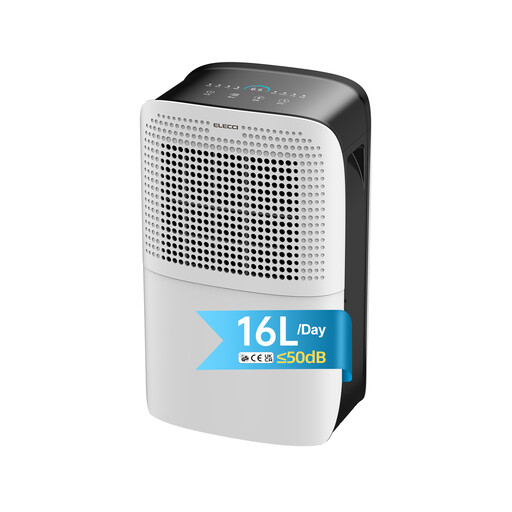
ELECCI 16L/D dehumidifier, 3.1 l tank
A compressor dehumidifier to compare if damp persists in a usually heated room; according to the Dutch Consumers' Association, performance decreases in cooler spaces.
The product name lists a 3.1 l tank, four modes, continuous drainage, auto-defrost, a 24-hour timer and R290. The stated room coverage is 32 m².
The usage information warns against using the appliance somewhere it could be splashed with water.
Joybuy
 No image available
VINO 12L Smart Dehumidifier, Wi-Fi control, 24 m²
A compressor dehumidifier to compare if damp persists in a usually heated room; according to the Dutch Consumers' Association, performance decreases in cooler spaces.
The product name lists Wi-Fi control, R290, three modes (Auto/Dry/Sleep), a 1.8 l tank and coverage of 24 m².
The product name also gives a noise level of 32 dB. The usage information recommends keeping the appliance away from water sources and extremely damp environments.
Joybuy
Frequently asked questions
Does a dehumidifier need to be in the bathroom to deal with damp after showering?
No. Start with ventilation and check whether there is a suitable spot outside the bathroom. The Meaco DD8L Zambezi Z2 manual prohibits use in the bathroom; that instruction does not automatically apply to other models. The Wood’s WDD80 manual says to keep it away from water sources. Always follow the manual for the exact model.
When is a dehumidifier more than a temporary measure?
According to buying advice from the Dutch Consumers' Association, a dehumidifier may help if humidity stays above 65% over time after issues such as poor ventilation or leaks have been dealt with. A brief spike after showering is not the same as persistently high humidity.
How can I compare electricity costs without guessing a monthly figure?
Compare the power rating, setting and running hours: watts × hours ÷ 1,000 gives the consumption in kWh if the appliance runs at that power for those hours. Multiply this by your own price per kWh. With automatic controls, the actual number of hours the appliance is running may vary.
What can I do if an appliance breaks down too soon when bought from a Dutch retailer?
ACM ConsuWijzer distinguishes between a manufacturer’s guarantee and your statutory rights. If a product breaks down sooner than you could reasonably expect under normal use, the retailer must provide a solution free of charge under the applicable terms. Online purchases generally come with a statutory 14-day cooling-off period from delivery, although exceptions apply.


