
Student with the occasional delivery note
You want to keep a document now and then without immediately buying another device. Your phone’s scanning feature may be all you need; Apple Support explains how to scan using Notes or Files.


If you only scan one delivery note now and then, try your phone’s scanning feature first. A separate scanner is most useful if you handle paper regularly or want a dedicated input device. For single sheets and limited space, choose a compact USB scanner; for small stacks or double-sided documents, look for a model with an automatic document feeder and duplex scanning; or, if you want to scan without connecting a laptop, choose a scanner with a battery and Wi-Fi. Before buying, check that the paper size, feed mechanism and software are suitable for your documents and devices.
You want to keep a document now and then without immediately buying another device. Your phone’s scanning feature may be all you need; Apple Support explains how to scan using Notes or Files.
You regularly scan single sheets and want a compact scanner you can put away after use. Brother Netherlands lists the DS-640 as supporting single-sided scanning up to A4, powered via USB from a PC or laptop.
You handle several documents or double-sided sheets and want to reduce the number of manual feeding steps. The Brother DS-740D scans both sides; Canon lists a 10-sheet feeder and duplex scanning for the imageFORMULA P-208II.
Start by considering how often you scan and whether scanning with your phone is enough. Then think about the space available, how much paper you handle and whether you want to scan without connecting a laptop.
| What to consider | What should you check? | Who is this important for? |
|---|---|---|
| Do you need a separate scanner? | Try scanning a delivery note with your phone and check that all relevant text and any information on the back are clear and saved in full. | If I only keep one delivery note now and then, I’d rather try my phone first than make room for another device. Around 36% of consumers prioritise avoiding a separate purchase. |
| Limited desk space | Measure the space available while the scanner is in use, and check the USB connection and supported paper sizes. | If my desk is small and I have a laptop, I’m looking for a scanner I can put away after use. Around 29% of consumers prioritise saving space and having a simple USB set-up. |
| Stacks or double-sided sheets | Check how many sheets the feeder can handle and whether both sides are scanned automatically. | If I handle several delivery notes or documents printed on both sides, I want to spend less time feeding or turning them over by hand. Around 21% of consumers prioritise batch processing or duplex scanning. |
| Scanning without a laptop | Check whether the scanner has Wi-Fi and a battery, and whether its software works with your phone or tablet. | If I want to scan in different places without connecting a laptop, I look for wireless connectivity and battery power. Around 14% of consumers prioritise this type of set-up. |
If you only scan the occasional delivery note, a speed figure alone won’t tell you how convenient the whole scanning process will be. Your phone may already have a scanning feature.
Try scanning a delivery note with your phone first, then check that the scan is complete and legible. Only then compare the steps involved with those of a separate scanner.
Duplex scanning and feeding multiple sheets are different features. The Brother DS-740D scans both sides; Canon also lists a 10-sheet feeder for the P-208II.
Check separately whether both sides are scanned automatically and how many sheets the feeder can handle.
According to Brother, the DS-640 is powered via USB from a PC or laptop. Epson lists a battery and Wi-Fi for the WorkForce ES-60W.
Choose a connection that suits where and what you’ll actually use to scan. Also check that the software works with your device.
The DS-640 and DS-740D offer compact USB options for single-sided and double-sided documents respectively.
The imageFORMULA P-208II is designed for small stacks and double-sided documents.
The WorkForce ES-60W is designed for mobile scanning with Wi-Fi and a battery.
These models suit different ways of scanning delivery notes: compact USB scanners, models with an automatic feeder for small stacks, and scanners with Wi-Fi or a battery.
 No image available
An option for anyone handling small stacks or double-sided delivery notes.
According to the product description, the feeder can hold up to 20 sheets and the scanner supports automatic duplex scanning. It is powered via USB; the description lists support for Windows and Mac.
According to the product description, wireless scanning requires the optional WU10 Wi-Fi unit.
 No image available
A good fit for a small workspace where you want to process individual documents using a paper feeder.
The product description lists a compact scanner with a paper feeder and a U-shaped or straight paper path.
 No image available
An option for double-sided delivery notes in a workspace where a compact paper path is useful.
The product description lists automatic duplex scanning, Wi-Fi and a U-shaped paper path.
 No image available
Worth considering if you scan individual A4 delivery notes and have a laptop or PC available.
The product description lists a compact handheld scanner with a USB connection, powered via a laptop or PC.
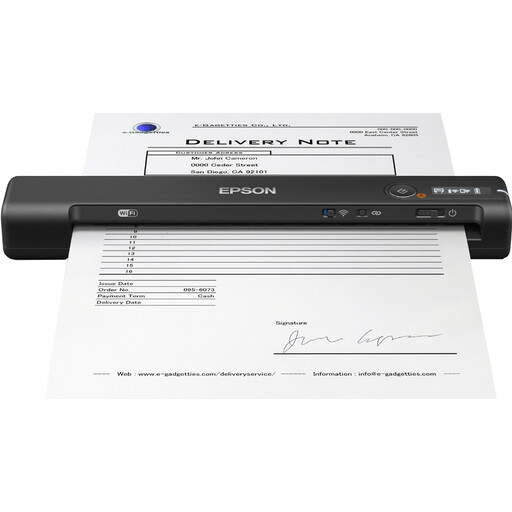 No image available
An option if you want to scan individual documents somewhere without a laptop connected.
The product description lists Wi-Fi, a rechargeable battery, USB power and an LCD screen. The built-in battery is needed to use the scanner without a connected power source.
Not necessarily. If you already have a suitable phone, you can use it to scan a document. Apple Support explains how to scan using Notes or Files; check that all relevant text and any information on the back are clear and saved.
Before buying, check that the connection and software are suitable for the exact model and your computer or phone. According to Brother, the DS-640 is powered via USB from a PC or laptop; Brother provides model-specific drivers. Follow the instructions for your model when cleaning it.
No. According to the Dutch government, there is no fixed statutory warranty period in the Netherlands. You are entitled to a product that works properly, and if there is a fault, the retailer is your point of contact. Any manufacturer’s warranty is separate.
Not simply because you scan delivery notes as a private individual. According to the Dutch government, individuals are not legally required to keep their financial records; its advice is to keep them for five years in case of a possible tax reassessment. Businesses and self-employed people have different record-keeping requirements.