
Scanner for a small desk
You process delivery notes at a fixed workstation and want to know how much space the scanner and paper path take up while scanning.


If you regularly scan stacks of delivery notes, first check how much space the scanner takes up with its paper feed and output in use. A compact scanner with an automatic document feeder may be a good fit. If you mainly scan individual sheets or want to put the device away after use, a mobile scanner may be more practical. In either case, check that single- or double-sided scanning, connectivity and the way readable files are stored suit your workflow.
You process delivery notes at a fixed workstation and want to know how much space the scanner and paper path take up while scanning.
You regularly scan several sheets and want to know whether automatic feeding and double-sided scanning suit your workflow.
You usually scan individual delivery notes, share your workspace or want to put the scanner away after use.
First decide whether your main priority is saving space while scanning, processing stacks or being able to put the scanner away after use.
| Consideration | What should you look for? | Who is this important to? |
|---|---|---|
| Space while in use | Measure the space with the paper path in use; don't compare only the dimensions of the scanner when closed. | If I have limited desk space, I want to know where the paper goes while scanning. Around 33% of consumers put space while in use first. |
| Processing stacks | Check the automatic feeder, single- or double-sided scanning and the types of paper you need to scan. | When I regularly scan stacks, I want to spend less time feeding or turning sheets by hand. Around 27% of consumers prioritise processing stacks. |
| Connectivity and portability | Check which connection and power supply are needed, and whether they suit the places where you want to scan. | If I scan in different places or put the scanner away after use, I want it to suit my setup. Around 20% of consumers put portability first. |
| Readable, easy-to-find files | Check which file formats and scan destinations are available, and make sure both sides are readable. | For my records, I want to keep complete scans that are easy to find. Around 20% of consumers give archiving top priority. |
The space a scanner takes up while scanning may differ from the space it needs when put away. Canon lists different dimensions for the imageFORMULA R10 with the tray open and closed; Epson describes a U-turn path mode for the DS-C330.
Measure the available space with the paper path and tray in the position you'll use them.
If you regularly scan stacks, feeding sheets and turning them over by hand can mean extra steps. The Brother DS-640 scans single-sided; according to Brother, the ADS-1300 has a 20-sheet automatic feeder and scans double-sided.
Think about how many delivery notes you usually scan in a row and whether you need to capture information on the back.
For invoices and receipts in Dutch business records, the Dutch Tax and Customs Administration says a scan must be an accurate and complete representation of the original. Your records must also remain usable in the event of an audit.
Check that each scan is readable and complete, and set up a consistent filing system that makes files easy to find.
The DS-C330 is a desktop scanner with U-turn and straight-through feeding; the WorkForce ES-60W is a mobile scanner.
The ADS-1300 combines automatic feeding with double-sided scanning; the DS-640 is designed for mobile, single-sided scanning.
The imageFORMULA R10 is a portable USB model with a 20-sheet automatic document feeder.
According to ScanSnap, the iX1300 combines a compact paper path, a 20-sheet automatic feeder and Wi-Fi.
This selection includes sheet-fed and mobile scanners for a fixed scanning spot, processing stacks or putting the scanner away after use.
 No image available
An option for a fixed scanning spot where sheet-fed input suits your workflow; measure the space needed for the paper path.
Sheet-fed document scanner for A4.
600 × 600 DPI.
 No image available
For a small, fixed workspace: Epson describes the U-turn path mode as feeding paper without needing extra space behind the scanner. Check that your delivery notes are suitable for this feed mode.
ADF and sheet-fed input for A4.
600 × 600 DPI.
 No image available
A mobile scanner for individual sheets if you want to put the device away after use; consider how much manual feeding will suit the stacks you scan.
Handheld scanner for A4.
600 × 600 DPI.
 No image available
A mobile option for scanning in different places; check that the stated Wi-Fi and battery features suit your workflow.
Handheld scanner for A4.
600 × 600 DPI.
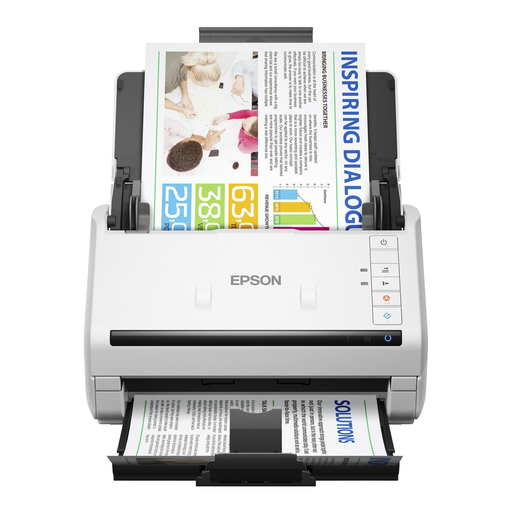 No image available
Designed for processing stacks and double-sided documents; check that the feeder capacity suits the delivery notes you scan one after another.
Sheet-fed document scanner for A4.
600 × 600 DPI.
Scan the back too if it contains information you need. If you regularly scan double-sided documents, a suitable duplex scanner can save you from turning sheets by hand; Brother says that the DS-640 scans single-sided.
Not automatically. For invoices and receipts in Dutch business records, the Dutch Tax and Customs Administration allows digital storage under certain conditions: the scan must accurately and completely represent the original. If the conversion meets the requirements, you don't need to keep the paper originals. Don't assume this applies to every delivery note or other document.
The Dutch Tax and Customs Administration generally specifies a retention period of 7 years for invoices and 10 years for invoices relating to immovable property. A 10-year period also applies to certain supplies and services under the Union or Import scheme. Whether a specific delivery note must be retained depends on its role in your business records.
First consider whether the storage method provides suitable protection for the personal data on your delivery notes. The Dutch Data Protection Authority says organisations must determine appropriate security measures based on the risks; scanner specifications alone can't tell you whether a particular cloud folder is suitable.
Measure the scanner with the tray and paper path in the position you'll use it. The stated dimensions for the Canon imageFORMULA R10 differ depending on whether the tray is open or closed; Epson describes a U-turn path mode for the DS-C330 which, according to Epson, doesn't need extra space behind the scanner for paper to feed through.