What should you look for when choosing one?
First, address sources of moisture and ventilation, and check humidity at different times. If it remains consistently high, choose the technology according to the temperature where you’ll use the appliance, then compare its practical features.
| What to consider |
What should you look for? |
Who is this important for? |
| Cause of condensation |
Check ventilation and possible sources of moisture, then see whether humidity remains consistently high. |
If I see recurring condensation, I want to know first whether ventilation or a source of moisture is contributing before buying an appliance. Around 36% of consumers prioritise identifying the cause and tackling persistent damp. |
| Drying laundry indoors |
Compare the stated capacity with the room, and check for a laundry mode, tank capacity and continuous drainage. |
If I regularly dry laundry indoors, I look for ease of use during longer drying sessions and consider how the water is drained. Around 29% of consumers prioritise drying laundry indoors. |
| Noise and everyday use |
Compare noise levels, dimensions, tank capacity and drainage. Tank capacity is not the same as the amount of moisture removed per day. |
If the appliance is close to where I relax or sleep, noise, available space and how often I’ll need to empty the tank are important considerations. Around 21% of consumers prioritise quiet operation and practical placement. |
| Room temperature |
Measure the temperature where you’ll place the appliance and compare compressor and desiccant technology for those conditions. |
If the room stays cool or unheated, I want to know whether the chosen technology is suitable and how much electricity it uses. Around 14% of consumers prioritise performance in a cool room. |
Dehumidifiers at Joybuy
These models are designed for additional dehumidification when damp persists and for situations such as drying laundry indoors. Check that the specifications suit the room and temperature where you plan to use the appliance.
 No image available
CONOPU 16L dehumidifier with a 2.5-litre tank
The humidity control and drying function described make this model suitable for situations where damp keeps returning after you’ve addressed its causes, or when you dry laundry indoors.
Stated capacity: up to 16 litres per day; tank: 2.5 litres. The description lists a compressor, timer and continuous drainage option.
Before buying, check the CE marking and product documentation for the specific item.
Joybuy
 No image available
TRULIVA AP10-2012EE, 16L dehumidifier
The description mentions automatic humidity control and a drying mode for use when damp persists or you dry laundry indoors.
Stated capacity: 16 litres per day; tank: 1.35 litres. The title states around 32 m²; the description lists continuous drainage and automatic defrosting.
The instructions recommend leaving the appliance upright for 2 hours after it has been tilted or transported, and leaving at least 10 inches of clearance around it. Before buying, check the CE marking and product documentation for the specific item.
Joybuy
 No image available
ELECCI 12L/D dehumidifier with a 3.8-litre tank
The drying mode and continuous drainage are useful features if you dry laundry indoors or run the appliance for longer periods.
The title states that it is suitable for spaces up to 25 m² and has a 3.8-litre tank. The description mentions a timer and automatic defrosting.
The instructions recommend leaving the appliance upright for 2 hours after it has been transported or tilted. Before buying, check the CE marking and product documentation for the specific item.
Joybuy
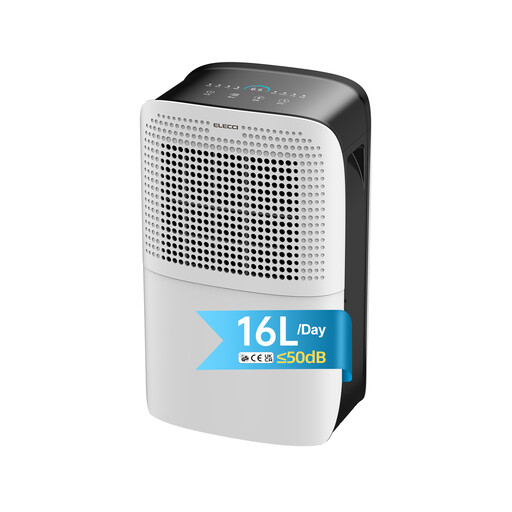 No image available
ELECCI 16L/D dehumidifier with a 3.1-litre tank
The automatic humidity control and drying mode described may be useful when damp persists or you dry laundry indoors.
The title states that it is suitable for spaces up to 32 m² and has a 3.1-litre tank. The description lists four modes, continuous drainage and a timer.
The safety instructions recommend leaving 25 cm of clearance around the appliance. Before buying, check the CE marking and product documentation for the specific item.
Joybuy
 No image available
VINO 12L smart dehumidifier with Wi-Fi
The product description mentions a sleep mode and drying function. Check that the controls and drainage suit where you plan to use the appliance.
The title states that it is suitable for spaces up to 24 m², has a 1.8-litre tank and offers three modes. The description mentions a drainage option; according to the instructions, the drainage hose isn’t included.
Before buying, check the CE marking and product documentation for the specific item.
Joybuy
Frequently asked questions
When should I try something else before buying a dehumidifier?
First, check ventilation and sources of moisture, such as cooking, showering and drying laundry indoors. Consumentenbond says a dehumidifier may be a useful addition once these causes have been addressed, if humidity remains consistently above 65%. If mould keeps returning or you suspect a leak, the underlying cause should also be assessed.
Should I close the air vents while the dehumidifier is running?
No, keep ventilating sufficiently. The Dutch government recommends ventilation day and night. A dehumidifier removes moisture from the air, but it doesn’t remove stale indoor air or bring in fresh air.
How should I use a dehumidifier after transporting it?
Follow the instructions for your specific model. Qlima recommends leaving its dehumidifiers upright and unplugged for at least 2 hours after transport. If the appliance was transported on its side or upside down, the brand recommends waiting at least 24 hours. This is the manufacturer’s advice, not a general legal waiting period. Also check the model-specific instructions for the tank, filter and drainage hose.
Do I need an additional warranty plan?
Not necessarily. According to the Dutch government, the seller must provide a solution if a product is faulty. The Netherlands doesn’t have a fixed statutory two-year warranty period, so compare the extra rights a paid add-on plan actually offers.
Is CE marking required for an electric dehumidifier?
CE marking is required for electrical products where the applicable rules specify it. The Netherlands Food and Consumer Product Safety Authority includes electrical products in its guidance. Check the marking and product documentation for the specific model. CE marking isn’t an independent test result for dehumidification performance.


